
With today being the last prom being held at the current Monroe High School, the administration has invited all previous prom kings and queens from that building to attend and be announced. In honor of that, this column will look at what some of the early proms were like more than a century ago — before there was even a yearbook published at the school. The students who attended these proms attended school in the high school built in 1906, but the proms were held across the street in Lincoln School because that high school had no gymnasium. [The high school can be seen on page 98 and Lincoln School on page 102 of the Pictorial History of Monroe.]
The first article about the junior-senior prom for Monroe High School students was found in the Monroe Evening Times on May 10, 1919 held the evening before, which described it as “one of the most delightful school functions ever tendered the upperclassman. The gym was beautifully decorated with the high school colors of red and white. The upper hall carried the senior colors of blue and gold with the junior’s purple and white intermingled.” A sumptuous banquet was served at 6:30 to the two classes and participating faculty with red and white flowers decorating the tables.
Very different from more recent proms, an address of welcome was given by Byron Wood, junior class president, to which Eugene Klassy, senior president, responded. In addition, members of the senior class and faculty gave brief talks before the formal program. Shirley Dietz performed a piano solo before a declamation by Grace Thorpe. Arthur Chambers performed a saxophone solo before the junior jazz band performed. A French kan-kan ended the program before dancing was enjoyed until 1:00 a.m.
The prom in 1920 was similar with 104 juniors, seniors, and faculty participating. The three course banquet was served by the ladies of the Grace Lutheran Church. A similar program was presented with Harry Roth, junior class president, giving the welcome. Entertainment included a saxophone solo by Ralph Krueger, a vocal solo by Daisy Cramer, a violin solo by William Wendt, and a piano solo by Hilda Miller. Edna Faeser then gave a reading before Esther Baltzer and Charles Booth performed a vaudeville act. Finally, “dancing was enjoyed in the corridors with music by Miss Elsie Dahms, Fred Maurer, Albert Pfund and Louis Pandow.”
For the third consecutive year, prom was held on a Friday night in 1921. The senior colors were purple and gold for the first time. Ten tables were arranged to form a star to seat the 57 seniors, 60 juniors, and 15 faculty members. Walter Blumer welcomed the group with Harry Roth giving the response. For the first time, Superintendent L. R. Creutz made comments. “Marian Stewart, Helen Streiff, Dorothy Kohli, Betty Shriner, Annabelle Penn and Geraldine Schindler gave a delightful Egyptian dance in costume.” A piano solo by junior Marian Kundert followed. “Four juniors, Misses Maxine Booth and Wilhelmina Tschudy, Roderick Bennett and Edward Maurer, gave a one-act play, which met with unanimous approval.” Chester Becker then took part in a drama directed by Miss Bernice Cadman.
The evening ended with dancing “in Lincoln hall” from 9:00 to midnight to the music of Miss Mabel Streiff, Nathan Bear, Edwin Schuetze, and Roderick Bennett. The junior colors, green and gold, were used to decorate the hall.
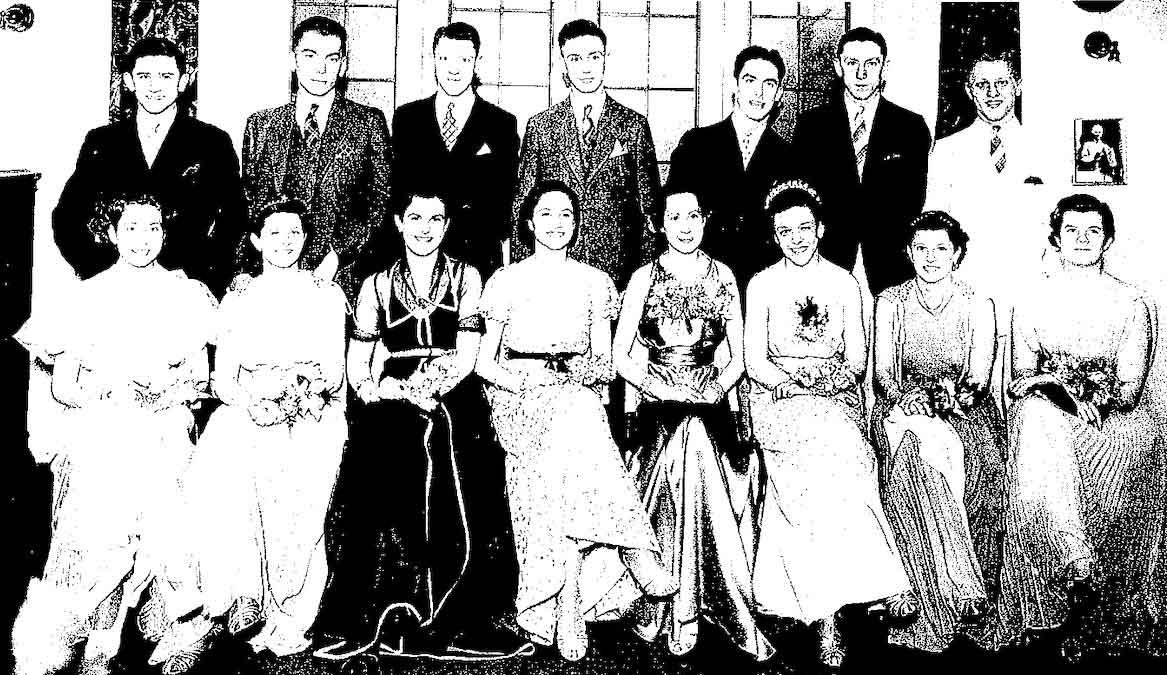
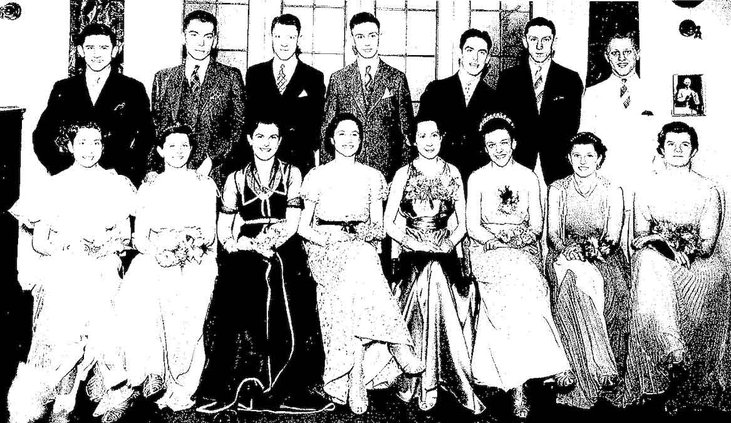
Nothing was found about the proms in 1922 and 1923, but it was shared on May 8, the day before prom in 1924, that it had “been ruled that no dates were to be made” that year. “Dates of more than a month and a half’s standing will be fulfilled tomorrow when the bobbed haired misses of the Senior high school will receive marcels and other waves to make the shorn tresses more beautiful. So great is the demand for marcels and the dressing of coiffures that many of the prom-goers were obliged to have their marcels today. In the date book of a local beauty shop are listed the names of three maidens with long tresses. The rest have the all fashionable bob and shingle.”
Purple, gold, and lavender streamers of crepe paper were draped in heavy masses from a huge chandelier in the center of the Lincoln School gym to all four corners that year. The lights were shaded with gold paper and the tables decorated with yellow roses placed to form the initials M H S. This was the first year that place cards were used. The sophomore domestic science girls acted as waitresses for the dinner. The place cards were arranged so that the men would dance first with the woman to his right while the sixth dance would be with the woman to his left. There were two tiny rooms “beautifully and comfortably furnished with chairs and cushions” at each end of the hall for students to rest.
The gymnasium was transformed into an interior Japanese garden for the 1926 prom. About 170 students and faculty participated under “a low ceiling of cherry blossoms.” An inverted Japanese parasol shaded the center light and Japanese lanterns of many colors were strung along the cherry boughs. White lattices were decorated with cherry blossoms at the sides of the gym; the “lattice orchestra booth was most attractive with lighted bridge lamps in Japanese lanterns.” Members of Miss Flanagan’s class again served the 18 tables. Helen Johnson, junior class president, welcomed the seniors with a response from Lawrence Courtney. During the entertainment, Miss Mary Suzanne Soseman appeared as Cherry Blossom and Hugo Voelkli and John Aeschlimann sang duet numbers.
I hope that you were able to visualize these proms from the detailed descriptions. The papers of yesterday were so different from today. We have to be thankful that so much of our history has been preserved for those who enjoy reading about it. Unfortunately, no photos of MHS proms from the 1920s have surfaced.
— Matt Figi is a Monroe resident and a local historian. His column will appear periodically on Saturdays in the Times. He can be reached at mfigi48@tds.net or at 608-325-6503.