

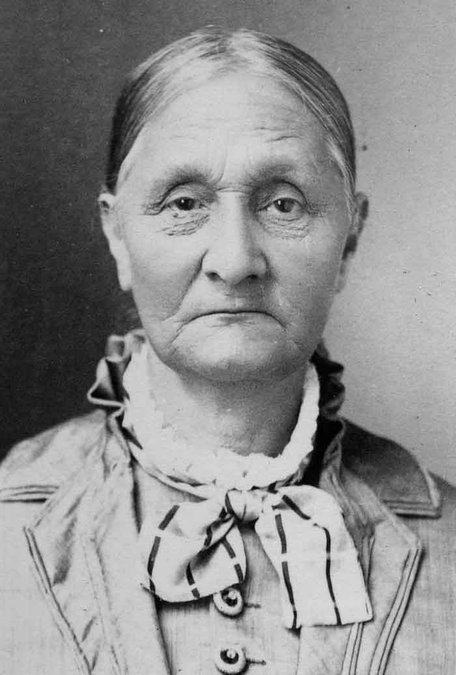
You may remember that, in a previous column, I wrote about the book, Lincoln’s Counterfeiters. One of the persons mentioned a few times in that book was Almira Humes. Thanks to the author of that book, Andrea Nolen, for sharing a newspaper article, I can now write more about the interesting, sometimes apalling life, of her in two columns. The information about her early life came from that article printed on May 10, 1893; it was written by her granddaughter, historian Helen Bingham. This will give you an idea of what a difficult life some of our early settlers lived.
Almira was born in Portsmouth, New Hampshire on April 5, 1806 to a Mr. Humes and the former Huldah Temple. The couple had at least one more child, Silas M. Humes who was born about 1800. Their father died during Almira’s early childhood and her mother remarried Silas E. Gardner. The Gardners had at least two more children, Silas M., born in 1809, and Elijah T., in 1811.
Almira’s mother, “an ardent admirer of Dr. Thompson,” was often very ill for months at a time. During one illness, when she thought she was about to die, she gave her daughter to a stranger. Her stepfather learned that “she was treated with great cruelty, given insufficient food, and made to work like a slave.” Gardner brought her back to her mother where there was still no time for childish things. Almira “was busy caring for her mother, doing housework, binding shoes, and spinning thread for her father’s shoe shop,” and probably helping care for her younger siblings.
Almira’s mother regretted being separated from her sisters, Naomi, who lived in western New York, and Nabby, who lived in Batavia, New York. Naomi’s son had written an account of a trip through Illinois, which Nabby read and said, “we will go west.” So in the fall of 1816 the Gardners sold their house, loaded themselves and their goods into a one-horse wagon, and left for Batavia. Gardner rented a small house and they waited there until spring. Mr. Gardner made the trip on horseback and stopped a great many times on the way to make shoes, his occupation, which kept him busy all winter. Gardner had actually refused to make shoes for the soldiers during the war of 1812 “because the government price was so low that only poor leather and poor work could be put into soldiers shoes.”
Naomi joined the family at Batavia and spent the winter at Nabby’s house. She was the only one of her family to go west because her children were grown and her husband had gone to Washington to get a patent. This process drove him insane and he was put into an asylum there.
Mr. Gardner took charge of the trip in the spring of 1817 when it was time to move. Nabby’s husband, Patrick, a veteran of the Revolutionary War, was old and not mentally stable. Gardener first took Nabby and her family to Olean Point, near Pittsburgh, before returning to Batavia for the rest of the family. In Olean Point there were 12 houses for rent to travelers who were about to go down the Ohio River. Each house consisted of two stories with one room on each story. Each story was to accommodate one family. Even Nabby, who had four adopted children with her in addition to her own family, could only rent one room.
By the time Gardner had arrived there, there were so many families there that the only house he could rent was a cabin a mile and a half from the Point. Then Nabby had to go back to Batavia because the people that bought her farm had not yet sent her the money they had promised. When Nabby returned to the Point, she brought no money, but brought another child and a helpless old maid. She borrowed money from Gardner, bought a boat, and went down the river as far as Marietta, Ohio. The Gardners spent the winter in their cabin while Gardner worked all the time. He spent any leisure time building a flat boat for himself. “Provisions of all kinds were very scarce and difficult to get at any price.” The principal food was boiled grain (wheat or rye) eaten with milk bought from a family two miles distance.
In the spring, “a great abundance of greens formed a welcome addition” to their diet. One day, 14 raftsmen stopped at the house and declared that they had not eaten for two days and a night. “By repeated promises to send from Pittsburgh, not money, but what was much more valuable - provisions, they persuaded mother to give them dinner. The family dined on boiled rye and greens, and never heard again” from the hungry raftsman.
Gardner’s boat was finished in the spring of 1818 and the family removed to Big River, 30 miles beyond Pittsburgh. They remained there until the people of that area had been supplied with shoes. Gardner had a fever and Almira received and recovered from a dangerous snake bite that winter.
The Gardners rejoined Nabby’s family near Marietta “towards fall” when both boats floated down the river to Lawrenceburg, Indiana. Meanwhile, smallpox had killed one of Nabby’s daughters and two of her grandchildren. Nabby also learned that her son-in-law had been dead for years. No money had arrived for her fine farm. Patrick had recovered and “walked to Washington to get money due him from the government,” after which he walked back to Cincinnati and found his family.
More will be shared in the final column about the lives of Almira and her family.
— Matt Figi is a Monroe resident and a local historian. His column will appear periodically on Saturdays in the Times. He can be reached at mfigi48@tds.net or at 608-325-6503.