
More than two years after 12-year-old Almira Humes, her parents, and their family left New Hampshire, they arrived in Lawrenceburg, Indiana, where her stepfather sold his boat and prepared to make that their permanent home. However, his system was full of malaria and he died before the end of winter. Nabby and her children had spent the winter in Cincinnati where she acted like “a modern humane society and associated charities.” She was very poor since she never received the money for the farm and the money from Washington had not yet arrived. She still adopted two more children and “gave relief to many families.”
In the spring of 1819 Huldah, sick and in poverty, took her children to Cincinnati, where she and the children “worked ceaselessly.” They taxed their “strength to the utmost, washing, sewing, and doing every kind of work we could get.” They traveled to Shawneetown, Indiana on a keel boat in the fall of 1819 arriving there in December after a six week journey. Almira, now 13, “did the family cooking and washing on top of the boat, where there was a fire. She also made poultices for the carbuncles, which made mother almost helpless.” The weather was bad and she “was so exposed to the wind that several times I was nearly frozen.” That place was so small that her “clothes were badly burned.”
There was a kind captain, who did what he could for the family, “but the mercury, he induced mother to take produced salivation of many months duration.” They wintered in a dismal shanty with only one room. The brothers, who had gone ahead, joined the family in the spring of 1820. A man was hired to move the family to Edwardsville, Illinois, but his horses were so weak that Huldah was the only one allowed to ride. The family found a log cabin, formerly a schoolhouse, near Marine Settlement, which they were able to call home. It had windows filled with oiled paper, and there was room for two beds and a little space to lie on the floor between the beds.
Uncle Patrick’s home was 15 miles away, however, he did not live much longer. He had loaned several hundred dollars to a man who paid him in paper money, though it was only worth half the amount. This “completed the financial ruin of the family.”
Almira would eventually meet and marry William Boardman Churchill, a native of Vermont who was 12 years older, on August 3, 1823. They had five children, the oldest being born in 1824 and the youngest in 1835.
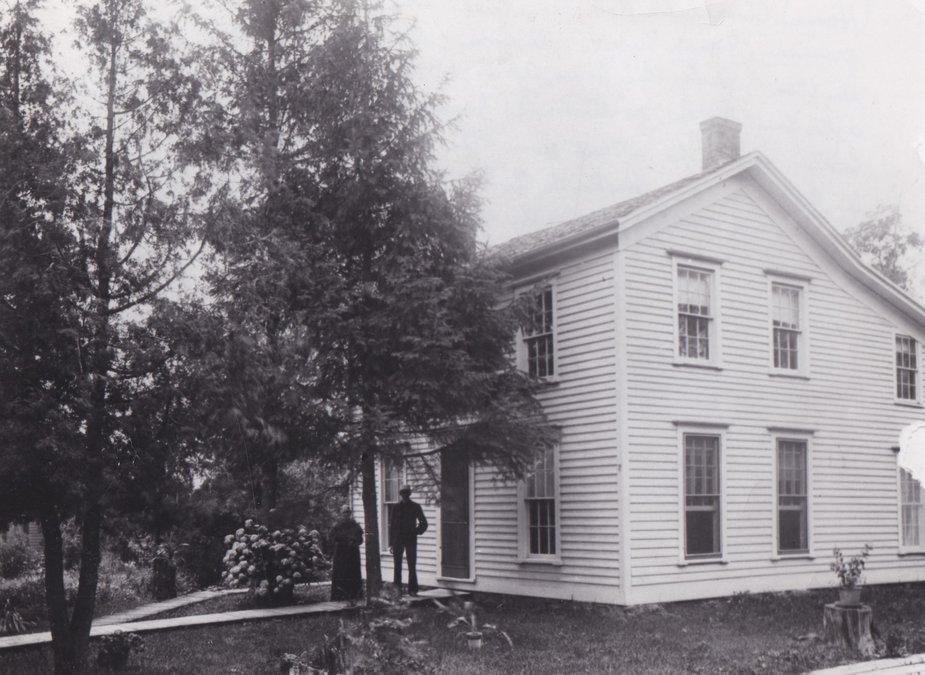
This marriage did not last. Almira and her children came to Green County with her brother, Elijah Gardner, and his family in 1840; their mother also accompanied them. Elijah settled on Skinner Creek, but Almira came to Monroe and settled in a log cabin near the center of town. She would meet and marry her second husband on September 28, 1842. Jesse Robertson was a native of Kentucky and 13 years her junior. It is unknown where they first lived, but soon afterward they were living on the southwest corner of 10th Street and 15th Avenue, which would be Almira’s home for the rest of her life.
Almira would give birth one more time, at the age of 39, to Charles on July 4, 1845. Almira’s mother, Huldah Gardner, passed away on March 22, 1850 and is buried in Greenwood cemetery. The 1850 census shows the family with five children living in the house. Caroline was already married to John Bingham; her daughter was born a few months after her uncle Charles Robertson. Jesse and sons, Norman and George, were all listed as carpenters. Their real estate was valued at $600.
Almira’s older brother, Silas M. Humes, came to the area with his large family and settled in Sylvester Township in 1842. Nothing was printed in the early newspapers about the Robertsons. The 1860 census showed that they had accumulated $2,000 of real estate and $1,000 of personal property. They shared their home with Charles, 14, and a 16-year-old German servant. By 1870 Almira’s 30-year-old daughter, Maria, was living with them again as well as what appears to be a 3-year-old granddaughter. In addition there was a young American-born domestic servant with them.
Almira and Jesse were separated by 1880 and her daughter, Lucena Sykes, 39, and her three children were sharing the house with Almira. [Lucena was the topic of a previous column.] It was reported on June 15, 1881 that Almira and her nephew, Murray Humes, were leaving to visit her brother, Silas Gardner, in Decorah, Iowa on Friday. She returned from this trip on August 2 “in pretty good health” accompanied by her grand niece, Mabel Gardner. They attended the funeral of her brother, Silas Humes, that evening.
Numerous relatives surprised Almira on her 79th birthday as she returned home on Easter Sunday evening, April 5, 1885 from Caroline’s house. Numerous gifts were received and refreshments that had been prepared in advance were served.
Almira, accompanied by her granddaughter, Jennie Sykes, left Monroe on June 26, 1888 to visit and spend the summer with her son, Charley, and family in Pierre, Dakota. She was “well and quite rugged for one of her age.” She was 82. They returned on the morning of August 21.
Two years later, Almira had been quite ill with neuralgia and acute dyspepsia for two weeks. It was reported in September that she was “able to be out again” and was attending church on Sundays. Another two years later, she was able to travel to Janesville to visit Dr. and Mrs. Cole.
Her death occurred five months later on Sunday morning, April 23, 1893, less than three weeks after her 87th birthday. The funeral was held from her longtime home. “Elmira H. Robertson” was one of the first six people to be immortalized in 1895 on the tall, stained glass windows in the Universalist Church, which had been built in 1861 by her oldest son, Norman Churchill.
— Matt Figi is a Monroe resident and a local historian. His column will appear periodically on Saturdays in the Times. He can be reached at mfigi48@tds.net or at 608-325-6503.