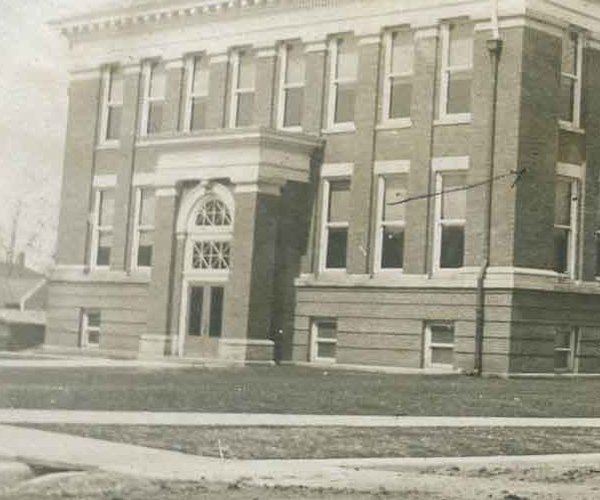

Jesse Robertson began the building of the Robertson Block on the west side of the square during the summer of 1899. The newspaper shared on October 4, “Jesse Robertson’s new front begins to loom. The walk in front of his block is built. In another month things will look tidy in that quarter. It is going to be a handsome building.” It was expected that the new block would be enclosed by the end of October.
Jesse, almost 79 years old, was “severely hurt by a fall” while working on his new block in early November. He was “slowly, but surely, recovering” a week later.
Stevenson & Treat moved their boot and shoe store into their new quarters, the south storefront of the new block, on January 3, 1900. By mid-February, Hodges & Knight were receiving “new and tasty lines of clothing and gents furnishings” daily for their new store — the other half of the Robertson Block. “When they get settled Messers. Hodges and Knight will have the most up-to-date general clothing and furnishing goods Emporium in this county and one of the best in the state.”
Jesse received a telegram on Friday, October 10, 1902 from his only granddchild, Maud Tayloe, that her husband had been killed. Edward C. Tayloe was in charge of the Indian school and plantation near Bonesteel, South Dakota and was shot by an Indian named George Bear. Tayloe had refused to give Bear permission to sell wood off the reservation. An altercation ensued and Bear was threatened with arrest if he continued to do so. An Indian policeman named Shaw “was also killed by the infuriated derelict.”
Mrs. Tayloe sent the telegram from Naper, Nebraska while on her way, with her husband’s body, to Washington, D. C., where the family resided. The Tayloes had “been connected with the schools of the reservation for years;” Edward had recently been promoted and was highly respected. He was buried in Kinsale, Virginia in the same cemetery as his parents.
The next reference to Jesse was on March 28, 1906. An article, printed in Owingsville, Kentucky, was copied in the Monroe Sentinel and said that he “will win the prize at Louisville during ‘homecoming week’ in June for having been away from Kentucky longer than any other Kentuckian attending the homecoming exercises.” He had not returned to Kentucky in those 71 years. A number of his relatives were to meet him in Louisville and take him to Owingsville to celebrate with his numerous relatives. “Efforts will be made to secure his consent to remain here the remainder of his life.” After all of this hype, nothing was printed in the paper about the 85-year-old and his wife making that trip.
Jesse, now 85, may have realized that he was getting old, so he transferred the south half of the Robertson Block to Lizette on June 11 for $1,500 and “love and affection.” He transferred the north half of the Block to his granddaughter, Maud, on the same day for $1 and love and affection. Charles would have life use of Maud’s portion.
Charles, who had been at a GAR in encampment in Minneapolis that August, stopped in Monroe on his way home to visit his parents and old friends.
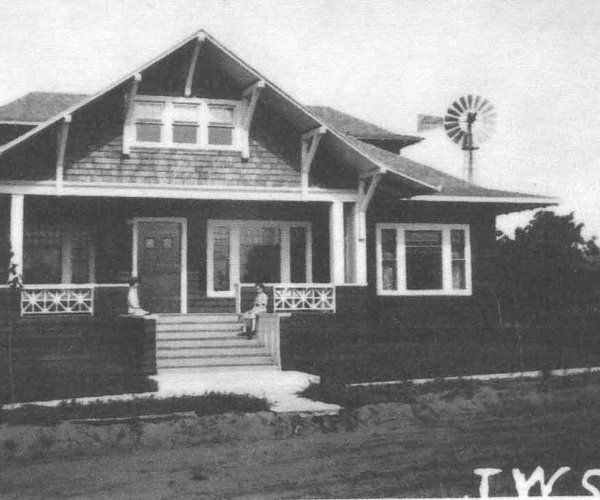
Two years later in May, it was reported that Jesse had sold the residence that the family had lived in for more than 50 years to Fred Kundert; Kundert planned to move it to one of his lots on the east side of 14th Avenue in the first block north of 9th Street. Robertson expected to “build a fine new residence for his own use” on that lot. No record of this sale was found at the courthouse.
Jesse, 89, had been engaged in building a new residence during the winter of 1909-10 when he became ill because of paralysis of the bowels in early February. On February 3 he transferred ownership of the new home to Lizette for $1. They also transferred the two lots at the west end of that block, along with the home where they were living, to Maud Tayloe for $1; Charles and Vennice would have life use of this property.
Jesse passed away at home on February 8. Charles had arrived the evening before from Washington, D. C., where he had recently moved. Charles and Vennice then remained in Washington until 1911 when they moved back to Monroe to care for his mother, with whom they shared the home.
Lizette sold the new residence on the southeast corner of 10th Street and 14th Avenue to J. C. Gillum on November 15, 1910 for $5,700 plus the property taxes for 1910 (another $50 according to the newspaper.) In a Quit Claim Deed on February 11, 1911 Lizette transferred the north half of the Robertson Block to Maud for $1. Maud would marry John Bixler in Washington D. C. on that November 11.
Lizette continued to live in the home with Charles and Vennice until his death in 1922. Vennice continued living there; their daughter and son-in-law, John and Maud Bixler moved here after retiring in 1927. Lizette had moved out by 1930 and lived in the upstairs of the Robertson Block. By 1933 she had moved into the home of Mrs. Adelaide Eley, 1110 20th Avenue, where she would remain until April 14, 1935 when she was taken to Deaconess Hospital because of a malignancy. She died there on August 17.
Maude and John continued to live in the 10th Street home until he passed away on June 20, 1941. Maude stayed in that home until the mid-1950s when she moved to 1804 10th Street, where she would remain until her death on February 27, 1958. This was the end of the Jesse Robertson family as Maude had no children with either of her husbands.
— Matt Figi is a Monroe resident and a local historian. His column will appear periodically on Saturdays in the Times. He can be reached at mfigi48@tds.net or at 608-325-6503.