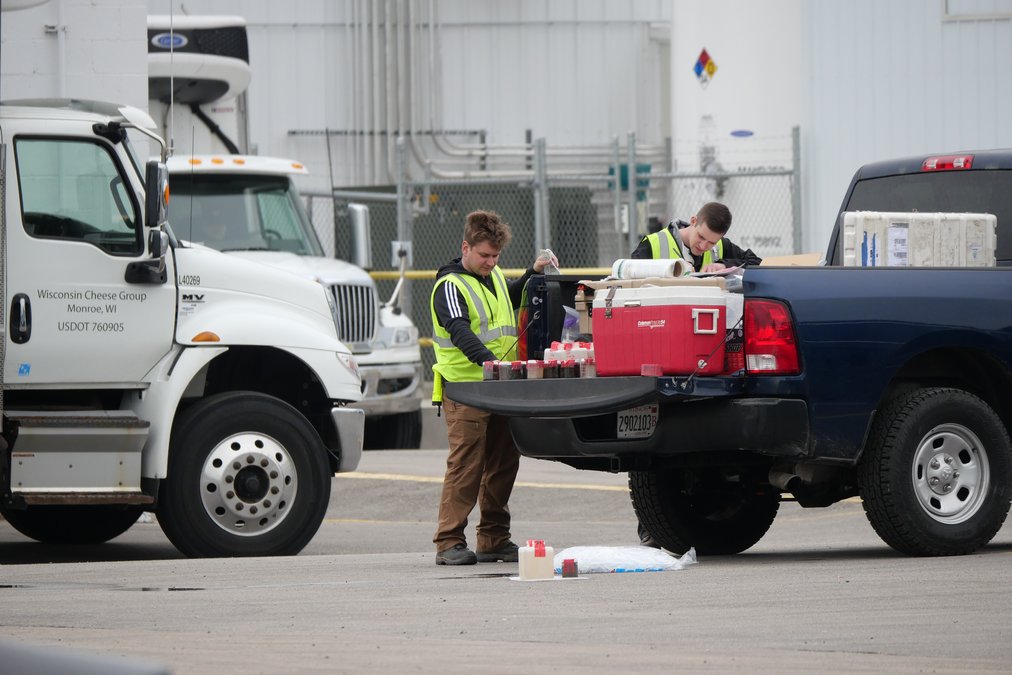
MADISON — Monroe-based Wisconsin Cheese Group was fined $237,500 Thursday in federal district court for wastewater violations at its Monticello cheese plant.
Operating under the Sabrosura Foods name, the company bought a Monticello dairy plant in 2019 and in 2022 “ramped up” production without an adequate plan to treat the wastewater it generated, according to a memo the U.S. Attorney Chadwick Elgersme filed in district court.
The memo continued:
The company didn’t know whether Monticello’s wastewater treatment plant could treat the volume of wastewater it discharged or if the treatment plant’s staff were trained to handle the industrial effluent.
The company began disrupting the village’s wastewater treatment plant resulting in the village violating a state-issued permit 19 occasions. At one point, the village shut off the plant’s access to the sanitary sewer system.
Wastewater generated by cheesemaking contains several types of pollutants if left untreated can kill fish and harm human health by disrupting the village’s treatment plant where it can’t treat any waste, including sewage.
The U.S. Attorney’s memo stated that it is a crime under the Clean Water Act for an industrial user to disrupt a treatment facility that it violates the user’s permit.
Wisconsin Cheese Group has a pretreatment permit that regulates the volume and composition of the wastewater it sends to the Monticello sewer plant. The village’s wastewater treatment plant discharges wastewater into the West Branch of the Little Sugar River.
The company moved its cheesemaking operations from Monroe to Monticello in 2022, obtained a permit and began discharging wastewater into the sanitary sewer.
Between June and November 2022, the company caused the village to violate its state discharge permit on 19 days.
“On many of these days, the company exceeded its biological oxygen demand limit ... by more than 1,500%,” Elgersma wrote.
High levels of other pollutants, including phosphorus and suspended solids, were also discharged by the company.
The company didn’t use “reasonable in managing wastewater operations,” Elgersma wrote. Its storage silos overflowed and leaked and it lacked real time monitoring of the pollutants it sent to the sewer plant.
A pH meter and a turbidity sensor were “eventually” installed but weren’t maintained and neither functioned properly when law enforcement executed a search warrant at the company’s plant in the spring of 2025.
Maintenance employees weren’t adequately trained in managing the wastewater system.
On June 4, Wisconsin Cheese Group pleaded guilty to one count of violating the Clean Water Act by negligently discharging pollutants which caused the Monticello sewer plant to violate its wastewater permit.
In the plea agreement, the parties agreed to a $237,500 fine and a year of probation.
The U.S. Attorney called the company’s conduct “serious” as it caused the village to release untreated wastewater in the Little Sugar River’s west branch.
The village’s two wastewater treatment plant employees could fully treat the company’s volume of wastewater discharge causing the release of untreated wastewater into the river.
The village shut off the company from the sanitary sewer system when it became frustrated with the company’s reoccurring excessive discharge volume.
Elgersma wrote that the company’s conduct was due to negligence and not intentional wrongdoing. The firm took a “wait and see” approach to wastewater management, which was “ill-advised and had serious consequences for the village but was not intentional.”
The plant has a history of non-compliance with stormwater management as spilled “sugar water” whey in separate incidents which reached the village’s storm sewers because the firm couldn’t contain these liquids on site.
The company took two years to obtain an industrial stormwater permit after many requests and a penalty was issued by the Department of Natural Resources.
Wisconsin Cheese Group kept violating its pretreatment permit after obtaining it. In seven months between October 2024 and April 2025, it exceeded its biological oxygen discharge limits “by significant amounts” and was only in compliance on eight days during this time period, Elgersma wrote.
The government doesn’t believe the discharges during this period caused the village to violate its state permit but shows the company’s “willingness to skirt the rules,” Elgersma wrote.
In Wisconsin Cheese Group’s memo to the court, attorney Matthew Krueger wrote:
The company bought the Monticello plant in 2019 and made substantial investment to upgrade and expand the plant. When wastewater volume increased, the company “spent significant effort and capital to improve its wastewater practices.”
Since then, WCG “has invested hundreds of thousands of dollars in remediation and monitoring systems, hired additional personnel, and discontinued practices that contributed to the violations.
“These voluntary measures, combined with the probationary requirements, provide assurance that the conduct will not recur,” Krueger wrote.
The fine was determined by multiplying 19 days of Clean Water Act violations by $12,500 per day. The terms of the plea deal also provide for just punishment. The fine was calculated by multiplying the 19 days of violation by $12,500, which is the midpoint in the $2,500 to $25,000 penalty range under federal law.
Village of Monticello Cleark/Treasurer Stephanie Adams released a statement on behalf of the municipality, “The Village of Monticello appreciates the investigative work done by the Federal Government and we will continue working collaboratively with all our local businesses while always serving as responsible stewards of our natural resources.”
A call to WCG Monroe office for comment on the sentence was not returned by deadline.