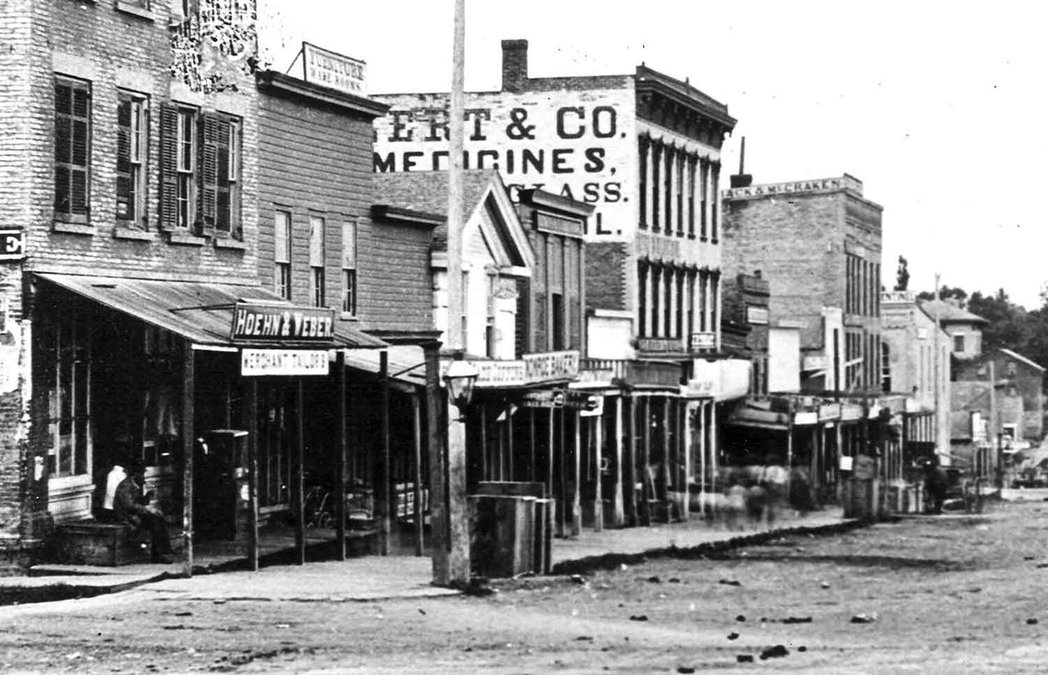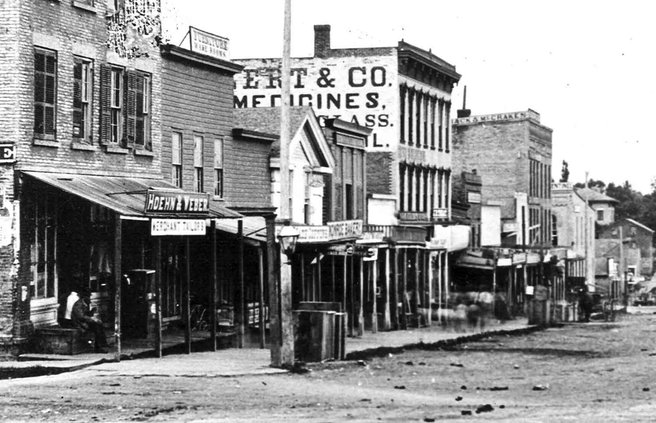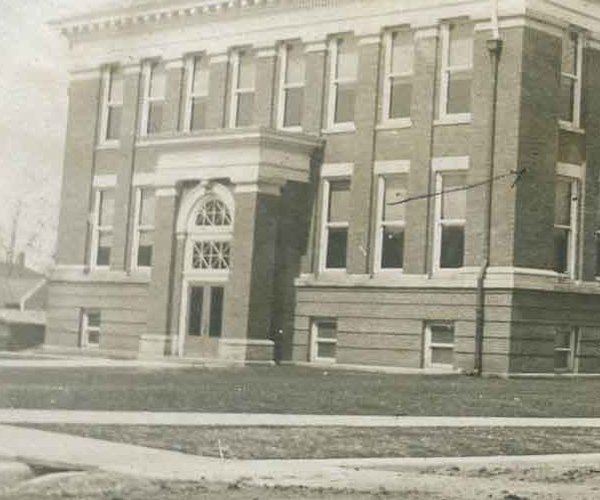

By March 1872 Jacob K. Eilert had made so many improvements to his drugstore on the east side of the square that the editor referred to it as a “Drug Palace.” At that time, he had already sold out his manufacturing interest in the Great Family Remedies to a Chicago House, intending “to devote his whole time to the retail and jobbing of this line of goods.”
Eilert received “a large assortment of glass, putty, paint, and oils” the following month. The editor shared that Eilert was “carrying out the Temperance law to the letter. A man went into his Drug Store for a pint of alcohol, the other day — a temperance man at that — and wanted it for the purpose of making some shelac [sic] varnish, but he could not get the alcohol until he bought the shelac and put the alcohol in it.”
Eilert continued to take good care of his building. It was announced on October 1, 1879, “The Whitney-Eilert block is to be repainted in good style.” In May 1880 he put a new door in the drugstore because “the old one was worn out by the tramp of customers”
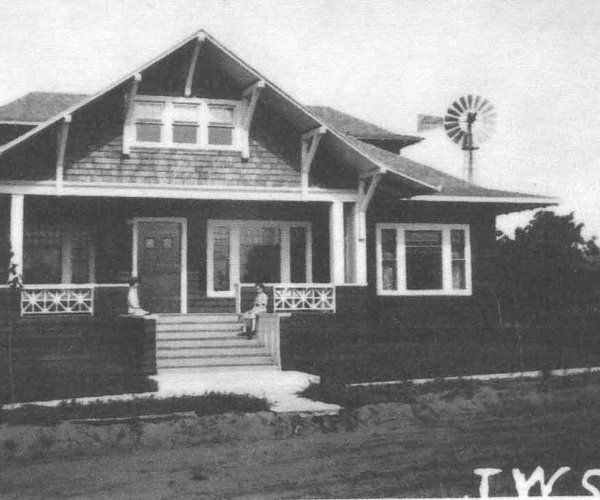
The Eilert family lived on the southwest corner of 10th Street and 20th Avenue. The 1880 census showed that their daughter, Mary, 27, was the only other person in the house with them; it also showed that her parents had been born in Baden. Unfortunately, Margaret passed away three years later at the age of 58 on Sunday evening, December 30, 1883 after “long suffering and patient waiting for surcease from pain.” Jacob and Mary continued to live in the residence from which the funeral was held on New Year’s Day.
Eilert developed cancer of the mouth on the left side of his face two years before his death on Tuesday evening, July 19, 1892. He had been confined to his home constantly for the last year of his life and, at the time of his death, “worn away from his constant suffering.” During his illness, Frederick Trukenbrod, who had worked for Eilert for years, ran the store. Even though Eilert was only 68, he had owned “the oldest drug [store] in continuous service in the state.” One of his obituaries stated, “To us who knew him well, he was ever the same kind hearted neighbor and friend, and we doubt if their [sic] is a man in the world that will say ought against him.” His funeral was also held from his house on Thursday with services by the Masonic order from 10:30 to 11:30. “As a fitting mark of respect, every business house was closed the day of his funeral.” He left “a loving mother and a devoted brother and many relatives in Stephenson county, Illinois.”
His will, which appointed J. B. Treat administrator and executor, was read later that month. The use of nearly all the property was left to his adopted daughter, providing for the expenses of administration, insurance, taxes, etc. He left his interest in the paternal estate to his mother and provided for the sale of his valuable formulas and recipes.
Mary Kafer Eilert continued to live in the family home until her death as a result of several strokes on Saturday, March 31, 1923 at the age of 71. The former home of the Eilert family was being wrecked in January 1927. Gèorge J. Stauffacher owned the property at that time and planned to build a new house that spring [now 1922 10th Street].
A judgment was made in 1911 which showed that Eilert did own his building on the east side of the Square at the time of his death.
The Eilert drug business continued on; the stock was sold in August 1892 to the highest bidders, Thomas Eilert, Jacob’s brother, and Charles Lytle. They planned to continue the business in the old space under the name, Eilert & Lytle. Lytle, “being a practical pharmacist” who had been employed by Eilert, was the manager. That new firm also owned “the formulas for the famous remedies and compounds of the pioneer drugs and will keep up the supply.”
The men added a new plate glass front to the drugstore in October 1892, which added “materially to its looks.” The firm, however, dissolved in March 1893 with Lytle taking over the firm. Thomas Eilert, then 59, removed his part of the divided stock to Dakota, Illinois. It was reported on April 19 that the store in Monroe “has received new invoices of goods, and is as bright as a new dollar”
An article in the November 16, 1900 Monroe Evening Times stated, “Lytle’s Cash Drug House is proprietor and manufacturer of Eilert’s Hair Restorer, Lytle’s Boss Cough Cure, Lytle’s Vegetable Liver Pills, Van Wagenen’s Indian Herbal Liver Cure, Eilert’s Sensation Soap, etc.”
Lytle, retiring from business permanently, sold the business to William P. Bragg in December 1900. Lytle then planned to “go South for his health, which has been failing fast of late.”
The news clippings from the 1850s in these three columns were all taken from the book, Becoming a Village: Monroe in the 1850s. If you would like to read more about the people and businesses in Monroe during that decade, you may purchase a copy at the Toy Haus on the west side of the Square for $15. All money goes directly to Main Street Monroe.
— Matt Figi is a Monroe resident and a local historian. His column will appear periodically on Saturdays in the Times. He can be reached at mfigi48@tds.net or at 608-325-6503.