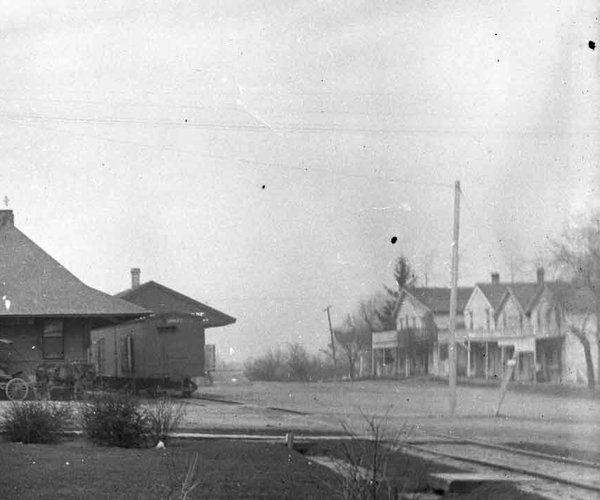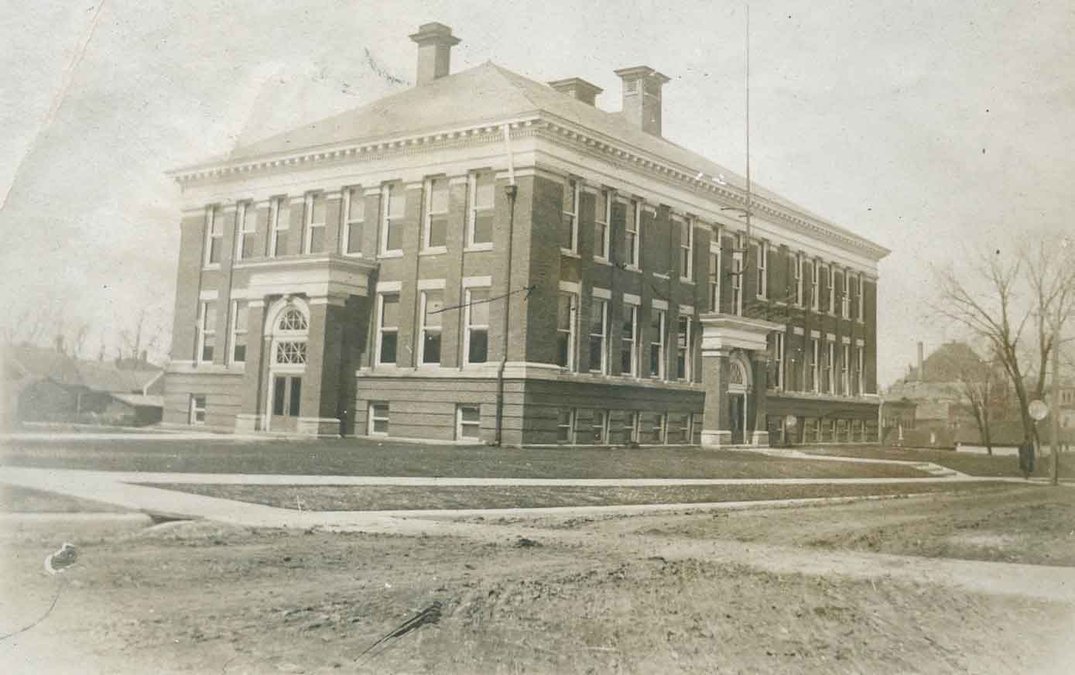
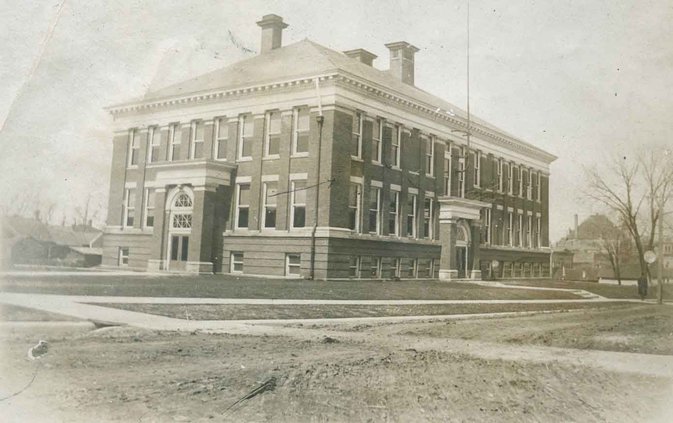
Now that students have had classes in the new Monroe High School for more than two weeks, I decided that this would be a good time to go back a century and share some information about the changes that were going on in Monroe High School at that time. Classes had been held in that building, which was situated just west of 16th Avenue between 13th and 14th Streets, for more than two decades by then.
Nicholas J. Stoneman, the new physical education director and football coach, and his wife arrived in Monroe on August 26, 1925. Plans were to meet with the 45 potential players expected to respond to the call for a meeting on Monday, August 31. New equipment had been purchased for the team, with seven or eight veterans expected to return. Al Stauffer was the captain that year and games were played at the fairgrounds. Known games were scheduled against Mount Horeb, Orangeville, Mineral Point, Wisconsin High (in Madison), and Monticello.
It was announced on August 28 that work on changing the football field to run north and south that year would start soon afterwards, so that it would not “interfere with the baseball diamond.” The old gridiron had the diamond included.
You may recall from a previous column that some of the high school students who came to school from the country would walk to the public rest room off the square and eat the lunch that they brought from home; city students were able to go home for a hot lunch. Domestic science teacher, Gertrude Flanagan, had her students prepare “one hot dish each day” for these pupils to eat with the cold things they brought from home. Beginning in late October, the pupils were served in the domestic science room with a member of the faculty in charge.
An M club had been organized by Coach Herman L. Jacobson earlier in the year, on March 23, to which “all wearers of the Monroe high school athletic M and aMa awards” were eligible. Gordon Stauffacher was the first president with Henry Hefty the vice-president, and Delbert Zilmer the secretary.
In November of that fall Nellie Roese, the girl’s athletic director, organized the girl’s athletic association, with Miss Hestad, school nurse, as an honorary member. Evelyn Gorham was elected the first president. A committee of 20 received the class of 170 girls from the junior and senior high as the initial part of the initiation on November 1. As an initiation, each of the members was to wear a hair ribbon, a man’s large handkerchief pinned on her dress, and carry a market basket until the close of school that Wednesday.
“The organization was organized for the purpose of creating a spirit of good sportsmanship in all interscholastic and interclass contests, of developing an interest in athletics for girls and to further the abidance of rules of personal hygiene.”
In the spring of 1927, it was announced that, “The crack of the bat will be heard instead of the snap of the starting gun on the Monroe high school athletic grounds this spring.” Coach Stoneman shared, “There is not much local track material this spring. Baseball material is an unknown quantity, of course, but sentiment seems to favor baseball and will specialize on that sport as an experiment this year.” Mount Horeb, Fennimore, and Lancaster were all potential candidates for games.
A drive to sell between 200 and 300 football tickets to the high school students began on September 20 that year for 75 cents for the season of four games, possibly more. That would save the students more than $1 over single game admission. It was expected that the football expenses would be met with this money. Businessmen would later be given the chance to purchase season tickets for $1.50.
At a high school assembly on October 17, Superintendent E. Orville Evans said that “he had heard that the local school was noted for its fighting spirit, [but] he had failed to see it in the students at last Saturday’s game.” He asked,”What is it that helps some team from a very small school defeat that of a larger school?” He answered, “School spirit is the answer.”
It was also announced in the fall that the first school mixer for the year would be held in the Lincoln School gym in the form of a Halloween masquerade to be given by the junior and senior class to the sophomores as an initiation into the high school.
Another attempt to form an M Club was announced the following month. “All men who ever boasted an M athletic award” were invited to a banquet to be held at 6:30 on Thanksgiving day after the high school football game. Stoneman stated, “The purpose of the banquet is to bring all wearers of the M together to form an M Club, such as those groups of colleges and other high schools.” Men on the faculty, men on the school board, and M men were all eligible to attend for $1 a plate. About 60 men ate a turkey dinner where the 1927 letters were given out.
It was announced on April 20, 1928 that MHS was a member of a new athletic league that included Fort Atkinson, Stoughton, Edgerton, Wisconsin High, and possibly Watertown that fall. Each team would play each of the others in football and twice in basketball. They were also scheduled to play Warren and Madison East that year.
Eric Jubeck, current Athletics and Activities Director at Monroe High School, along with the help of a student or two, plans to post information like this on a website that they are maintaining at https://cheesemakers.touchpros.com/Timeline?tabid=11684.
With one look at the current high school, one can easily see that times have changed immensely in the last century!
— Matt Figi is a Monroe resident and a local historian. His column will appear periodically on Saturdays in the Times. He can be reached at mfigi48@tds.net or at 608-325-6503.