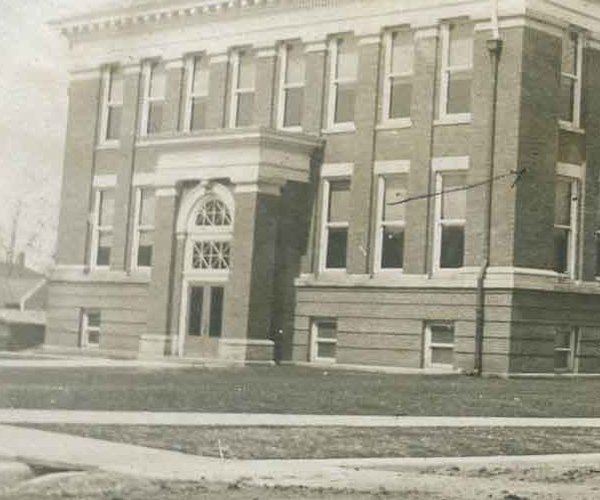

It had been announced earlier in February 1907 that Monroe builder, L. S. Waagner, had been awarded the contract to build a new high school in Stoughton. However, it was announced on February 27 that the Stoughton school board had not formally awarded the contract because “all the bids exceed the amount of the appropriation.” Both Wagner and Bauman went to Stoughton on April 15 “with five men to begin work on the new high school building.” In the meantime, Wagner and Keister & Bauman (both firms from Monroe) had each submitted bids to build a Carnegie library at Stoughton. However, there was one lower bid, so neither of them got the contract.
Wagner was then awarded the contract for $5,200 to “build a fine residence” for Henry Brown on 7th Street that June. The house on that corner lot was to be moved “to make room for the new building.” Fred T. Burke would install the heating and plumbing making the total cost of the home $6,000.
Wagner joined E. F. Bauman as a partner, sometime before February 18, 1908, when it was announced that Bauman & Wagner were the successful bidders for the high school contract at Edgerton for $40,000. The partners lost the bid for building the high school at Lake Geneva that August by a difference of only $7. Even though the Monroe bid was less, the Lake Geneva bidder was using bricks manufactured there.
Wagner & Bauman [Notice the change of the firm name.] received the contract for the water plant addition, which also included “repairs to be made in the old building at the pumping station.” The new addition was to be 30 x 60 and would cover the new engine and boiler. A portion of the old roof was to be raised and a new roof was to be placed over the old building.
Bauman and Wagner left for Milwaukee on the morning of March 1, 1909 where they were “among the bidders for the contract for building the Lutheran home for feeble minded at Watertown,” which was to be let that day. It was announced on March 30 that they had the lowest bid from seven contractors, with a bid of just more than $30,000.
A week earlier Wagner was the successful builder for the building of a garage to be erected by Thomas Wells on west 11th Street. The building was to be “40 x 90, two stories high, and of brick construction.” It is believed that this building was in the 1500-block and housed Monroe Auto Sales before it was razed before the parking ramp was built at that location. [That building is shown on page 67 of the Pictorial History of Monroe.]
It was announced in April 1909 that Wagner & Bauman had “secured the contract for a new $20,000 bank building to be erected at Delevan,” with a bid that was $130 less than the next lowest bidder.
Wagner & Bauman took “a force of men and tools to Whitewater” on Monday, November 1 “to break ground for the new state normal school [now University of Wisconsin-Whitewater].” The article did not state which building was being built, but the contract was for $41,852 — and did not include ventilating, heating, plumbing, or electrical work.
The firm was awarded the contract in May 1910 to build a dormitory for the boys at the state industrial school at Waukesha for $15,787. It was announced at the end of the month that they had also received the contract to build the Columbus County training school at Columbia for $25,000; it was to be completed by the following April.
Wagner & Bauman lost the $75,000 contract in July for building the Sauk County Asylum. The two partners had been in Reedsburg with their figures all prepared. Bauman went on an auto ride out to the asylum, but was stalled for a few hours in the hot sun. They added $1,000 “to their figures for hauling.” This caused them to be $761 higher than the lowest bidder..
Wagner & Bauman were then awarded a $35,000 contract on February 25, 1911 to build a four-story factory building for the Hunt Manufacturing Company in Harvard, Illinois. They expected to put masons to work the following week on that job, which would require a million bricks. During May the firm was awarded the contract to build the new $30,000 high school in Fennimore. They were also awarded a contract “for the construction of a shack and the remodeling of two old shacks at the Wales sanatorium, the state institution for tuberculosis patients” in October for a bid of $14,541.
Wagner & Bauman continued to stay busy out of town. They were “awarded the contract for the Carnegie library to be erected at Rochelle, Illinois at a cost of $12,000” in June 1912. Rochelle is just south of Wagner’s former home in Monroe Center. The firm received their largest job (at that time) in October when they were hired to erect “the Grant county asylum at Lancaster” for $105,000. The building was to be 170 feet wide by 246 feet long and would replace the one that had been destroyed by fire that spring.
While superintending the building of the school house at Rochester, Wisconsin for Wagner & Bauman, Straus Krise fell 70 feet while working on the structure on October 8, 1912. He received several broken ribs as well as suffering other injuries. This was the only injury to one of Wagner’s workers found in the newspapers. Krise, had previously operated the Krise Emporium on the east side of the Square in Monroe, which was the topic of a previous column.
L. S. Wagner and his partners continued to build buildings for decades. Find out more in the next three columns.
— Matt Figi is a Monroe resident and a local historian. His column will appear periodically on Saturdays in the Times. He can be reached at mfigi48@tds.net or at 608-325-6503.