
You may remember that I did a column a few months ago about George Walker and the Monroe Shoe Peg cigars that he made; Joe Hillary had contacted me about the cigar box he found while he was renovating an apartment in the building that he owns at 824 17th Avenue. He recently contacted me again to see if I knew when that building was constructed and who had built it. I went to my index of newspaper articles and found both the builder, L. S. Wagner, and the year that it was built. This column, and the next four, will explore the life and accomplishments of Wagner, who most of us had probably not ever heard of before. It is quite remarkable how many buildings he built in Monroe, elsewhere in southern Wisconsin, Illinois, and at least one in Iowa.
Lewis Sheldon Wagner was born on September 22, 1864 shortly after his parents, Frank M. and Maranda, moved here from Licking County, Ohio where they had been married earlier in the year. The 1870 census shows the family of three living in Monroe Township with $6,000 of real estate and $1,000 of personal property. The 1873 plat book shows that his father had accumulated 240 acres in Section 2. Little is known of his early life, but he and his younger sister, Clara, were living there with their parents in 1880. An article on May 12, 1880 stated that they had moved into Monroe. However, Frank’s obituary on April 25, 1883, stated that he “died at his residence in Monroe Township, near this city.”
L. S. Wagner, listed as a farmer, was married on September 24, 1884 to Kittie Adams at the residence of her parents, Jacob and Ellen, on the northwest corner 15th Avenue and 16th Street by Daniel R. Howe, minister at the Christian Chapel. Witnesses were Frank Corson (Kittie’s brother-in-law) and Melissa Adams. Kittie would turn 17 years old two months later and he had turned 20 only two days before. The earliest city directory (1885) shows that L. S. was boarding on the north side of 11th Street between 12th and 13th Avenues. [Kittie was not listed.]
The only reference to Lewis in the newspapers at that time was in the Monroe Sentinel on March 23, 1887. It stated that L. S. Wagner had the contract “to paper and decorate the walls and ceilings of the Ludlow House from garrett to basement, throughout, in elegant style and with the best materials. Mr. Wagner is the north side dealer in books, wall paper, stationery, musical instruments, ready mixed paints, etc.”
The 1889 city directory showed that they lived on the east side of 15th Avenue between 15th and 16th Streets. His obituary stated that they “moved to Rockford, where they remained two years and then lived at Monroe Center, Ill. for 10 years.” The 1900 census shows Lewis, Kittie, and their children, Margaret, 10, and Francis, 4, living in Monroe Township, Ogle County, Illinois, where his occupation was listed as a “contractor and builder.” They were not listed in the Monroe city directories again until 1906.
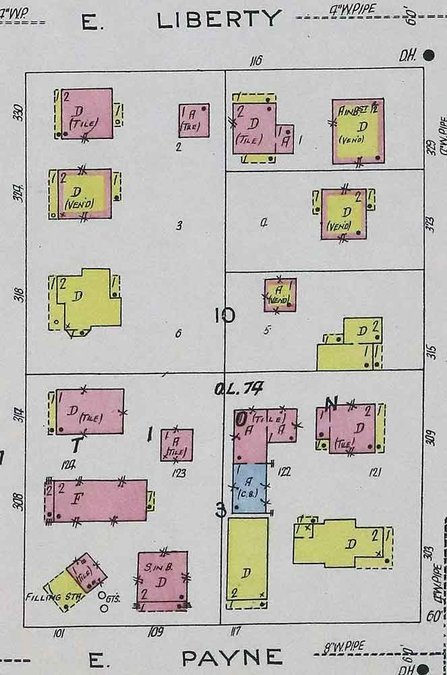
L. S. Wagner, while still living in Monroe Center, purchased property on April 20, 1905 in an administrator’s sale for $2,425. He sold out in Illinois and planned to move back to Monroe. This lot and a half, formerly owned by the late Clara McLean, was 90 feet on the southeast corner of 17th Avenue and 120 feet on 8th Street. Wagner planned to build on both the east and west ends of the lot. He planned to make improvements to the house, which he then planned to occupy during the summer. Interestingly, Wagner sold that property to his wife for $2,500 on September 29.
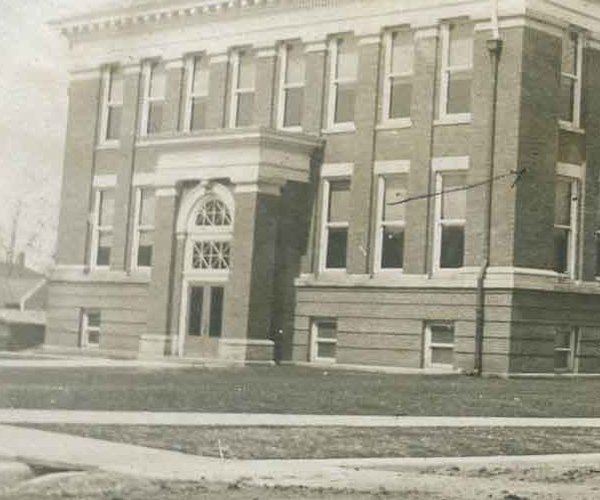
By September Wagner had been awarded a contract “to build a fine brick house for Christ Bleiler” for $4,500. This would be the start of an illustrious career in building back in Monroe. On April 5, 1906 he was awarded the contract to build the new Monroe High School, which had been designed by Architect Claude, of Madison. [A photo can be seen on page 98 of the Pictorial History of Monroe.] His bid of $36,630 was the lowest of the 14 contractors in the competition. Work on the building was to be started as soon as possible and the building was to be completed by November 1.
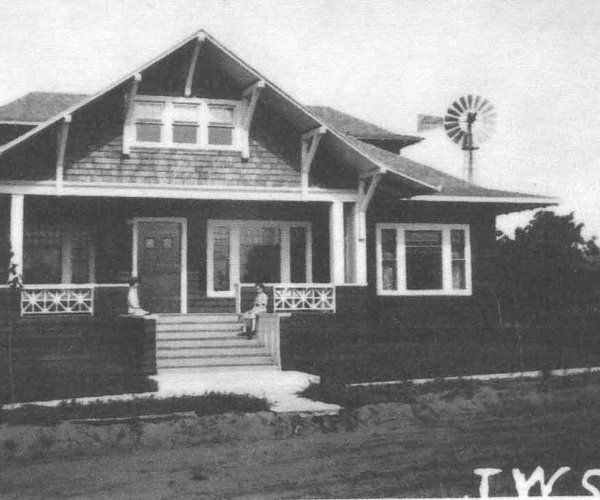
Wagner must have had quite a crew as he had “broken ground for a new residence on his vacant lot” on 17th Avenue by April 20. In early May, he was awarded the contract “to build a brick house for C. R. Schepley” on east 11th Street, with work to be started at once. By October 22, he was ready to break ground on another “fine brick residence” for John Hawthorn at 1314 17th Avenue.
While Wagner was “finishing his work on the new high school here” in February 1907, he was awarded the contract to build the new $45,000 high school at Stoughton. He planned to begin work there as soon as the weather permitted; the foundation had already been laid. The editor included, “Mr. Wagner has been handling numerous contracts here and has been highly successful in his work. The class of buildings he has erected in Monroe warrants the statement that the people of Stoughton will never regret awarding him their high school contract.” E. F. Bauman and Fred T. Burke, both of Monroe, had also submitted bids for the Stoughton school.
More will be learned about Wagner’s career in the next four columns.
— Matt Figi is a Monroe resident and a local historian. His column will appear periodically on Saturdays in the Times. He can be reached at mfigi48@tds.net or at 608-325-6503.