

You may have noticed the Robertson Block on the west side of the Square in Monroe that now houses the Toy Haus. It was built by Jesse Robertson, ex-husband of Almira Humes Churchill Robertson, who was a carpenter and builder in Monroe for decades. He will be the topic of this column and the next one.
Jesse was born on December 6, 1820 near Sharpsburg, Kentucky and came to Monroe in 1840, about the same time as Almira arrived from Southern Illinois. It is unknown where he lived when he first arrived or how he met Almira, who was 13 years older than him, but they were married September 6, 1841. He may have built the home where she planted the first flower garden in Monroe on the southwest corner of 10th Street and 15th Avenue a few years later. Jesse’s only son, Charles, was born on July 4, 1845 — probably in that home.
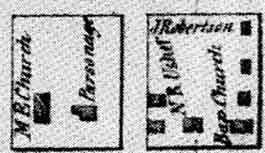
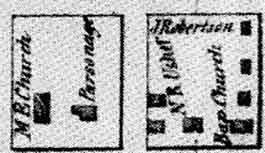
Not much was printed about Jesse in the 1850s newspapers. He was working with his stepson, Norman Churchill, in the brick steam mill. They have may have been partners in Churchill & Robinson [sic]. Information about that is printed on page 26 in Becoming a Village. The only article found in the 1860s stated that he had opened a carpenter and joiner shop with Silas Gardner, his brother-in-law.
Jesse was improving the store he owned on the northwest corner of the Square in August 1877. The floor was lowered and the entire building repaired and painted so that a new firm could open a grocery store there. This could be the building in the top photo on page 13 in the Pictorial History of Monroe. Two years later Daniel S. Young purchased that property, occupied by F. L. Stone, and would “occupy the same with a fresh stock of groceries.” The price was $2,400 for the west 20 feet of that lot.
Two years later Robertson decided to build onto the wooden bakery building instead of building the brick store that he had contemplated. Later in 1881 he purchased “two lots north of the old red Brick” on the west side of the square where he considered building a brick block in the spring. He paid James Wilkins $4,900 for the future home of the Robertson Block. Jesse and Almira had separated by this time; Jesse was living somewhere on 16th Avenue when the census was taken in June 1880, possibly in this building that he later purchased.
It was reported on June 7, 1882 that Strawser & Summeril had moved to one of the new stores in Jesse Robertson’s “new block” on the west side of the square. It is unknown where this new block was located.
According to their obituaries, Jesse married Miss Libbie Dale in 1884. No other information was given about the date or location. The directories show that they lived on the northwest corner of 11th Street and 22nd Avenue from 1885 through 1895.
Jesse’s only biological son, Charles, left for Dakota Territory — near LeBeau — on April 28, 1886. His wife and only child, Maud, were to leave two weeks later. Charles and Vennice had sold Jesse their home on two lots, located at 1402 10th Street on April 16 for $700.
There was a large fire on the northwest corner of the Square in the early morning of New Year’s Day 1889. It destroyed Young’s grocery store and the bakery building, which was owned by Lucena Sykes, Jesse’s stepdaughter. However, Jesse owned the lot under the bakery. It was announced in February that Robertsons sold the 20.5 foot lot to Daniel Young for $2,550 so Young could “build a block of stores during the summer.” The original brick wall on the east half of that property was preserved.
It was shared on May 19, 1897 that Robertson would begin the “demolition and removal of his wooden building” on the west side of the Square with plans to erect “a two-story brick block of modern style for stores and offices.” It is unknown if the wooden building was demolished, but it was shared on August 4 that he postponed the building “until he gets a good ready to build.” It was then reported, on September 22, that a man from Freeport planned to open a new restaurant in one of Robertson’s wooden buildings on the west side.
Jesse purchased the family home that he shared with Almira for decades on April 29, 1898. Since Almira’s death, it had been occupied by her daughter, Lucena Sykes and Frank. The two lots were sold for $2,064.50 by Lucena, Frank, and her brother, George and Emma Churchill. Frank then re-purchased the south lot that August for $750, where he expected to build a home to share with his mother. Jesse retained one foot off the north side of the Sykes’ lot and 10 feet off the west end.
Fitzgibbons Brothers carriage shop suffered a large fire in January 1899 and then found temporary quarters in the Robertson building that had recently been vacated by Charles Chambers.
In May Dr. Samuel R. Moyer purchased the building on the south side of the Square at 1604 11th Street from Robertsons. The newspaper stated that it sold for $4,300, but the court records said $3,000.
By that summer Robertson had finally decided to build his new block on the west side of the Square. “Work of clearing away the dilapidated, partially burnt old wooden structures” began on June 27. He sold the larger building, which was “in good preservation,” to the Planing Mill where it would be moved and used to as a storehouse for finished products. Building of the new Robertson Block would begin as soon as the ground was cleared. It was shared on August 2, “Work on the new west side building is progressing rapidly. The hole will be filled up before long.” By the end of September, the cut stones had arrived.
More will be shared next week about the completion of the Robertson Block and the rest of Mr. Robertson’s life
— Matt Figi is a Monroe resident and a local historian. His column will appear periodically on Saturdays in the Times. He can be reached at mfigi48@tds.net or at 608-325-6503.