BLANCHARDVILLE — Two outdoor studies to safeguard Wisconsin bats will soon take place, giving volunteers a unique opportunity to peak into the life of one of the most misunderstood mammals in the state. Wisconsin bat counts will be held at Yellowstone Lake State Park, 8495 N Lake Road, Blanchardville, Lafayette County; and at Stonefield Village, 12195 County Hwy VV, Cassville, Grant County. Both bat counts will be conducted to collect data on two fascinating local populations of bats.
Both events, which will take place in early June, are pre-volancy bat counts, which means the counts are done before this year’s pups are able to fly. In addition, information collected is being done to monitor the bat population, and to estimate the size of the maternity colony that has returned to the bat houses in both locations. The counts also assist with learning more about the effects of white-nose syndrome on bat colonies throughout the region.
Heather Kaarakka, Conservation Biologist with the Bureau of Natural Heritage Conservation will be leading the bat counts at Yellowstone Lake State Park and at Stonefield Village. She looks forward to meeting with those who are interested in learning more about bats. One of the things that makes the bat count interesting, is the observing and learning more about the eight bat species who make their homes in Wisconsin.
“Wisconsin once had 7 species of bats until in 2015 when we discovered a small breeding population of Evening Bats in the very southern edge of the state,” shares Kaarakka. “It’s possible this species has been shifting north for various reasons. It’s unlikely that we will see new bat species moving their range into Wisconsin, but there is always the possibility of an incidental individual just like we sometimes see with birds.”
The eight bat species found in Wisconsin are either endangered, threatened, or concerned. In addition to the newest species, the Evening bat (Nycticeius humeralis), the more common species include: Big brown bat (Eptesicus fuscus), Eastern red bat (Lasiurus borealis), Hoary bat (Lasiurus cinereus), Little brown bat (Myotis lucifugus), Northern long-eared bat (Myotis septentrionalis), Silver-haired bat (Lasionycteris noctivagans), and the Tricolored bat (Perimyotis subflavus).
“Wisconsin is one of very few places where little brown bats appear to be recovering, and the reason we know how this species is doing in both, summer and winter, is thanks to all of the volunteers counting bats from roosts, and recording bats on acoustic surveys,” says Kaarakka. “We’re very grateful for the time and effort that bat surveyors give us every summer. Without their help we wouldn’t be in the place we are today, for understanding the impacts of white-nose syndrome in Wisconsin.”
Each year, two bat counts occur, not just at Yellowstone Lake and Stonefield Village, but by countless volunteers who conduct bat counts on their property. Those volunteers are as important for counting the bat population that resides in their backyards, roosting in bat houses and trees throughout the state of Wisconsin. Some people admit that the more they know about bats, the more they want to learn.
“Bats are amazing and resilient creatures,” says Kaarakka. “At sites like Yellowstone Lake where they are persisting and surviving white-nose syndrome, it is important to protect and manage their roosts to ensure they have safe homes to return to every summer so they can give birth and raise their pups. Bats are long lived and have high site fidelity. We have one bat that was tagged at a site in 2012, who continues to return to the bat house making her 15 years old this year!”
Equipment onsite at both locations have digital readers for passive integrated transponders (PIT) tags that have been attached to bats.
“The PIT tags are essentially the same as microchips used for dogs and cats,” shares Kaarakka. “Every time a tagged bat flies through or across the antennas on the bottom of the bat houses their tag number is recorded and logged with a date and time. We PIT tagged bats over several summers at Yellowstone Lake beginning in 2020 and we continue to get fairly high returns even of bats tagged in 2020 making many of them at least 7 years old this year. This is part of a larger project at multiple summer and winter sites in Wisconsin, and we use this information to identify survival rates and behavior of bats surviving white-nose syndrome.”
Volunteer bat counts and PIT readers both assist biologists in studying bat biology, white-nose syndrome and how bats are thriving, and being protected throughout the state.
“The June 2025 total at Yellowstone Lake was 1,100 bats,” said Kaarakka. “I’m hoping to have a higher number of bats this year.”
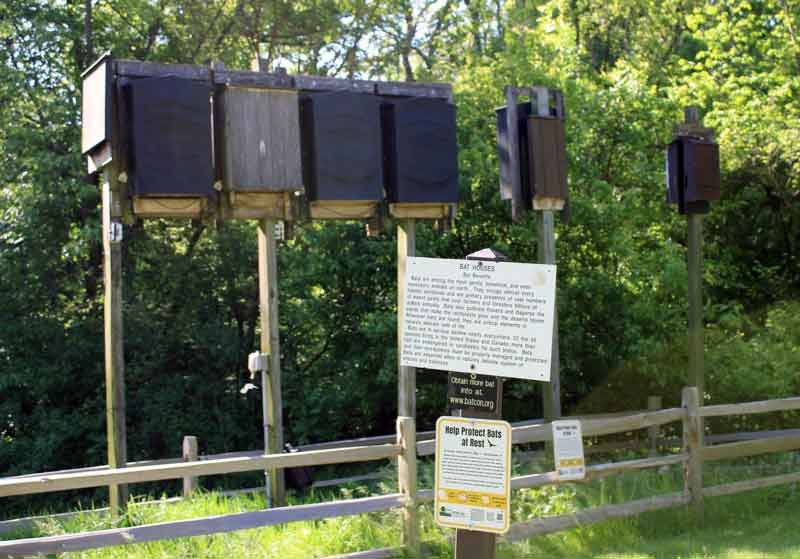
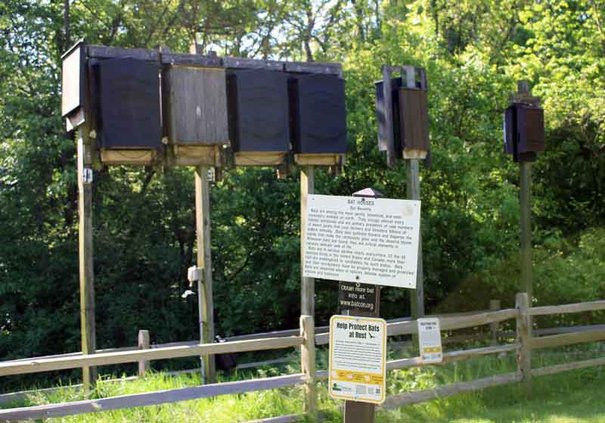
Yellowstone Lake in Lafayette County has about 30 bat houses, which are credited to volunteer Kent Borcherding. The houses are scattered across five different locations throughout the park. To sign up and learn more about the date and time of the bat count being held at Yellowstone Lake State Park in June, email Heather Kaarakka at Heather.Kaarakka@wisconsin.gov.
The Stonefield Village bat count will take place on Thursday, June 11, beginning at 7 p.m.
“Stonefield continues to be the largest known little brown bat roost in the region and bats are doing well at the more than 30 bat boxes that Kent Borcherding built,” shares Kaarakka. “Over the last couple of summers we have counted 3,500-4,000 bats which is only slightly fewer than before white-nose syndrome (white-nose syndrome) got to the state. During the height of white-nose syndrome impacts, Stonefield’s colony dropped down to about 1,300 bats. Bats are now doing well at the site.”
Sign up is underway with a program held just prior to the bat count, which is also part of the experience in Cassville. Those wanting to learn more can sign up by logging onto the Stonefield Village website: stonefield.wisconsinhistory.org/upcoming-events/.
Despite their prevalence, the bat population remains under threat with white-nose syndrome, which continues to claim countless bats nationwide each year. Volunteers are requested at both locations, and landowners are needed throughout the state. Those who volunteer at the Lafayette and Grant county locations are reminded to dress according to the weather, wear good walking shoes, and to bring along your own chair for comfortable viewing and counting of the bats. Together, the public can continue to work together, in hope of recovering the population of bats which help contribute to the good of the environment in which we all call home.