
The description of the mezzanine above the new Eugene Hotel lobby continues. “A reed chair at a reed desk, which rests on a beautiful oriental rug of wondrous color and design, is alluring. Then, too, there is the pretty reed settee, which looks comfortable and inviting after one has written lengthy letters or business correspondence.
“At the opposite end of the women’s writing room appears the men’s furniture and equipment. The writing desk and chairs are of mahogany.
“To the extreme end of this, against the wall, is a huge full-length and very wide mirror. Its extraordinary size and brilliance adds to the beauty of the mezzanine floor.”
A few miscellaneous items were also shared about the building. All of the glass windows opening to the outside were plate while the court windows were made of wire enforced glass. There was a flexibility of room arrangements; regular rooms could easily be thrown into suites with bath, which raised the number of rooms connected with such convenience. Tillman Fetterhoff, 72, was one of the painters and worked 24 consecutive days without losing any time. Not a workman suffered any injury or consequence during the period of construction.
In the basement there were two water softeners and a 1,000-gallon hot water boiler to supply hot water to the entire building as well as the steam heating plant. Direct pressure flushed the toilet bowls, so no tanks were needed. The first private telephone exchange in the city was installed here with 55 phones in the building. This exchange was located just to the north of the lobby and required an operator. All that wiring was in conduit separate from the electric wiring.
The wide halls that circled each floor around the court section were a special feature of the Eugene. “A traveler with two grips has ample space to carry one in each hand and to pass another person. Wide halls are also of advantage in an emergency. The building is semi-fireproof, but the wide halls and two stairways, one to the lobby and one onto the square offer ample means of escape. On each floor, there is a hose, and fire extinguishers are scattered about freely.”
The large article in the paper on the day before the open house said that the Eugene would have 50 rooms and had cost $125,000 and took a year to build.
Beyond their expectation, nearly 4,000 people, 80% of the population of Monroe at the time, inspected the building. “In a never-ending stream, the line of humanity filed into and out of the new and handsome structure last evening. Sidewalks about the corner were jammed, and the square had the appearance of a Wednesday or Saturday evening so filled was it and surrounding blocks with automobiles.”
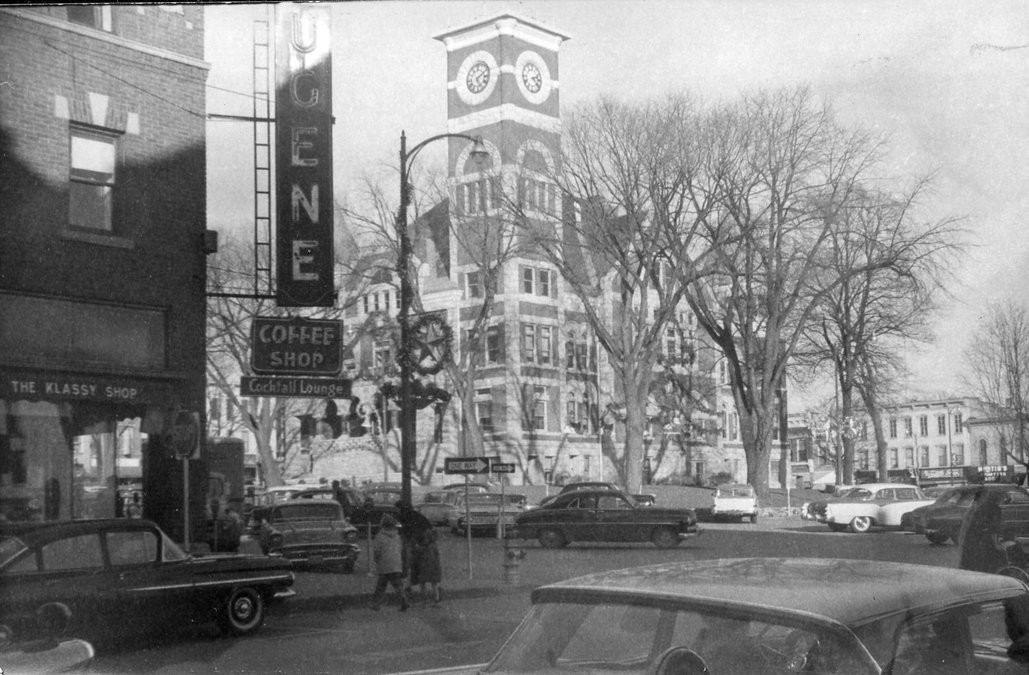
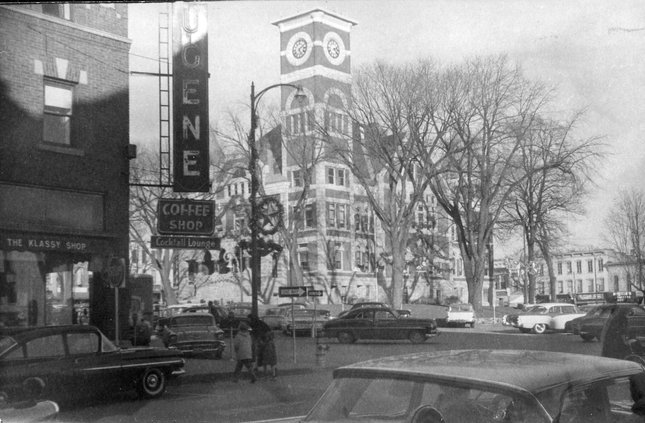
The visitors entered through the coffee shop where “a nattily uniformed bellboy” held open the door. The visitors then passed to the lobby where some guests lounged in the easy chairs. The line wound to the staircase where frequently there were so many on the stairs that the line would be held up for a time. Some stopped on the cozy mezzanine, where “exquisite gladioli beautified this floor, and the lobby.” Each guest room also had flowers.
“The second and third floors called forth happy exclamations from the visitors. From room to room they wandered, marveling at the arrangement and the appointments. The building was a flood of light and the artistic shades in all rooms blended beautifully.”
Owner White received congratulations and compliments “as he stood in the lobby, smiling upon his many friends.” Robert Rote, architect and builder, Harry Young, manager, Mrs. Dell Warne, hostess, and Ray Young, coffee shop operator, were also present. The hostess was “a position which assures a feminine touch in the comfort and conveniences for the guests.” More than 60 gallons of punch was served in the corner store.“Jaunty bellboys with their brass buttoned ‘Eugene’ caps and linen coats were assisted in guiding the visitors about by a core of young women.”
Even though the open house officially ended at 9:30 and “the dance was over early, visitors continued to pass through the hotel and to rest in the lobby until long past midnight.”
E. J. Tischler, Madison, was the only person to sleep in the hotel that night. He was a representative of the Standard Sanitary Manufacturing company, which supplied the hotel with bathroom equipment. He had planned to return to Madison, but had the idea at 10 o’clock to stay overnight. He said that he slept fine. It was great; no spooks had disturbed him. The hotel officially opened on the morning of the 15th.
Monroe’s largest electrical sign, weighing 600 pounds, was placed on the building on August 21. It was a 21-foot green porcelain-enamel sign with the words Hotel Eugene in white glass letters. There were fifty 50-watt lamps inside for illumination. It was placed on the southeast corner of the building so that it could be seen easily from all directions. A large number of people watched the installation. It was also planned to have a small electric “Eat” sign placed in front of the coffee shop.
In 1925 Hotel Ludlow, Hotel Monroe, and City Hotel were all operating along 16th Avenue as well as the Green County House on 15th Avenue, all in the downtown area. Each of them may have had concerns about their establishments with this modern hotel moving into town.
It was shared on August 14, 1925 that Eugene White said, “The Eugene hotel is built in the hope that it will bring more people to Monroe by providing additional first class accommodations for their stay here. It is built to increase business rather than to take business away from those institutions already established. It is my hope that the Eugene will add to the prosperity of the city.” I know that is the sentiment of the present owners and investors of the new Eugene Hotel.
— Matt Figi is a Monroe resident and a local historian. His column will appear periodically on Saturdays in the Times. He can be reached at mfigi48@tds.net or at 608-325-6503.