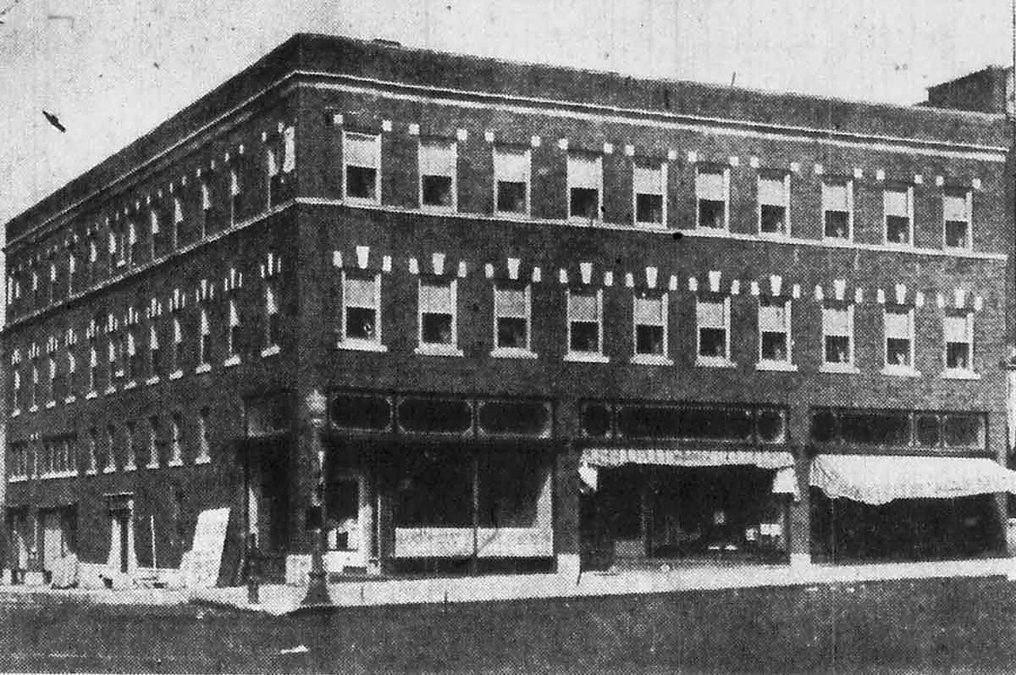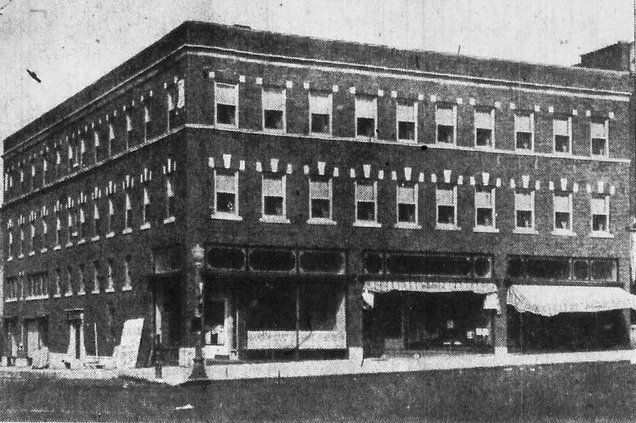

The weather had been so favorable that the 24 men working on the new Eugene Hotel had not missed a day and were ahead of schedule. At that time, they thought it was possible that the hotel would be ready for occupancy by July 1. Plastering of the upper floors was to begin before the end of the week of February 10, 1925. The red oak flooring had already arrived and was ready to be laid.
Nothing more was seen in the newspaper about the construction of the Eugene Hotel. An advertisement announced that Knight’s new store was to open on Saturday, May 23. Knight, you might remember, was the only occupant allowed to stay in the building during construction. The firm, formerly Knight Merchandise Company, carried shoes, men’s furnishings, and men’s work clothes. It was located in the center of the three store fronts facing the square. Milady’s had already moved in, but the corner shop had not yet been leased.
It was announced on Thursday, August 6 that the hotel would receive guests for the first time during fair week. “Rugs, furniture, and even curtains are now in place in the beautiful, modern hotel, but the lobby is not completely finished and a formal opening before fair time does not seem possible.” Harry Young was the manager. [This article stated that there were 48 rooms.]
They announced on Tuesday (11th) that plans had changed and the hotel “will be formally opened for inspection of the public” from 7:00 until midnight on Friday (14th). Booth’s orchestra furnished music and then moved to the basement at 9:00 “to play for dancing.” No rooms would be closed since the first guests would not arrive until Saturday. The coffee shop would be open for inspection, but would not be open until the following week. There were some places that needed another coat of paint or varnish, but guest rooms were ready to the extent that the soap dishes contained soap.
Much more information was contained in the advertisements and articles in the August 14 newspaper. The hotel was to be operated on the European plan with rates from a dollar and up. There were also special rates on single rooms or suites by the month or year.
The coffee shop, on the southwest corner, was to be operated by Young & Company under the supervision of Ray Young, who had “operated the popular luncheon service at the Monroe Country Club for two seasons.” Emma Zimmerman, with 20 years experience in hotels, would be the cook in the coffee shop. The walls were in pencil blue, which would “harmonize well with the pencil blue frocks” of the employees. The trim would be in chocolate “with a dash of lively orange to brighten up the dollar blend.” [A photo of the coffee shop can be viewed on page 59 of the Monroe Area Pictorial History.]
Three miles of conduit enclosed the wires throughout the building. The electric system was “the largest and most elaborate in the city.” There were 300 hot plugs, 275 bracket fixtures, 125 ceiling fixtures, and 180 tumbler switches. More than 600 lamps were connected and ready for use. The three miles of conduit also carried the telephone wires. A fire alarm system with a gong on each floor had also been installed. There was also a regular city fire alarm system box in the lobby over which a department call could be sounded by the use of a lever. Police protection was also afforded by a police light on the corner of the building operated from the United Telephone Company office, which could be seen by an officer from any direction.
On the day before the open house, they were expecting 1,000 people to visit the hotel between 7:30 and 9:30. Even though it was not complete in all details, the lobby was open so the public could gain “an idea of its Gothic design and attractive gray finish.”
Another article that typifies the 1920s said, “Rainy days need not worry the straight locked bobbed haired miss, who stops at the Eugene. Electric plugs, sometimes hidden back of the mirror of the dressers, may be used for the electrical curling iron. There is also a socket where [the] electric cord of the vacuum cleaner may be attached, thus ensuring the spick and splan [sic] cleanliness which is to be an outstanding feature of the hotel.”
The guest rooms had soft shades of gray, blue, black or buff on the walls, which were not bare, but “artistically broken by a harmonizing, framed picture.” A pretty, soft rug covered the finished oak floor. The woodwork had a cream tint. Each room had a metal bed or beds, a metal chair, metal dressers, a metal desk, metal stand, and shellacked mache waste paper basket, with a wood and tapestry easy chair. The windows were covered with cream colored marquisette curtains. The dresser had a pretty linen scarf with embroidery at the corners. On the dresser was a long, linen pin cushion, plus a “quaint candle stick holding a white candle and a glass bud vase” to appeal to the women. For the men, there was a cuspidor. A glass water tray with pitcher and glass tumbler was placed where it could be reached with little effort. Tiny cakes of soap were also placed at the lavatory.
“A wrought iron ornament [sic] railing on the mezzanine floor brings color into the room with a coat of copper green with dashes of red and yellow. The furnishings are relied upon for further color, a bright oriental rug being in the window.”
More of a description of the mezzanine was given in four additional paragraphs. “Even the most neglectful letter writer will receive sudden inspiration and long to write an interesting missive when he or she glances at the writing room on the mezzanine floor.”
This description will be finished in the final column.
— Matt Figi is a Monroe resident and a local historian. His column will appear periodically on Saturdays in the Times. He can be reached at mfigi48@tds.net or at 608-325-6503.