If there was an issue to unite all in a polarized country on the verge of a big national election, leaders in Washington and Madison might want to take note: No one — from deeply conservative, born-again Christian, to hippy progressive seems to like data centers.
At least not in Green County and much of Wisconsin. As the trend to build the sprawling computer farms necessary to power artificial intelligence and other emerging technologies builds into a frenzy nationwide, Green County on Monday became the latest local government to say ‘no’ or to at least put on the brakes.
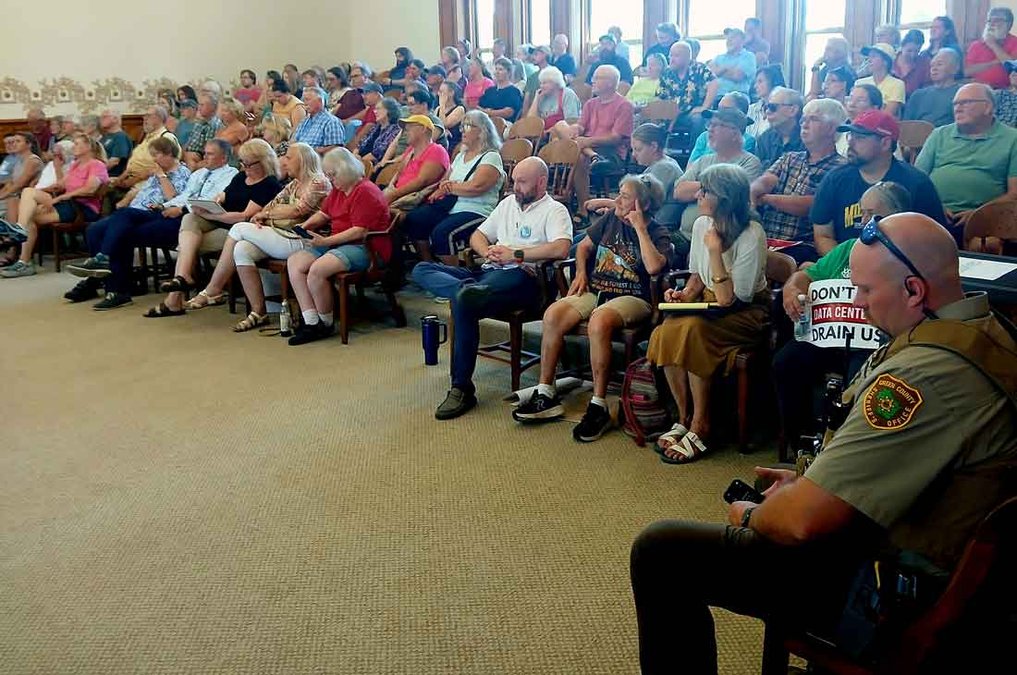
At a packed meeting in a room that holds well over a hundred, residents and elected officials from throughout the county came to address the Green County Land Use and Zoning Committee, which voted unanimously to recommend the county board adopt a one-year moratorium on considering any data center proposals.
The issue is now up to the county board which could vote on the matter as soon as its next meeting, which at the time of the Monday committee meeting, was the next day, July 14.
Data centers house critical computing, storage, and networking infrastructure. Sometimes sprawling over more than 500 acres, they are the backbone of the internet, processing and storing the data behind cloud computing, websites, streaming services, so-called large-language models and other Al training.
Opponents Monday spoke cordially but forcefully as they urged the committee and county writ large to reject the centers, with the two biggest issues being the massive amount of water and electricity such facilities demand from the communities that agree to host them. There were politicians and candidates for office in the crowd — alongside everyone from farmers to artists and tech workers. Many said a year-long moratorium is not enough.
“You wouldn’t have to consult Al to make this decision,” said Josh Mittness of Clarno, who is running as a Democrat for the District 50 assembly seat.
Bryna Caves, who also is running for the District 50 seat, organized a protest prior to the meeting and distributed printed signs. She said the area’s streams and waterways have to be protected from the impact of thirsty data centers.
Beyond the crucial issues of water and electric demand, data centers wreck the environment, and take up vital farmland. People, bees and animals can’t stand the frequency of the constant humming sound they emit 24 hours a day, and once a center locates nearby, residential property values plummet, speakers told the committee.
One attendee compared the Wall Street tech boon that is adjacent to data center demand as also behind the swift push to build them. In some cases, communities have revolted when developers force officials to sign non-disclosure agreements before the public can unite against the projects, or even get information. Another speaker likened the situation to the dot-com bubble of the late 1990s, and said that overspending on such projects will end the same way as it did then.
“This is a gold rush and developers are not acting in good faith,” said resident Peg Schaffer.
Still others said the issue shouldn’t even be a consideration and seemed to cite a generational gap between those in government and those speaking out — although there were people of all ages in attendance.
“I’m 27-years-old and more worried than half of you old-heads here,” said resident David Andrews.
Prior to a swift and unanimous vote — and again, after it — committee chairman and District 17 representative Dennis Schwartz thanked the crowd for its interest and civility around the issue, and emphasized that the moratorium is not in response to any proposals to build here.
Some speakers also criticized the downstream impacts of the things that data centers and Al are built to enable — among them mass surveillance, fake images, music, books and videos; and the loss of citizens’ private data and individual privacy.