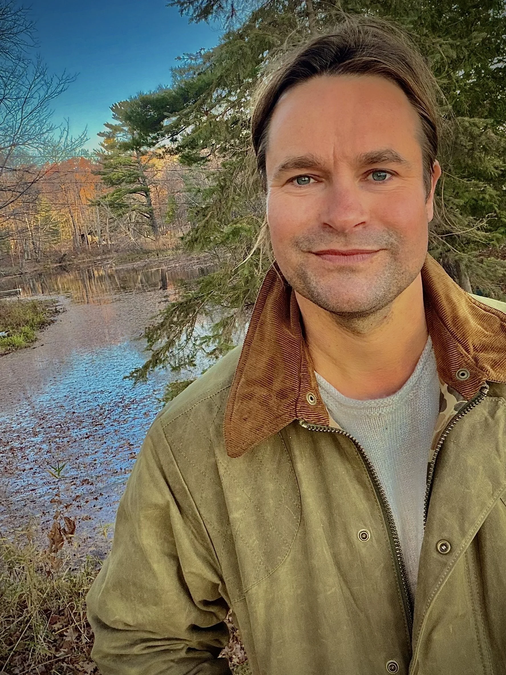
Friends, we are delighted to have permission to share this excerpt from a new book by Rev. Daniel Cooperrider, a Wisconsin pastor. We found it to resonate with many of the recent conversations we’ve been having and look forward to further engagement around it.
From “Live Each Season as It Passes”, copyright 2026 Daniel Cooperrider, published by The Pilgrim Press, Used by permission.
Birders tell of their “spark bird”—the one that ignited their passion. As a mushroom forager, maitake has been my “spark fungi,” and has been a portal into the marvelously queer and queering world of fungi. What we call a mushroom, which is the part that flushes aboveground (often likened to the fruit, as in the apple from the apple tree), is the fleeting avatar of the fungal world, which is vast and exists almost entirely and invisibly underground. At the cellular level, fungi begin as hyphae, filaments that thread together to make mycelium, which branches, entangles, forks, folds, and connects to the forking, branching, entangled roots of plants and trees, creating mycelial networks that pulse underground and act as something like the forest’s internet or brain or intelligence center, although there is no internet, no brain, no center.
As with the picture Merlin Sheldrake paints in Entangled Life, together with what new studies are revealing about fungi, we are learning that they are troubling or complicating all that we might assume as settled or static in the natural world. Fungi are nonbinary, neither plant nor animal but sharing characteristics with both, prompting us to make up a new kingdom of life to try to understand them; they are ephemeral and ancient, microscopic and vast; they outnumber plants and animals; as food they can be a source of life in their edible forms, of death in their poisonous forms, and of experiences that feel like neither life nor death in their psychedelic forms; they decompose and recompose; when faced with a fork in the road, mycelium don’t have to choose, but can take both routes at the same time (for example, if they need to look for water, they can look in many directions at once); mycelium is a body without a plan, and maybe even a body without a body, and a brain without a brain; they are neither male nor female nor both but can reproduce through up to 23,000 possible mating combinations; they can survive on Mars and in outer space, suggesting the notion of panspermia—that life on earth is of extra-terrestrial origin; they can detoxify the landscape—fungi were the first life forms to return to Chernobyl after the nuclear disaster, and the emerging field of mycoremediation is offering hints at the power of fungi to be an ally in our attempts to return health and vitality to ecosystems; they sequester more carbon than any other form of life; they are in the clothes we wear and in the detergent we use to wash those clothes; they are in the air we breathe; miso, kimchi, kombucha, beer, wine, chocolate, bread, cheese, and so many more culinary delights are all fungal creations.
From an evolutionary perspective, fungi created the conditions for life. They evolved and made the move from water to land millions of years before plants, and through decomposing mineral rock, they created the earliest soil-like conditions which allowed plants to venture onto land, and when they did, plants took root in soil that fungi created by making mycorrhizal relationships with mycelium. Plants are here on dry land because fungi are here, and by extension, we are here because fungi are here. Life on earth is essentially and radically (to the mycelial roots) fungal.
Fungi raise radical questions. Is there such a thing as plant or tree without fungi? Where does “animal” begin without the mycorrhizal fungi-plant relationship? Maybe it’s not different kingdoms of life, but one fungi-plant-animal-mineral-atmospheric kin-dom of life? To start to see the world fungally is to start to see it less as a collection of individuals and species and fixed categories of life, and more as a branched, forked, entangled, nonbinary, fluid, web or mesh of aliveness. Could waking up to fungi be the key to waking up to the rest of life in its decentralized, diaphanous, connective commingling?
What if we took mycelium as our organizing principle as we try to meet the ecological moment we’re in, welcoming the wisdom of their in-betweenness, their ways of cultivating myco-trans-species relationships of symbiosis, collaboration, solidarity, reciprocity, and alliance?
— This piece was made available by the Wisconsin Council of Churches. Find more at www.wichurches.org