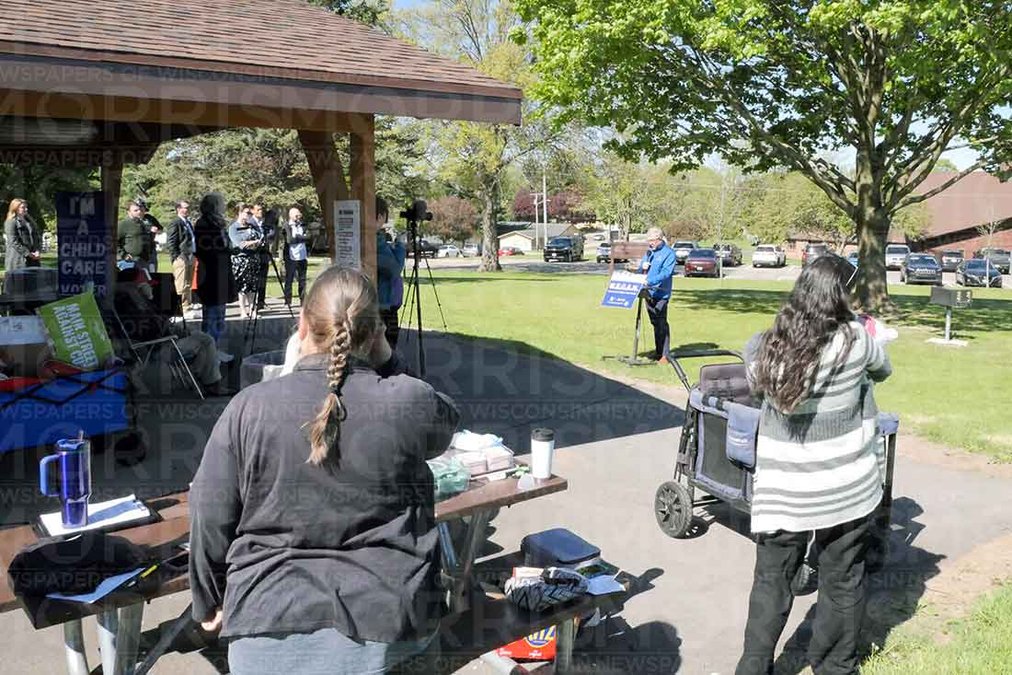
MONROE — For the fifth year in a row, local childcare providers led an advocacy day aimed at bringing attention to the dire landscape of the current childcare funding situation in the state.
“We invited all current elected officials and current running for office to attend to speak with us” said Jillynn Niemeier of Monroe, owner of Blue Door Daycare and Green County Child Care Network president.
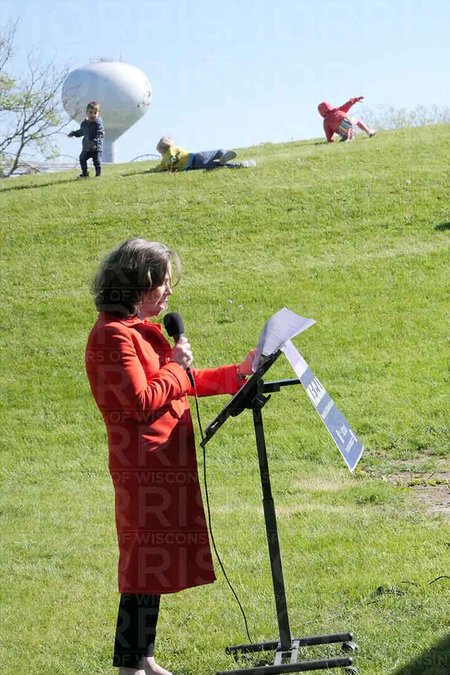
More than 30 people attended the event held Monday morning, May 11 at Northeast Park in Monroe. Among the 13 speakers was current Wisconsin Lt. Governor and Democratic candidate for Governor Sara Rodriguez.
“A Day Without Child Care is not a protest. It’s a window into what would happen if the people who change the diapers, rock the babies and teach the colors and read the books stop showing up,” Rodriguez said. “Hospitals would close shifts. Factories would slow lines, small businesses would lock their doors. ... And we would finally, finally, admit out loud what providers have been saying for years: childcare is not a personal problem — it is infrastructure and essential to Wisconsin’s economy as the roads we drive on. And right now, that infrastructure is buckling.”
Rodriguez worked night shifts as an ER nurse to pay her way through college. Later, she juggled a career, two children and was also caring for her father, who battled Alzheimer’s.
“I know what it is to look at a calendar and a checkbook, and a child’s face and try to do the math,” she said.
In her travels across the state as Lt. Governor over the past three-plus years, she said time after time, one issue sticks out about all others.
“Childcare comes up as a number one concern almost everywhere I go. It is too expensive for families. Families are opting out of the workforce because they can’t afford it,” she said.
The impact of those decisions hits more than just the individuals living in those households.
“We are losing almost a billion dollars within economic activity because we are having people leave the workforce,” Rodriguez said. “And the reality is the most common person to leave that workforce is a woman.”
Representative Jenna Jacobson of the 50th District, which includes all of Green County, said she’s heard similar concerns from Wisconsinites in her own travels. However, she said the issue is especially articulated here in her district.
“I travel around the state quite a bit and nowhere folks talk about childcare quite like they do here in Green County. And I think that’s a testament to the work of the Green County Childcare Network,” said Jacobson, who is one of three Democratic candidates for the 17th Senate District, currently held by Republican Howard Marklein.
One of the Joint Finance Committee co-chairs, Marklein has had a strong influence shaping the past three state budgets. Those budgets have neglected to fund childcare, early childhood education, and public education with any significance, if not under-paying from what was already promised. As the economy has down-turned, it has only hit local communities harder,. School districts area frequently holding referendums to fill the gaps in funding shortfalls from the state, while surplus budgets of between $2-5 billion each year has sat in the state coffers. Instead, child care services and school districts have had to bank on the increasingly thinned out federal funds to get by.
“We don’t have to go to referendums every year for our schools. We could actually budget in and pay our school districts properly so that they don’t have to have these historical referendums every year that we’ve been having,” said Brooke Legler, a former childcare provider from New Glarus.
Public schools desperately need to avoid the cycle of constant referendums, referendums that voters are seemingly convinced it’s the school board’s fault, and not the legislature that is causing the financial crisis in public education, said Bill Oemichen, New Glarus School Board President and candidate for Assembly District 50.
“We must recognize childcare and public education as public goods, just like our roads, just like law enforcement and our emergency services,” Oemichen said.
Marklein declined to attend the Day Without Childcare on Monday.
“Right now with a Republican-led legislature, they have been very clear that childcare is not a priority for them. They do not prioritize childcare,” Rodriguez said. “This is a big problem that we have to solve at the state level and to make sure that childcare is affordable. We’ve got to deal with the reality of Wisconsin today. We have to deal with the reality that childcare is infrastructure. And when we have a Democratic led legislature, I know that we can get this done.”
Other speakers included:
● Corrine Hendrickson, 17th Senate District candidate and former childcare provider
● Sean Phetteplace, National Campaigns Director for Main Street Alliance
● Steve Donovan, New Glarus, Green County Board Supervisor, District 27
● Sam Rikkers, Wisconsin Economic Development Corporation and Green County Board Supervisor
- Jill Gaskell, former Pecatonica Area School Board member
- Joshua Mittness, 50th Assembly District candidate
● Olivia Otte, Green County Development Corporation Executive Director
● Kate MacCrimmon, Ph.D. researcher, educator and policy advisor
Each speaker brought a little something different to the table, while keeping their focus on the need to change the funding from the state level as well as thanking early education and childcare providers.
“Green County needs roughly 700 more childcare slots than it has. The spaces missing cost this county’s economy, an estimated $21,000,000 every year. Statewide, average infant care runs nearly $12,000 a year: The equivalent of a year of tuition at UW Madison paid in cash up front. The people doing this sacred work — family childcare providers — in Green County are averaging $7.42 an hour,” Rodriguez emphasized.
Gaskell said that legislation is needed that will allow childcare providers and public school teachers to make a living wage.
“Seven dollars and 42 cents an hour? My God,” Gaskell gasped. “It’s vital to the well being of a child in a childcare setting to provide the building blocks for a successful student, nutrition, stimulation, and knowing that there’s an adult who cares about them.”
Donovan said every person in a child’s life plays a role, alluding to the well-repeated African proverb that “it takes a village” to raise a child.
“But childcare providers and preschool teachers give something even deeper than those lessons, shapes, colors, letters, numbers, getting back up after they fall down, how to share, how to comfort a friend, how to give a good, good hug. They help shape who our children become in the quiet hours of a work day,” Donovan said. “People are not being supported the way they should be. We need to step up, remind our government that supporting child care is not optional, it’s a core responsibility.”
Hendrickson said that in the United States society today, low dollars and low wages “means you’re worthless. And that is simply not true. We are holding the back of our entire safety kind on our backs.”
Rodriguez spoke directly to the childcare providers in the crowd, both current and former, reassuring them they had a friend in office.
“Hear me clearly: You are not babysitters, you are educators. You are first responders for early childhood development. You are the first people outside a child’s own family who teach a Wisconsin kid that the world is safe and that they can be curious. You are carrying Wisconsin’s economy on your shoulders, and the next chapter has to be one where Wisconsin carries more of that weight with you.”
How to fix the funding problem
While there is no crystal ball to how to successfully fund childcare that helps families save on the rising expense and also make it affordable for providers to earn enough income to live, other states and countries have already begun tackling the problem. Paid family leave, insurance for providers, and a slew of other adjacent issues plague the continued discourse.
Vermont passed its funding program in 2023, which is funded by a 0.44% payroll ta, and increases subsidy eligibility up to 575% of the federal poverty level. That equates to $157,000 for a family of three, $189,000 for a family of four, and $222,000 for a family of five.
Vermont saw over 1,700 new childcare slots open up since passing the measure.
New Mexico became the first U.S. state to offer no-cost universal childcare to all families — regardless of income — for children under 13. That program, voted on by the state’s taxpayers, eliminates income eligibility requirements and waives co-pays.
“Early childhood education is essential for creating the bright future and opportunities that our children deserve. How much more are we going to ask from working people like us before we have nothing left? We deserve to have a vision of the future that lies beyond our next paychecks,” Mittness pontificated.
Phetteplace talked about how Minnesota passed investments for childcare in 2023, and that on Monday, Gov. Abigail Spangberger of the Commonwealth of Virginia was signing paid family medical leave into law.
“We have members who are involved in that fight. We have members who were involved in hoping to get it off the finish line. And it’s a critical moment for family, small business owners and others in that great Commonwealth,” Phetteplace said. “Main Street Alliance has been very focused on these issues. I would say the first thing we need to do is we need to expand health access to healthcare. That is absolutely critical.”
He said he and his wife have just one child, because it wasn’t financially feasible to comfortably raise another child with the trending financial rates.
“The reason my wife and I have one kid instead of two is because we couldn’t afford it, and that is a tragedy. That should not be the calculus,” he said.
He said he was also lucky that his employer allowed him to be at home for three months of paid paternity leave to help his wife recover from childbirth.
“You should not have to win the employer lottery to get the basic minimum that’s needed to be able to have and grow a family,” Phetteplace said.
The United States is the only advanced country in the world without guaranteed paid paternity leave for parents, whereas Scandinavian countries in northern Europe have laws in the books to offer as much as a year of paid leave.
“Childcare is a public good, and we need to keep saying that louder. What I did during my graduate studies was study Denmark for a year and I studied their system in-person, specifically family childcare. What I found was a system that provides universal childcare is already working somewhere else in the world, MacCrimmon said. “We might not be able to take that exact program and plant it here, but where there’s a will, there’s a way.
“We have the money. It’s just the political will to be able to do this. I was able to see a system that actually works in person, where providers don’t have to take care of more than five children, and oftentimes less, and children have special needs because they are public employees,” she added.
Rodriguez said she has a plan, and it’s pretty simple to follow.
“Three commitments: cap the cost, raise the wages, end the deserts. That’s the plan, but a plan is only as good as the people who make it real,” Rodriguez said. “First, we cap what families pay. No Wisconsin family should pay more than 7% of their income for childcare. We make it a guarantee. New Mexico has done it. Vermont has done it. Wisconsin can do it.
“Second, we pay providers what the work is worth. You cannot run an economy on the unpaid labor of women. We raise wages, we treat this like the profession that it is.
“Third, we end the childcare deserts. We invest where care has disappeared through a mixed system that supports center-based care, family providers, faith-based programs, and community models. That’s what a serious childcare plan looks like.”
MacCrimmon said Budgets are like moral documents. … people place their money where they actually have values.
“And so when you look at our budget and see that there is pretty much no money for women for maternity leave; there’s no money for childcare, you can see what policymakers actually value. The legislators in power have prevented additional funding for the last 18 years going into public education,” MacCrimmon said.
The financial impact on local economies
Legler argued for supporting children, birth, and up through 21, perhaps even higher through college-age, would be an investment worth pursuing. “It’s what’s best for our communities. It’s best for us economically,” she said.
“Our state loses between $4 billion and $8 billion” due to parents leaving the workforce due to lack of affordable childcare, Hendrickson said. “We don’t invest, other states do. We have people that live on the border. They’re going over into the next state to work and to have their children go into childcare, but they stay here in our state.”
Oemichen said that over 25% of Wisconsin’s childcare providers have indicated they may have to close their doors entirely when the current funding for state Bridge payments and federal Childcare Counts funds stop.
“These professionals don’t just watch our children — they know them, they protect them, and they change the trajectory of their lives,” he said. “We are standing at the edge of a cliff, as of June 2026, state bridge pavements are scheduled to stop. Without the sustained financial support, the math for childcare simply doesn’t work. Imagine that every provider in our county simply didn’t open. Our hospitals, like the Monroe Clinic, where I used to serve as chair, would be understaffed. Our stores would be empty here in Monroe and across Green County, and our school classrooms would lose teachers who are also parents.”
Otte said Green County Development Corporation (GCDC) understands the local financial impact childcare has economically.
“When we talk about childcare, when we talk about the important role it plays in the foundation of our economy, it’s absolutely a critical part of the work that we do at GCDC,” Otte said. “Childcare continues to come up as really the top 3 items that our businesses are struggling with when it comes to retaining and attracting employees. Childcare is just an absolutely crucial part of our economy and the work that is happening here. We need policy changes in order to see things move forward in regards to childcare.”
Rikkers equated the Republican legislature’s strategy to that of his two-year-old that loves Band-Aids, because his child thinks that the Band-Aid is what heals the wound.
“She’s got a band-aid on her forehead, a band on her leg. It doesn’t matter. She loves putting them on. But guess what? She doesn’t get it: Band-Aids actually aren’t fixing the problem, right? We have choices either to invest meaningfully in a solution or continue using one-off investments in Band-Aids,” Rikkers said.