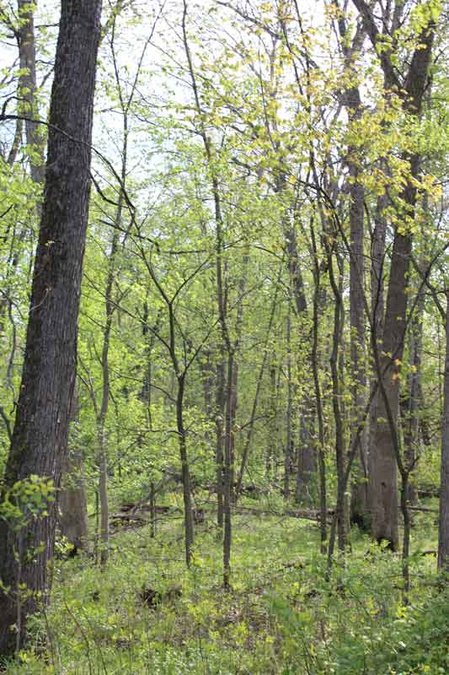
DARLINGTON — Forests cover nearly 50% of the state’s total land area, with the majority of the woodlands being privately owned. Whether public, private, or corporate owned, the majority of forests in Wisconsin are a variety of species that stem from two groups of trees: Hardwoods (walnut, oak, maple and basswood) and Conifers (pine, fir, and spruce). Forests in the state help to support the local economy, water resources, and biodiversity of natural land. With weather more favorable, and trees beginning to bud, now is when most landowners begin to take a step outdoors to assess the health of their woodlands and private hunting areas.
Ross DeWitt is the Senior Forester for Lafayette and Iowa counties. He is part of the Dodgeville team that consists of one team leader, and 7 foresters who look forward to assisting the public, especially in identifying invasive plant species, or if any questions arise.
“Our forests, prairies, grasslands, and lowlands are often invaded by invasive plant and insect species causing deterioration of all of our ecosystems,” shares DeWitt. “Invasive plants consist of Common buckthorn, Bush honeysuckle, Autumn olive, Multiflora rose, Japanese barberry, and garlic mustard. All these invasive plant species crowd out native shrubs, trees, and forbs and are very costly to control. Invasive insect species consist of emerald ash borer (EAB) killing all our ash trees, two-lined chestnut borer which tends to kill large stressed trees, spongy moth which often defoliates and stresses a number of different trees but really hits white oak species hard, and the picnic beetle which assists in the transmission of oak wilt.”
Maintaining good forestry management, on both, public and private land is something that DeWitt says he can’t stress enough.
“High grading, which is the process of taking out the best trees within your woodlands can be detrimental,” he shares. “A good example of this would be taking out all of your really nice Black walnut trees, and then leaving nothing but Boxelder, or Elm left in your woods. This happens a lot when we aren’t educated on what is in the woods, and aren’t familiar with the proper ways of managing our forests.”
Forestry concerns remain in Southwest Wisconsin are consistent with both private and public lands. There are many ways to help forested areas remain healthy from invasive bugs and plants, with some methods much easier than others.
“The simple answer would be to plant native trees, and plants in your woodlands and control these factors,” DeWitt says. “We offer cost share to control invasive plants in what is called the Wisconsin Forest Landowner Grant Program (50% cost share), and our federal partners offer other cost share programs called the Environmental Quality Incentive Program (EQIP). These cost share programs help landowners who have management plans for their woodlands offset costs of killing invasives.”
DeWitt says there isn’t a cost for DNR forester walkthroughs, which he enjoys taking the time to do. He also helps with some tree plantings, and non-commercial tree marking at a smaller scale, with no costs to the landowner.
“The best way to prevent ‘high grades’ is to contact your local DNR forester to request information on your woodland (10 acres or more required), or contact a private forestry consultant for more information,” he says. “Obtaining a forest management plan is the best thing you can do for your forest if it isn’t pastured, and if it is over 10 acres. To contact a forester for recommendations, and questions when dealing with your private property, or if you have questions on state properties. We’re here to help the general public with any questions they may have. I specifically would love to see all landowners obtaining forest management plans, killing invasive species, and planting trees but we all want to make sure we are doing it the right way.”
DeWitt and his team are constantly working to conduct management on some scale, who work along with the Wisconsin DNR and federal partners for public lands in the state.
“Whether it’s harvesting trees, planting trees, or simply just treating invasives, we have a lot of really great people who work for the Department of Natural Resources,” DeWitt shares.
Accidents and mishaps remain a concern for those who insist on doing things for themselves.
“On public lands all contractors must have workman’s compensation, health insurance, pesticide certifications,” shares DeWitt. “On private lands we try our best to educate on safety all across the board. Chainsaw safety, ATV safety, and pesticide safety is critical for all. The DNR offers chainsaw safety training, DATCP offers pesticide certification, and if you are involved with any prescribed burning there’s a lot of training in that realm as well.”
Sometimes it is necessary for a landowner to conduct a harvest of their property, for one reason or another. DeWitt shares a number of things to consider when conducting a harvest.
“First we want to make sure what we are doing is improving the forest, and not hurting it,” he says. “We consider invasive species whether they’re present or not, what is in the understory such as seedlings and saplings, and what is in the overstory. If we have to plant, treat invasives, or cut non-commercial trees prior or post-harvest on state lands we utilize the forest regeneration fund. This fund allows us to hire contractors to forestry mow, plant trees, cut non-commercial, as well as treat via. Herbicide. The ultimate goal is to grow our next forest to be better than it was previously.”
Ross DeWitt is more than just a local forester, he grew up in Stoughton being familiar with the southern part of the state. It was his passion for plant identification, his love for the great outdoors, and the sharp eye of his fiance who assisted him in finding his career with the Wisconsin DNR, doing something that he thoroughly enjoys.
“I specifically chose to go into Forestry because of my interest in plant identification, and my love of all trees, shrubs, and plant species throughout the state,” he says. “I decided on natural resources due to my interest in being outdoors. I grew up and am familiar with going hunting, fishing, hiking, and camping throughout the entire state. I was qualified through my knowledge of plant identification, silviculture, and summer experience in the forest management world.”
Ross DeWitt attended Vermillion Community College, in Ely, Minnesota, then transferred to UW-Stevens Point, graduating with an Urban Forestry Degree. His extensive knowledge and years of experience, along with a wealth of enthusiasm, has earned DeWitt the respect from the communities in which he serves.
Making plans to enjoy the outdoors is something that DeWitt encourages others to participate in, whether it be on private land, public land, or at a state park.
“Enjoy the great outdoors,” he says. “Public lands are a gift, and should never be taken advantage of. Be a good steward, join clubs, and become educated in conservation in your area. Please remember to leave no trace, and enjoy each moment and lasting memory.”