Across 75 ballot questions from the spring general elections, unofficial election results show that Wisconsin voters approved 46 school district referenda. These ballot initiatives ask voters to raise their own property taxes to pay for day-to-day school district operations – on either a temporary or permanent basis – or to issue debt used to finance building and renovation projects.
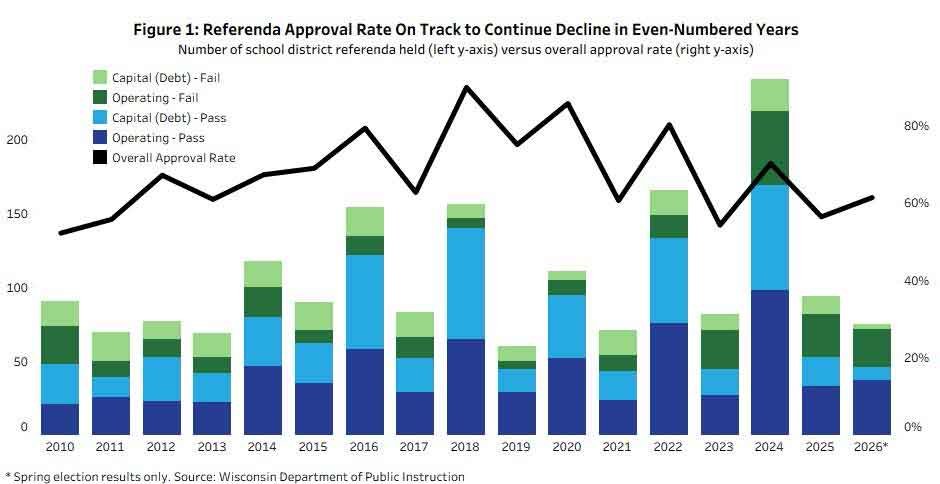
This 61.3% approval rate is not a final figure for 2026, since fall elections have yet to take place. If the rate were to hold through the fall elections, it would be a substantial decrease from the 70.1% approval rate in 2024. It would also be the lowest approval rate of any even-numbered year since 2010, when voters approved 52.7% of referenda (see Figure 1). Among spring elections only, it is the second-lowest approval rate in an even-numbered year since 2010’s 55.0%, coming in a tick above 2024’s 60.2%. Approval rates tend to be higher in even-numbered years, when midterm and presidential elections are on the ballot.
In this brief, we update our analysis of previous referendum election results and take stock of some impacts for school districts and the K-12 funding system at large. We find a system that may no longer be fulfilling some policy goals, as frequent use of referenda contribute to growing disparities in district funding.
Voters approve most referenda amid waning support
If fall election results align with this April’s, they would continue the general trend of weakened approval rates for both election-year and off-year referenda since their peak in 2018 and 2019. The spring results are all the more striking given the decisive State Supreme Court victory for the liberal-backed Judge Chris Taylor, since one might have expected left-leaning voters to support school referenda as well. Instead, the referendum results correspond to polling from the Marquette University Law School. In
February 2026, only 40% of those surveyed favored “increasing spending on public schools” over “reducing property taxes,” the lowest share since the question was first asked in 2013. Additionally, only 43% said that they were inclined to vote for a school referendum, with 57% against. These sentiments may have been partly tied to December 2025 property tax bills showing large jumps in K-12 levies.
Despite these warning signs, voters approved 14 of the 21 referenda with a dollar amount of $10 million or more, including a $147.0 million facilities request and $39.0 million operating request from Howard-Suamico School District. Other successful large operating referenda included those for the Appleton Area School District ($60.0 million), Watertown Unified School District ($22.5 million), and Wisconsin Rapids Public Schools ($19.0 million). Fond du Lac, Whitefish Bay, Baraboo, and Sauk Prairie were among the districts in which voters rejected larger referenda this spring. Unofficial tallies show some very close votes, including in Butternut and Shell Lake, where referenda passed by one and two votes, respectively.
In total, $541.9 million in new funds for school districts were approved – slightly more than the $534.2 million in spring 2024 – including $208.7 million for capital projects and $333.2 million for operations. School districts continued to rely on non-recurring referenda for the bulk of their operations spending requests, as voters approved only five recurring (that is, permanent) referenda totaling $3.8 million. A surprising 84.0% of spring referenda funded operations rather than capital projects, likely reflecting cost pressures and revenue constraints on school districts (discussed more in the following section). If it stands through the fall elections, this would be the highest percentage of referenda of this type by far since 1990.
Rural school districts make up 56.1% of Wisconsin’s 421 school districts, but accounted for 61.3% of referendum attempts this spring (46 of 75). Thirty-two of those referenda were successful (69.6%), on par with the 70% passage rate for rural districts in 2024. The success rates for other district types included one of two referenda in cities (50.0%) and seven of nine in suburbs (77.8%), but just six of 18 in towns (33.3%).
Disparities Grow Among Districts with Higher and Lower Revenue Limits
These referenda take place against a backdrop of gradually increasing disparities in the amount of funding that school districts are allowed to raise per child from their two largest revenue sources: local property taxes and state general school aid. The largest general school aid program is equalization funding, which is intended to compensate for variations in local property tax bases.
These caps on the combined amount of property taxes and state school aids, known as revenue limits, were originally set in 1993 and based on each district’s spending level at the time. In each state budget, lawmakers and the governor determine by how much the revenue limit will change, on a per pupil basis, for all districts.
In 2009, lawmakers and Gov. Jim Doyle decoupled per pupil revenue limits from inflation, meaning that they would no longer rise automatically each year. Since then, revenue limit adjustments have ranged from a 5.5% decrease in 2011-12 to the recent $325 per pupil increases first enacted for 2023-24, and have not kept pace with inflation.
Referenda constitute the other major factor affecting districts’ per pupil revenue limits. When voters approve an operating referendum, what they actually approve is an increase to a district’s revenue limit. If districts around the state go to referendum or get referenda approved at notably distinct rates, they will by definition have materially different amounts of money available to spend per pupil (although not every district chooses to levy up to its full allowable amount each year).
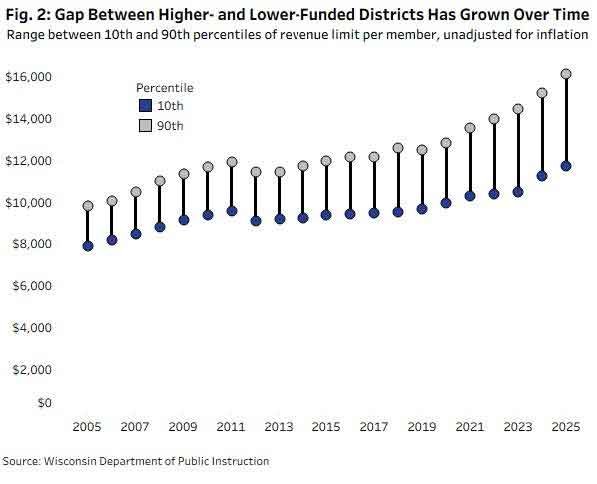
To gauge the size of these differences over time, the Forum measured the gap between the districts with the largest and smallest per pupil revenue limits. To avoid outliers, we used percentiles, comparing districts at the 10th percentile (meaning 10% of all Wisconsin school district revenue limits are below these districts’) to districts at the 90th percentile (that is, 90% of all Wisconsin revenue limits are below these districts’).
We found the gap has grown over the last twenty years (see Figure 2). In 2005, districts at the 90th percentile had a per pupil revenue limit that was 24.6% ($1,932) higher than their counterparts at the 10th percentile. By 2025, however, that difference had increased to 37.6% ($4,402). The widening gap occurred despite the Legislature taking certain steps to raise caps for the districts with the lowest revenue limits.
Some amount of variation between districts’ revenue limits is expected and appropriate. Costs of living, for example, are not the same across the state and affect district expenditures. Different student populations also require different levels of resources, with higher costs typically associated with educating students from low-income households, students whose first language is not English, and students with disabilities. Even if some difference between district funding is reasonable, however, the growing disparity in revenue limits may make it difficult or even prevent schools from delivering a similar level of education.
In addition, a brief examination suggests neither student need nor cost of living explain all of these differences. For example, Elcho School District and Prentice School District are both small districts in north central Wisconsin that serve more than 40% economically disadvantaged students. Despite their similarities, Elcho’s revenue limit of $16,416 per pupil in 2025 placed it above the 90th percentile of revenue limits, while Prentice’s revenue limit of $11,572 per pupil placed it below the 10th percentile. Mercer School District and Butternut School District form a similar pair in northern Wisconsin. Despite their similarly sized and situated student populations, Mercer’s per pupil revenue limit of $21,449 is above the 90th percentile, while Butternut’s limit of $11,588 is below the 10th percentile.
The Forum has previously found that the increasing number of referenda sought by districts is due to a combination of factors: state-set revenue limit increases that have not kept pace with inflation; a tight labor market and especially high inflation after the pandemic, which drove costs up further; the expiration of federal pandemic relief aid; and declining student enrollment, which decreases the total revenue districts receive under the caps. As districts responded by using referenda to authorize operating revenue increases, we and others noted the risk that greater disparities would emerge between districts with voters willing to pass referenda and those without. This latest analysis validates these concerns.
Municipal levy referenda
In addition to school districts, eight municipalities and Marinette County went to voters this spring to raise property taxes to increase their operating budgets. Only three of these nine referenda were successful, including a $1.4 million referendum in the city of Wausau that passed by just 89 votes. A $3.9 million referendum in Sun Prairie failed, as did two other referenda worth more than $1 million.
Municipalities and counties often tie referenda to exceed state property tax limits to priorities such as public safety and emergency medical services, which tend to be more popular with voters and account for large shares of local budgets. However, voters again appeared less likely to approve municipal referenda compared to those for K-12 education. Only one referendum (Wausau) explicitly tied to public safety succeeded, along with referenda focused on park services (Nelsonville) and library services (South Milwaukee).
Although it did not increase the city’s levy limit, we also note here that voters in the city of Port Washington passed a referendum requiring voter approval of any tax increment finance district valued at over $10 million. The referendum was proposed following intense public debate over the approval of a tax increment district for a new data center, although the new ordinance would not apply to that district. If it survives an ongoing legal challenge, the ordinance will require developers of these large projects to wait for a general or special election to receive voter approval, potentially lengthening a development and permitting process that can already last over a year in some Milwaukee suburbs.
Conclusion
For the 17th straight year, pending the results of the fall election, Wisconsin voters are on track to approve the majority of school district referenda sought. However, the large share of operating referenda on ballots coupled with lower approval rates and a widening gap between school districts with higher and lower revenue limits suggest that the current system is not always meeting the needs of students, local taxpayers, and school districts across the state.
The question may eventually be decided in court. In February 2026, a group of school districts, parents, and advocacy organizations sued the Wisconsin Legislature, alleging that it has systematically underfunded K-12 school districts and violated the state constitution in the process. The Wisconsin Supreme Court last found the school aid funding system to be constitutional in 2000.
In the meantime, Gov. Tony Evers and legislative leaders continue to negotiate over the potential use of the state’s large general fund balance to provide school funding and property tax relief. Simultaneously, districts with failed referenda face the consequences of the April 7 election.
While some districts will be able to keep their current operations mostly intact, others may need to take more drastic steps. The Dodgeville School District, for example, failed to pass an operating referendum for three elections in a row and now must consider freezing staff salaries and doing “the bare minimum” to address the needs of its facilities. Hustisford School District unsuccessfully sought referendum approval each April for the past four years, most recently hoping to raise funds simply to plan for consolidation with another district. With the latest failure, the district now faces immediate dissolution, potentially shutting down all of its schools and dividing up its students, funds, and territory between other districts.
Given the state’s shrinking student population, districts are likely to face some painful decisions in the coming years regardless of state policies. However, state policy around both aid and revenue limits as well as the outcome of local referenda and even court decisions will also make a big difference in the outcomes for students and those who pay for their education. We hope this information proves useful to those making these momentous decisions.
— The Wisconsin Policy Forum is the state’s leading source of nonpartisan, independent research on state and local public policy. As a nonprofit, our research is supported by members including hundreds of corporations, nonprofits, local governments, school districts, and individuals. Visit wispolicyforum.org to learn more.