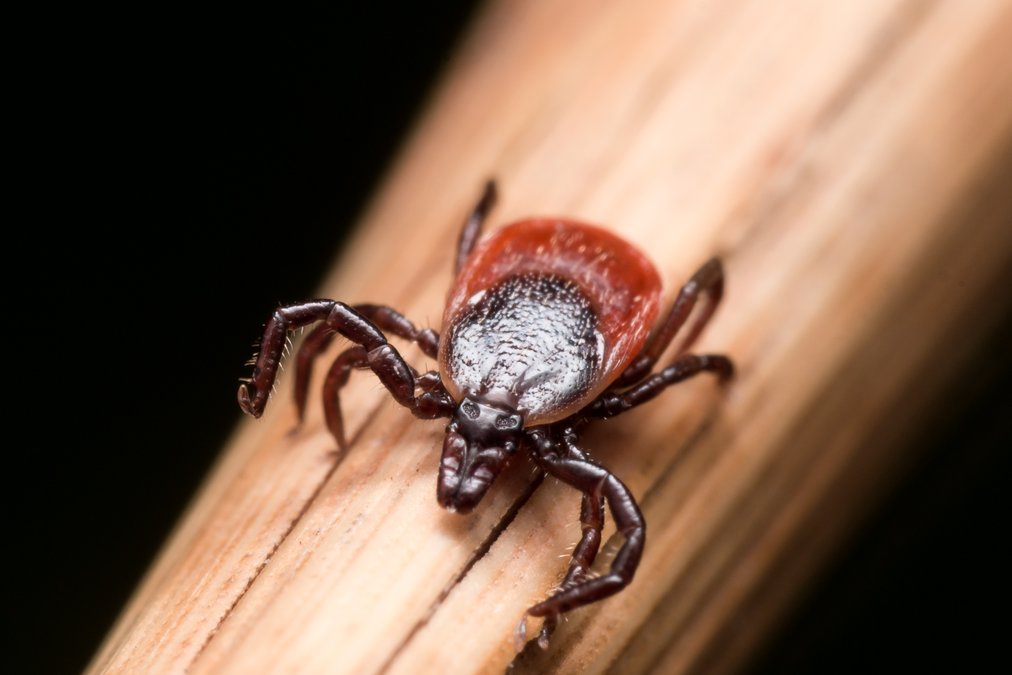
It’s not just you. It’s already a bad year for ticks.
The “Wisconsin tick bite tracker,” maintained by the state’s Department of Health Services (DHS), is currently at the highest springtime level it’s reached in the past five years.
Or take it from “The Wisconsin Bug Guy,” aka PJ Liesch, an entomologist at the UW Extension Service.
“I have gotten quite a few similar reports that folks are seeing a lot of tick activity, and I’ve also had quite a few samples come into the insect lab,” he said in an interview. “There are a number of indicators that this might be an active season.”
The good news? The increase is in wood ticks (or the American Dog Tick), not disease carrying deer ticks. (This reporter currently has four wood tick bites obtained during a 10-day period.) The DHS conducts hand counts of deer ticks in various locations, and those populations appear to be stable.
So what’s going on? Nobody really knows.
“The tick situation is rather interesting,” explained Liesch. “A number of our key tick species take two years to complete, so if there is, for example, a weather event that is beneficial to them, we don’t necessarily see that right away, but changing climate and increased precipitation could be playing a role.”
Wood ticks almost never carry disease in Wisconsin, according to Rebecca Osborn, Vectorborne Disease Epidemiologist at the DHS.
“We would consider it a very low risk,” she said. “That’s not the case in other states though. If somebody’s traveling to the southern states, they see more wood-tick associated illnesses.”
The opposite is true of the deer tick. Up here, grown men cower in their boots (and tuck their pants into their socks) at the thought of Lyme disease. Down south, not so much.
“That tick is present in a lot of the southeastern states as well,” Liesch said, “but it doesn’t really spread Lyme disease or other pathogens.”
She said there are a couple of hypotheses as to why. One is that southern deer ticks might be a subspecies that doesn’t bite as much as our deer ticks. Another theory is that lizards can claim credit for disarming the bugs.
“Certain reptile species can have antimicrobial enzymes in their blood, and if a tick bites them, they can kill the pathogens in the tick itself.”
What is known for certain is that all tick populations are spreading. And in fact, this increase in range might be one cause for the parallel spike in reported tick bites.
“We’ve seen this over the last several decades,” Osborn said. “We’ve seen the deer tick expand from only in the northwestern part of the state to really being everywhere in Wisconsin. You can find deer ticks in every county now. We see more deer ticks in the northwest and fewer in the southeast, but they have expanded southward in Wisconsin.”
As a result, more of the population is exposed to the possibility of a tick bite, explained Liesch.
“Historically you’d think of deer ticks as something a hunter or fisherman might see out in the woods,” he said. “Today, we might see it in a yard situation. It’s an emerging system. It’s still shifting.”
Wisconsin ticks aren’t the only species on the move, according to Osborn. One she’s keeping an eye on is the lone-star tick, which is creeping and biting its way north toward Wisconsin. A bite from a lone star can trigger the victim to develop an allergy to red meat.
How to prevent
If tucking your pants into your socks feels too cringe, there are more fashion-forward methods keeping the crawlies off.
A growing number of sprays, including traditional DEET, are available. Picaridin is a new contender that’s odorless and less greasy. And natural sprays made from oil of lemon eucalyptus are proven to deter ticks as well. According to Osborn, we’re getting closer to the day when, like our dogs, we can pop a chewable to kill ticks on contact.
In the meantime, Liesch emphasized the importance of checking your body for ticks. It takes a whole 36 hours for a deer tick to infect its host, he explained, so if you catch it early, you can reduce your risk of catching Lyme disease.
The Wisconsin Bug Guy knows this firsthand from a morel mushroom hunt he took in an area he knew was infested with deer ticks. He checked himself afterward and found none.
“I went to the gym and hopped in the shower again — and found a tick,” he said. “I knew for a fact that it could only have been on me for 15 minutes, so I didn’t worry about it.”
The DHS website contains extensive information about ticks, including how to identify them and prevent bites. You can even send a snap to their tick identification service and they’ll tell you what kind it is. Find these resources by searching ticks on the dhs.wisconsin.gov website.