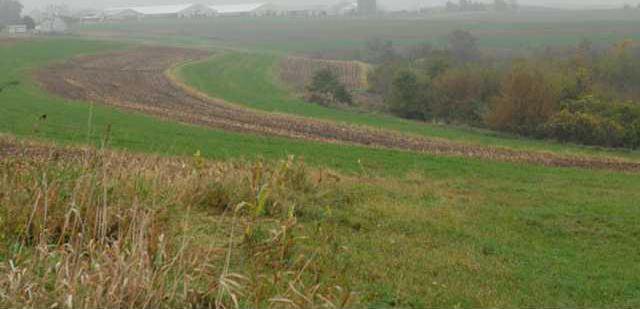

MONROE — Following a growing season marked by an extended heat spell and rainless stretches, the region’s corn and soybean crop should come in with average yields in the weeks ahead, according to area and state agriculture experts.
“Average is what I would expect in most places in the counties I cover,” said UW Extension’s Jordyn Sattler, an ag crops and soils educator in the agency that includes Green and Lafayette Counties. “Average isn’t the worst thing, but we had a few recent years with exceptional yields, it might seem like a drop.”
A prolonged mid-summer dry spell and pockets of severe drought — particularly in northern and northwestern counties — stunted yield potential during critical reproductive stages, experts say, acknowledging that it’s too early to make firm predictions. Moreover, the drought phenomenon was largely limited to the norther tier of the state, and recent August and September rain events have helped finish out the crops.
Meanwhile, lately it’s the opposite problem as heavy weekend storms are temporarily delaying early field work in most counties.
“Yes, it will be tough to work the fields in this,” said Stettler, who said she also spent her share of time in muddy fields recently, on UW Extension research projects.
State harvest forecasts were published in August as the USDA 2026 Crop Production Report detailed its forecast for the Wisconsin corn harvest. According to the report, Wisconsin farmers are expected to harvest 570.4 million bushels of corn across 3.1 million acres.
In 2025, 605.36 million bushels of the crop were produced across 3.22 million acres, the USDA said. As far as maturity, statewide, corn is roughly 73% dented as of late last month and soybeans are maturing rapidly, ag watchers estimate. As is always the caveat around statistics and even the most accurate yield estimates, the numbers can vary from county to county — even from farm to farm — in some cases.
In Green and Lafayette counties, early-season planted crops have fared the best, using early summer moisture to lock in decent pod sets and ear development. However, later-planted variations — especially on higher knolls and lighter soils — sustained heat and moisture stress in late July and August, resulting in some tip back and lighter test weights.
Rust has been noted in some areas but not a widespread problem across both Green and Lafayette Counties; and that goes for other yield-reducing diseases and pests, according to Sattler.
As for soybeans, plants are turning quickly, with 49% dropping leaves, according to the USDA, which is running ahead of the historical five-year average pace. Full grain combining is expected to pick up heavily over the next few weeks as fields dry out, the agency said.
The high price of diesel — and ever increasing prices on everything — have farmers concerned about the future, but she said it’s likely most of them will avoid the worst of those cost impacts this year due to contracts likely signed way before the Strait of Hormuz was shut down amid the US-Iran war.
“I’d be surprised if anyone didn’t already have the (diesel fuel) already contracted out at a much better price,” she said.
Other highlights of the 2026 corn/soybean grain season thus far, according to the USDA, UW Extension; and other ag sources:
● About 26% of the corn crop had matured. Silage harvest reached 32%, above the 21% average. Corn rated good to excellent fell one point to 61%.
● Due to pockets of low subsoil moisture, corn silage cutting started early. Producers have been averaging well over 5 days suitable for fieldwork per week, allowing grain and soybean harvest to begin accelerating smoothly across the state
● Late August and mid-September rains provided much-needed moisture to green-up pastures and late-season hay, but agricultural experts note it arrived too late to fundamentally change the 2026 yield potential of the primary row crops.
● Soybeans are dropping leaves this year in the state at 27%, compared with the 20% average, while 59% of the total crop was rated as good to excellent.
● Winter wheat planting reached 17% of Wisconsin fields, nearing the 18% average.