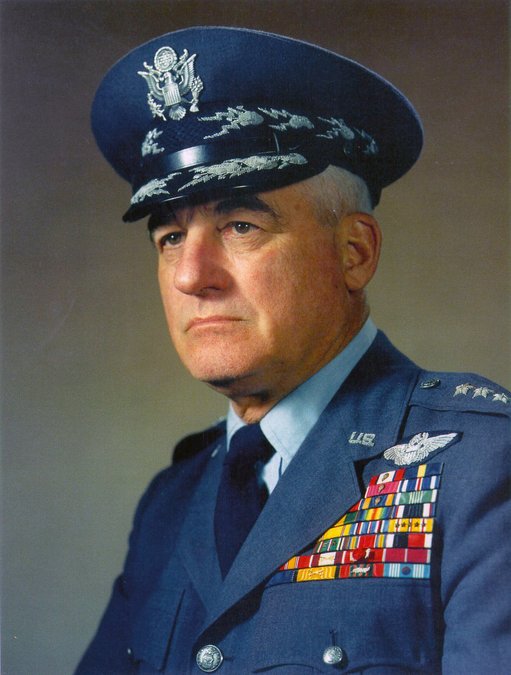
MONROE — In celebration of America turning 250 this year, there are a few fairly well-known figures in American history who were from Wisconsin and should be highlighted: Nathan Twining and Robert La Follette.
General Nathan Twining was born in Monroe and had important achievements throughout his career in the United States military. He was largely responsible for making a strategic air force that was unrivaled, and also played a huge role in leading the air war during World War II against Japan. Quite possibly one of his greatest accomplishments was becoming the Chairman of the Joint Chiefs of Staff.
In 1924, he became a U.S. Army pilot, eventually gaining more experience as a combat unit commander as well as a staff and engineering officer. Then, at the beginning of World War II, he was assigned as the Director of War Organization and Movements in Washington, D.C. Later in 1924, he was sent to the South Pacific, where he commanded all Army, Navy, Marines, and Allied Air Forces there. This joint air command was one of the first in U.S. history.
In June of 1953, Twining was named Chief of Staff of the United States Air Force, and he worked meticulously for the development of aircraft, missiles, and weapons that he and others would use. He was also one of the best qualified and experienced U.S. air commanders at that time for the position, and while he worked in this role, he contributed a lot toward making the Air Force an almost entirely jet combat force that had high atomic-weapons capabilities.
President Eisenhower selected Twining to lead a delegation of technical experts who were invited to Soviet air facilities to inspect them in 1956. This was one of the first visits since World War II that U.S. officers made to the Soviet Union. The President also appointed him a member of the National Advisory Committee for Aeronautics, where Twining stayed until 1957.
In August of 1957, he was named the Chairman of the Joint Chiefs of Staff, becoming the first airman to hold this position. During his time in this role, he helped a lot in developing an interventionist U.S. foreign policy. He eventually chose to retire in September of 1960.
For his various achievements during the war, he was awarded numerous personal decorations from the United States and many other countries. Some include: the Distinguished Service Medal, the Distinguished Flying Cross, the Yugoslav Order of Partisan Star, and the rank of Companion of the Order of the British Empire. In his honor, Twining has a city park in Monroe, Wisconsin, and an elementary school on the Air Force base in Grand Forks, North Dakota, named after him.
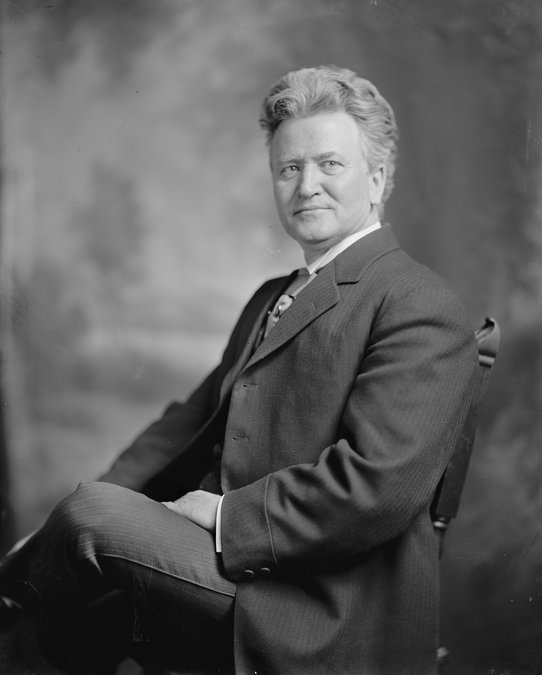
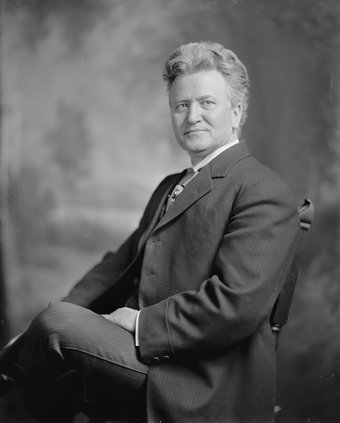
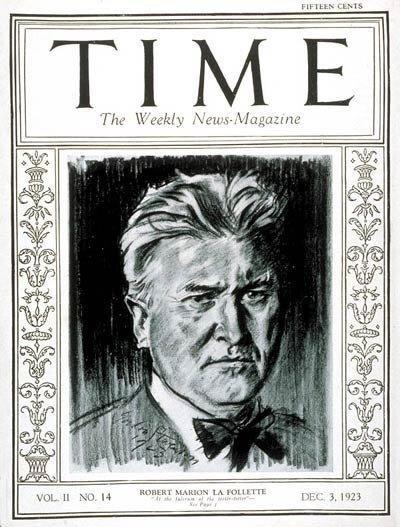
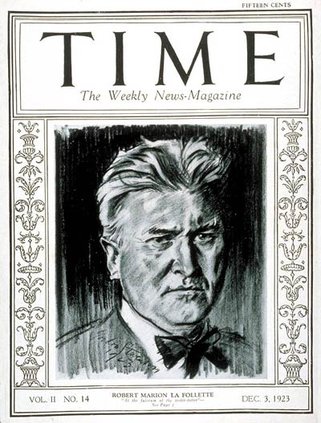
Robert La Follette, Sr., was an American leader of the Progressive Movement and was mainly noted for his support of reform legislation while he served as the governor of Wisconsin from 1901 to 1906 and a U.S. Senator from 1906 to 1925, when he passed away in office. Due to all of this, he earned the nickname “Fighting Bob” from many.
He grew up in somewhat prosperous rural areas, going to college at the University of Wisconsin from 1875 to 1879, becoming a county district attorney in 1880 and continuing that until 1884, and then he became a congressman, all of which helped him develop the personality and style that made him a popular leader among the people. La Follette was an articulate spokesperson for many popular causes, and he honored the citizens’ wishes, even if those ran against some desires of party leaders. His main concerns during his three terms as congressman were: economical government and protection for his district’s farmers.
In 1890, he was defeated for reelection to Congress and returned to Madison, practicing law and developing a political organization, one that in 10 years, would elect him the governor. Throughout his time as a congressman and beyond, he gained a reputation as an enemy of political bosses, especially in 1891 when he revealed that U.S. Senator Philetus Sawyer had offered him a bribe.
La Follette was elected the governor of Wisconsin in 1900, and he was reelected in both 1902 and 1904 before he decided to resign in 1906, and then was elected to the Senate that same year. His election to the Senate was seen as a big deal, given it was widely believed the Senate at that time was a refuge for millionaires. He became famous as a new type of senator: one who wasn’t controlled by “the interests.” During his first three years in the Senate, he had achieved the passage of laws targeted against the freight rates, labor policies, and financing practices of the railroads.
He had led the Republican opposition to the tariff, conservation, and railroad policies of President Taft, which caused him to be widely endorsed for President in 1912. Most of the progressives blacked him given that Theodore Roosevelt, their first choice for President, had declined to run. Later on in 1912, when Roosevelt decided to enter the race, many of those supporting La Follette turned to Roosevelt.
La Follette’s impact did not end there, though. He rose to leadership again in 1917 during the anti-war movement. He had been arguing since 1910 about the United States’ interventions with foreign governments, saying they were done to protect the assets of major U.S. corporations, as well as destroying any revolutions. He felt like the U.S. had entered World War I because many businessmen needed that protection for their assets, and because the President was detached from public opinion. So, when the United States entered the war, La Follette was opposed to the draft, he advocated for the civil liberties of the war’s opponents, and he maintained that the wealthy people and corporations of the U.S. should be the ones to pay for the war that benefited them most of all. Many groups and people who were pro-war insisted that he be expelled from the Senate for treason, though the investigating committee absolved him.
Given that he was a martyr for the panic the war caused, he became a beloved hero to millions of Americans. Adding to that, La Follette believed that World War I had given large corporations near-total control over the federal government and focused on exposing the most egregious corruption of the postwar years. His most substantial contribution was his significant role in publicizing the oil scandals of U.S. President Harding’s administration.
After La Follette passed in 1925, the Kennedy committee, which was led by John F. Kennedy, named La Follette as one of the “Famous Five” in 1957. The “Famous Five” was a short list to honor five of the “most outstanding” former members of the Senate. He was put on this list because the committee felt he was a “ceaseless battler for the underprivileged” as well as being bravely independent, since he always stuck to his progressive reform goals no matter what.
Something else to honor those that impacted American history are the many places around Green County that have memorials for those who fought in wars or otherwise served the country, as well as monuments or other pieces of history.
The Veterans Memorial Park at N3252 County Highway N in Monroe, which is within Pleasant View Park, has a memorial called The Hall of Honor to those in the Green County area who served in any war throughout American history or even during peacetime. There are also bricks purchased by families of those who served and have passed, as well as an old war helicopter and tank. Along with that, near the edge of the Community Park just off Highway 69 near downtown Monticello there is a Monticello Area Veterans Memorial. There is a stone monument in dedication to all the Monticello Area men who lost their lives fighting in American Wars throughout history, and to honor the sacrifices they made.
There is also, of course, Twining Park at 425 14th Avenue in Monroe, which has an old F-86D Saber Jet to honor General Nathan Twining as he believed it to be the best fighter jet in the Air Force. The memorialization of the park, and Twining himself, took place 66 years ago this July 4, where General Nathan Twining was in attendance. This park is also the location of many 4th of July celebratory events, including the fireworks display. Greenwood Cemetery holds the Memorial Day Service every year at the site of a small Soldier’s Monument, reminding us of those who have served our country.
You can find a few other monuments and objects from history as well just around the town of Monroe. On the Square next to the Courthouse, is a Civil War Soldiers and Sailors Monument. This monument was built to commemorate and honor the “patriotism and valor” of both the soldiers and sailors who fought in the Civil War. There is even a piece of the World Trade Center South Tower from the events of 9/11 that was given to the Monroe Fire Department to recognize “the service of the emergency responders who protected the Monroe Community.” It is located on 18th Avenue next to the Monroe Fire Department building in town.