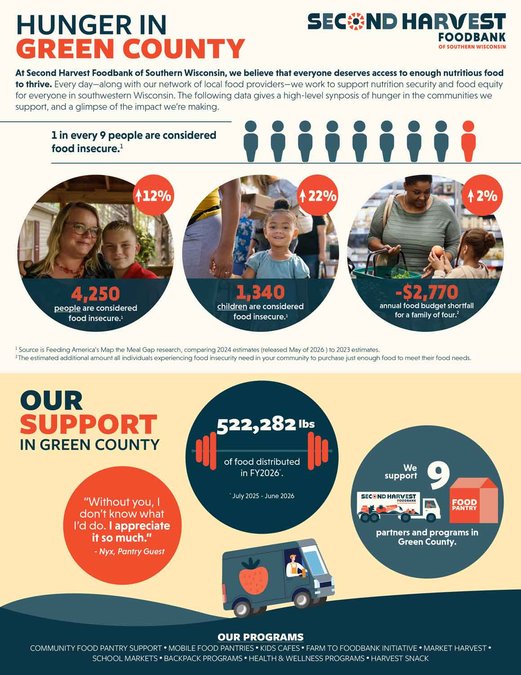
MONROE — Green County Human Services was the host site for a localized food insecurity summit hosted by Second Harvest Foodbank on Aug. 6. Community representatives and leaders met for the roundtable to discuss the challenges facing 1 in 9 people in the county, and what actions could be taken to help mitigate the problem.
Ceri Jenkins of Second Harvest opened the summit, which was attended by about two dozen people including District 17 candidates Corrine Hendrickson and Jenna Jacobson, simplifying the difference between a foodbank and a food pantry.
“The foodbank is like a Walmart distribution center, and then the food pantry as the retail outlets,” said Michael Keller, community relations manager at Second Harvest.
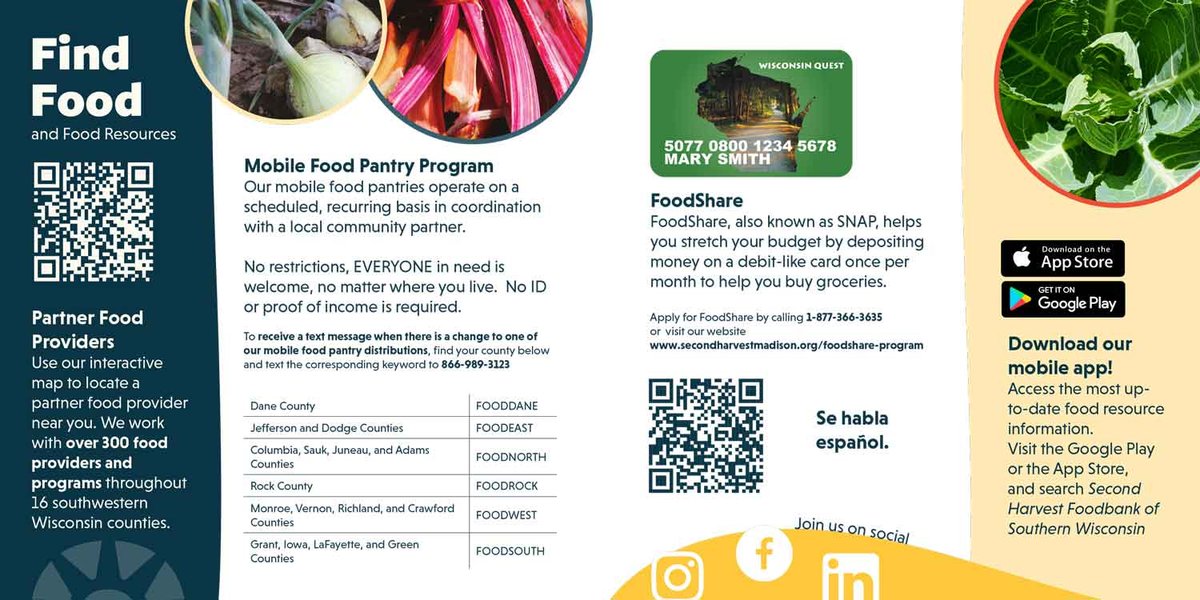
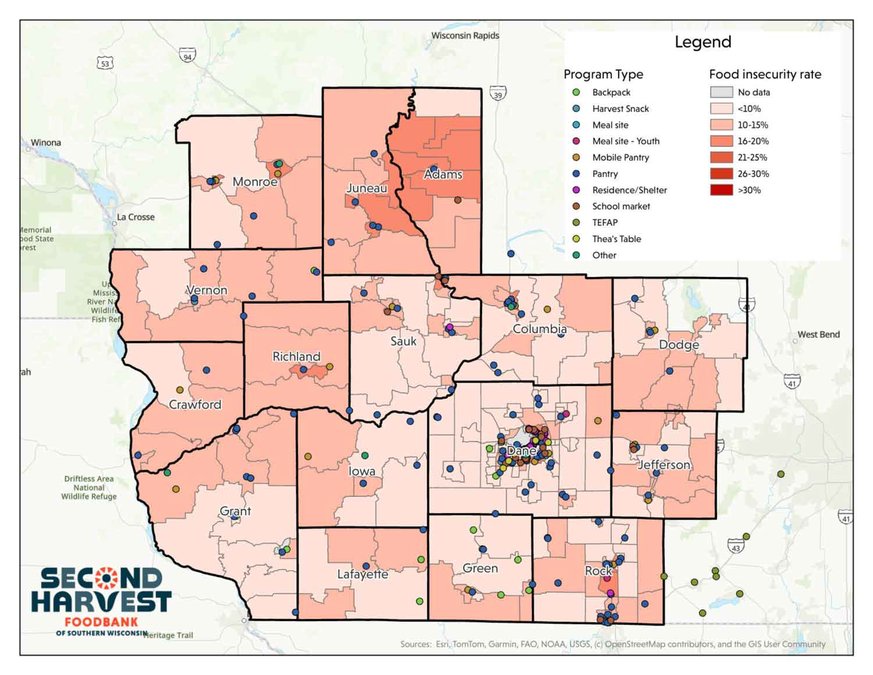
Second Harvest serves 16 counties in southwestern Wisconsin. Green, Lafayette, Iowa and Grant County make up the FoodSouth sector.
“Almost all of our food goes out into the community through our partners, and so we have a team that works closely with those partners, developing community impact, thinking about other ways that we can support our partners, and the kinds of partners we have,” Jenkins said. “So what you might think of as a traditional panty, we have schools, churches … a mobile handling program.”
There are currently 24 locations for mobile pantries and popups, which are all run by volunteers.
The biggest issue she and those at Second Harvest have noticed is simply the stigma that comes with those that need the help.
“Really a core driver of our work is the concept of dignity, and also what is needed,” but she said, there is still a stigma attached to those that receive the assistance.
The stigma can range from those who are in need feeling embarrassed to receive the help, to intimidating passersby taking stock of what cars are in line at the pantry.
According to Feeding America’s Map the Meal Gap research, released in May 2026, there are 4,250 people in Green County that are considered food insecure — this includes 1,340 children. The average family of four has a food budget shortfall of -$2,770 per year.
Among the area solutions are the successful Backpack Buddies programs utilized by many area schools. Traci Lincoln, Juda Schools District Secretary, discussed the Caring For Kids, Inc. 501(c)(3) organization program from her perspective at Juda schools.
Jeannie Blumer is the volunteer coordinator for Caring For Kids in Green County, which started with five schools in 2018 with weekend food programs. Today, the program helps students in the Juda, Brodhead, Albany, New Glarus, Black Hawk and Pecatonica districts.
Monroe has a similar, though separate Backpack Buddies program. Blumer said the program she leads has just one requirement: Be a student in the district. After that, there are no questions asked. If a student needs food at home, it gets sent home in their backpack. Lincoln said sometimes students come into the office hungry outside of lunchtime, and staff simply give them something quick to eat and then send them back to class.
“Every year the program is growing,” Blumer said. In 2025, 92,000 snacks were sent home through the local Backpack Buddies program. “I think that the beauty of our program is they each run a little differently at each of the schools, and they are small schools — they know their people.
“It’s serving kids, and obviously kids deserve and need to have nutritious foods. There is such a disconnect between free and reduced meals and what it really costs to live in Green County and Lafayette County. And that’s big, it’s not just a few hundred dollars. It’s thousands of dollars. A lot of us think that free or reduced meals are going to take care of the need for these kids that are low income. It does for some, but there’s a big gap where it doesn’t, and I would urge our local officials to urge the federal officials that they need to look at how those federal poverty limits get set and compare it.”
Blumer said there are 72 volunteers that operate in the seven school districts they serve. Their budget for this year is $75,000. She added that the program can easily be duplicated elsewhere.
“I do know a lot of folks that are really, really struggling right now. They need food, and they don’t need shame,” Blumer said. “I’ve had people walk up to me and say, ‘Why are we enabling these parents?’ And they were serious. And I said, ‘Well, I am not asking for their donation, but this is what we’re doing, and we’re going to keep doing it because it’s the right thing to do.’”
Blumer was once a single parent, and said she sympathizes with struggling parents in today’s financial climate.
“There’s probably nothing harder to do, as a parent, than to ask for food for your child,” Blumer said. “A lot of these people need the extra help. Food prices haven’t come down, and a lot of our schools are in what we call a food desert, meaning their options of nutritious foods are limited — they have to travel to get to a supermarket that has a variety of nutritious foods.”
Monroe Mayor Tom Miller has long worked with the Farmer’s Market on the square, and several years ago came up with a program to utilize SNAP benefits — basically doubling the dollars SNAP users could spend — but the program has been under-utilized.
Bob Wiegel of UW-Dept of Extension for Green and Lafayette counties said he’s heard a lot in the past year about the stigma facing people with food insecurities.
“People watch others go in and out of the food pantry. There are people in our community that think it is right to belittle people,” Wiegel said. He said his office doesn’t get a lot of inquiries from people that need help that UW-Extension could help, and that means his office has to reach out.
“It’s just a generational attitude. It’s societal. People in society need to change,” said Laura Moon of Second Harvest in reference to the negative stigmas. She said families have oftentimes come in to pick up for other families in need. “Sixty percent of people picking up are doing it for other families.”
She added that the Caring for Kids program is great, because the kids are happy just to have the food. “And it’s lessening the stigma,” she said.
Jackie Anderson, executive director of Feeding Wisconsin, said the stigma is such a big piece to overcome. “People are working and they still can’t make ends meet. Rent is up, costs are up. It’s very different now than it was 10-15 years ago,” she said.
Ellie Lombardo, Health Educator for Green County Public Health said that her department has seen a decline in the amount of SNAP and WIC dollars coming in from the state level, and that adds to the burden for families.
Melissa Burch of Bountiful Hope, a nonprofit farm that donates its produce to area food pantries, said there is often confusion on what information food pantries require. “For families, it’s overwhelming, and you’re already overwhelmed.”
Jenkins said that private pantries, like Ruby’s Pantry, can ask for more personal information if they so choose. Second Harvest, however, only asks how many people there are in the household so it can divide up the foods accordingly.
The discussion was just one of many taking place with Second Harvest across its coverage area. Earlier in the week, representatives met with leaders in the Boscobel area for a roundtable of their own. The conversation around food insecurity, and ways to lessen the stigmas surrounding it, are expected to continue well into the future.Overcoming the food insecurity stigma