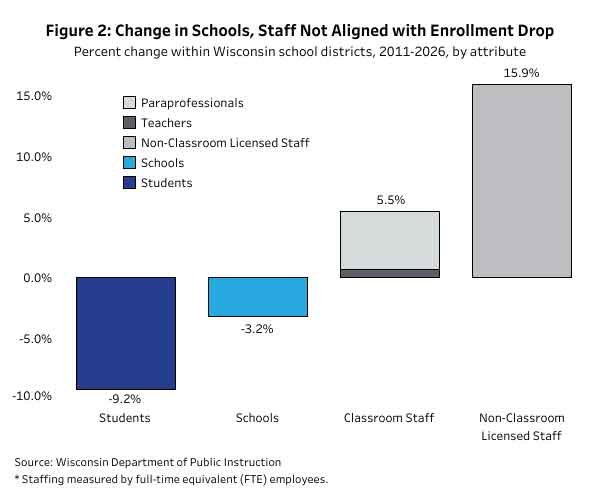
The number of students in Wisconsin’s public elementary and secondary schools declined by 9.2% over the past 16 years, even as the number of public schools decreased by 3.2%, and staff employed in public schools increased 7.0%.
Data for this report come from the Wisconsin Department of Public Instruction, including its enrollment files and the Public All Staff Report.
Enrollment in K-12 schools is important to districts because it directly influences the amount of revenue they receive. While the state’s funding formula includes hold-harmless provisions that can cushion the initial blow for districts losing students, long-term enrollment loss puts substantial pressure on district budgets. Analyzing enrollment alongside staffing and school counts provides insight into the challenges that districts face funding their largest expenditures — personnel and operations — with fewer dollars for fewer students. These challenges compound when the remaining students may have greater needs and when school finances are already strained by lagging state revenue caps.
Analysis of these figures should also take into account the barriers districts confront when attempting to reduce costs. While the decline in students may be incremental, staffing and physical buildings cannot change as easily. Student losses are typically spread across grade levels and buildings, making it difficult to cut teaching positions and shut down entire classrooms or schools. Staffing cuts and school closures are also unpopular and painful for districts and communities, leaving leaders with difficult decisions and tradeoffs.
Reduced number of students
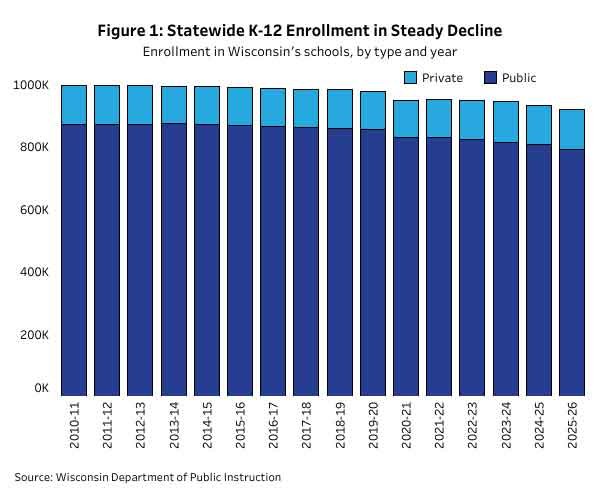
The number of students enrolled in Wisconsin public schools (including charter schools) gradually fell 9.2% over 16 years to 791,794 students in 2026 (see Figure 1). That is a decrease of almost 80,000 students. The primary cause was not students opting out of the public school system; during those same years, the number of students in private schools increased by only 0.9%, or a little over 1,000 students. Instead, the public school enrollment drop is primarily due to fewer children statewide. The overall decline in students aligns with a similar trend shown in the U.S. Census Bureau’s American Community Survey, which estimates a 7.5% decrease in 5- to 19-year-olds in Wisconsin during that same period.
While net migration into Wisconsin fluctuated over the time period examined, the birth rate for Wisconsin has steadily dropped since 2007, according to the state Department of Health Services. That is similar to the national trend and makes declining birth rates a key contributor to the state’s diminishing population of children.
The decline in births naturally affects elementary schools before high schools. The number of elementary school students dropped 15.8% over the past 16 years. The number of students in middle schools and high schools decreased by 8.9% and 7.6%, respectively.
Fewer schools
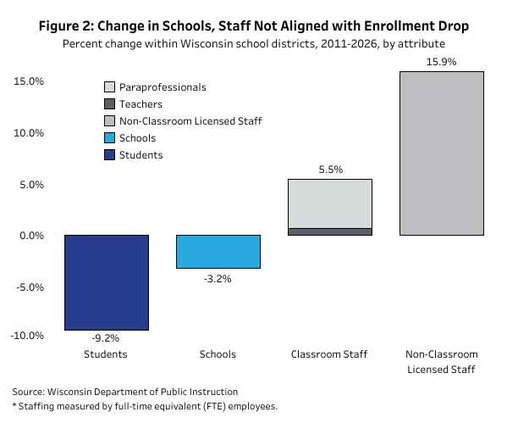
While the number of public school students fell 9.2% from 2011 to 2026, the number of public schools in Wisconsin decreased 3.2%, from 2,202 to 2,132 schools (see Figure 2). This rate includes a 4.1% decrease among traditional (not charter) public schools, which was partially offset by a net increase in the number of charter schools across the state. Schools identified as “multi-district charter,” which are often virtual schools, were not included in this report’s analysis to remove duplicative counts.
The rate at which the number of schools decreased differed by grade configuration. The number of elementary schools decreased by 9.2%, almost three times the statewide rate. Elementary schools make up more than half of the state’s schools. This category includes K-8 schools in addition to K-5 schools and other similar elementary grade configurations. Interviewed district leaders described elementary schools commonly closing as a result of two or more neighborhood schools consolidating into one larger, more geographically central elementary school or a district reconfiguring its grade levels across schools and ultimately eliminating one or more schools.
The number of high schools decreased by 5.8%. The closure of a high school is typically the result of consolidating two or more smaller schools.
Two school types increased from 2011 to 2026. First, the number of standalone middle schools, i.e., those that only serve older elementary students, increased by 6.5%. Such an increase may occur through district grade reorganization — for example, consolidating several K-8 schools into a single K-5 school and a single middle school. Middle schools make up a small proportion of the state’s system, comprising one-sixth of public schools (358 schools). Second, the number of schools that combine elementary and high school students grew 153.1% to 124 schools, many of them charter schools.
The declining number of schools appears to reflect districts’ attempts to adjust their operations and footprint in response to student enrollment. It is perhaps not surprising that the rate of decline in schools is slower than that of students, however, because reducing the fixed costs related to the physical buildings is difficult. A decrease in the student body cannot be addressed by a proportional reduction in operating costs such as utilities and building maintenance until the change is large enough to warrant the closure of an entire school. Not all districts may be able to close a school if their other schools are too far from some students to serve them. Small districts may only have one elementary or high school to begin with.
Compared to public schools, the number of Wisconsin private schools decreased at the faster rate of 8.3%. Private schools may be quicker to close because they can draw upon fewer public resources and typically operate with smaller economies of scale. Many private schools are also affiliated with religious institutions, which have seen declining attendance over time.
Increased staff levels
Although Wisconsin’s schools and students have decreased since 2011, the number of its licensed educators moved in the opposite direction. The number of full-time equivalent (FTE) positions in the public school workforce steadily grew from 2011 to 2026 for a 7.0% increase overall. While we might not have expected staffing to decrease at the same rate as students, due to the previously mentioned difficulties in adjusting staffing, an increase is initially somewhat surprising, especially given the cost of maintaining a growing workforce with shrinking revenues.
When we think of K-12 staff, classroom teachers are often the first to come to mind, as they make up by far the largest category of licensed educators. While their ranks did grow — by 470 FTEs, or 0.8% — much larger growth occurred among support and administrative staff. Paraprofessionals and program aides, the other classroom-based category, increased by 3,363 FTEs (30.7%). A large portion of these positions are held by unlicensed individuals (the only unlicensed positions counted in our analysis). In total, teachers and paraprofessionals in classrooms increased by 5.5%. The collection of all other licensed staff members — including district personnel, principals, counselors, therapists, and other school support — increased by 1,849 FTEs (15.9%). (See Figure 2)
When asked about the increase in school staff and specifically the rise in non-classroom positions, district leaders we interviewed cited the growing needs of students. They listed the additional services that schools increasingly provide around student mental health and well-being so that students are receptive to academic instruction. The Wisconsin Youth Risk Behavior Survey supports their observations, as it has shown several well-being indicators trending negatively. Also rising are the number and share of students diagnosed with disabilities and students for whom English is not their first language. Administrators further referred to students being more academically behind, requiring additional work to remediate and to address a widening skills gap. Overall, district leaders expressed frustration with employing more staff for fewer students, but said they have not found an effective alternative.
Notably, this trend of rising staffing alongside declining enrollment, which others have previously noted, is not limited to Wisconsin. Research by the Edunomics Lab at Georgetown University has shown a similar divergence across many states and in overall national data.
Difference by locale
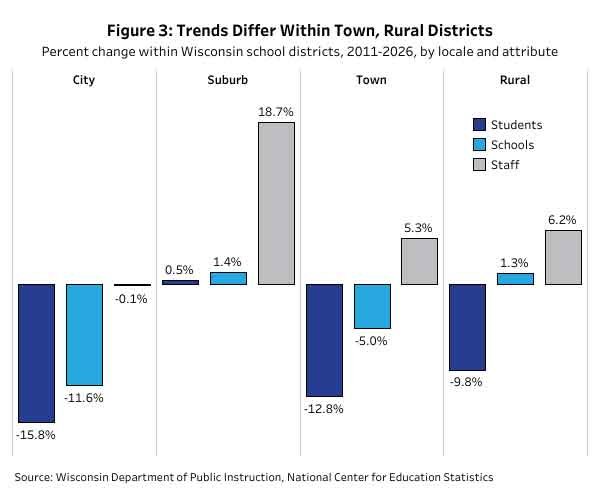
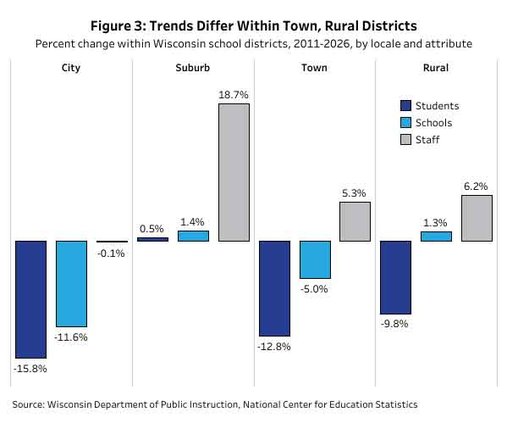
Changes in student enrollment, schools, and staff levels differed by locale, as defined by the National Center for Education Statistics. However, in each case there was a significant and roughly similar gap in percentage points between the change in enrollment and the change in schools and staff (see Figure 3).
City districts decreased on average across all three attributes between 2011 and 2026. These are usually larger districts, which may have more initial room to consolidate schools and eliminate positions without affecting core services. Suburban districts on average did not lose students or schools and invested heavily in new staff, with 18.7% more FTEs employed in 2026 than 2011.
Schools in town districts decreased 5.0%, which matched the direction of but lagged behind their dropping student count (-12.8%). And, instead of decreasing in staff, town districts employed 5.3% more FTEs in 2026 than 2011. This mismatch was also apparent in rural school districts, which experienced a 9.8% decrease in students on average but an increase in both the number of schools and staff, by 1.3% and 6.2% respectively.
District leaders across locales voiced concerns over logistical and practical challenges when attempting to consolidate programs and positions between schools and districts. Town and rural districts face the additional material barrier of greater distances between schools and offices, which can impede collaboration and limit what consolidation is possible without subjecting students to prohibitive transportation times. As smaller entities, town and rural districts also have fewer economies of scale to draw upon, which can constrain their ability to make cuts without affecting the core student experience.
Looking forward
The current decline in student enrollment is likely to continue based on today’s early elementary enrollments. The statewide cohort of seniors who graduated in 2026 across both public and private schools had 72,333 students. The kindergarten class of 2026, which is expected to graduate in 2038, had 17.9% fewer students, or only 59,360 students. If the current kindergarten class is an indicator of future enrollment, the 9.2% drop experienced in the past 16 years is far from the bottom for the state’s districts.
In suburban districts, enrollment appears relatively stable at the moment, but growing staffing levels will present their own challenge. City districts face the greatest enrollment declines and are likely to continue attempting to shrink their footprint and staffing levels. Rural and town districts may have the most pain ahead as they grapple with severely declining enrollment and limitations in what they can cut or adjust.
As decreasing student enrollment contributes to slower growth or even declines in the funding available to schools under state caps limiting districts’ revenues per pupil, the cost pressures of increased staffing will grow. That impact will be compounded by the fact that increases in the state per pupil amounts have lagged inflation. In addition, state aid for the additional needs of some students such as English Learners has not matched the increase in those costs. As a result, many districts of all types, irrespective of enrollment trends, have turned to operating referenda and may continue to do so in hopes of securing more funding to maintain services, lessen the impact of cuts, or adequately meet student needs.
As the Forum and others have noted, however, referenda passage rates are not guaranteed, and they have contributed to troubling gaps in funding between districts over the years. The problem of shrinking enrollment is therefore both a local and a state issue.
Observable mismatches between the number of students, staff, and schools can be a powerful local conversation starter around what communities value in K-12 education, how they will secure the educational services that they want to provide, and what tradeoffs those choices will require. District leaders may specifically look to the state for support not only on the financial front but also in adjusting their operations to serve a declining number of students with potentially greater needs.
State leaders, meanwhile, have the opportunity to examine current policy and consider how to best protect student learning during this demographic shift and do so in a way that does not disadvantage some students more than others based on their address or their needs.