DARLINGTON — The Wisconsin Department of Health Services (DHS) has officially declared a measles outbreak in Lafayette and Iowa counties, just as schools are ready to open for the fall. On Tuesday, August 11, two cases of measles were found in the counties. By Thursday morning, that number had risen to 15, with another six probable.
“The rapid emergence of these cases, particularly among people who have not traveled outside of Wisconsin, indicates that there is active local transmission,” said Ryan Westergaard, chief medical officer and state epidemiologist for communicable diseases for the Wisconsin Department of Health Services, in a call with reporters. “It is very likely that additional cases exist in the community that have not yet been identified or reported to public health. We are hoping that this is a small outbreak, and that we contain it quickly. Right now, it’s a dynamic situation.”
The original positive tests were confirmed through testing at the Wisconsin State Lab of Hygiene; one is a resident of Iowa County and one is a resident of Lafayette County. These were the third and fourth cases of measles confirmed in Wisconsin so far in 2026 and are not related to any of the previously confirmed cases. With Wednesday’s additions, that number has risen to 23 on the year in the state. Of those 23 people, 22 were not vaccinated with the Measles, Mumps and Rubella (MMR) vaccine. Three of the 23 cases are children under the age of five, and 14 are under the age of 18. In 2025, there were 36 cases of measles, with 22 under the age of 18, including four under age four, and two hospitalizations. None of the 36 were vaccinated against measles, mumps and rubella.
The DHS expects the case numbers to rise, as the spread is currently deemed as local to the two rural counties. Not everyone who becomes sick seeks medical care or is tested for measles, which means public health agencies and health care providers may not be aware of every case in a community, the DHS said.
Measles is a highly contagious disease that can be spread from person-to-person through the air and can stay in the air for two hours after a sick person coughs or sneezes. Measles can cause serious health complications, including pneumonia, brain damage, and deafness, and can sometimes be deadly. One in four people who get measles in the United States will be hospitalized. One or two out of every 1,000 children in the United States who get measles will die from the disease, even with the best care.
Residents should know the symptoms of measles and call a health care provider if they develop symptoms, even if they are not aware of a specific exposure. Symptoms of measles typically appear approximately 10 to 21 days after being exposed to the virus, and include:
● Runny nose
● High fever (may be greater than 104°F)
● Tiredness
● Cough
● Red, watery eyes, or conjunctivitis (pink eye)
● A red rash with raised bumps that starts at the hairline and moves to the arms and legs three to five days after symptoms begin
Anyone developing symptoms of measles should stay home (not go to work, school, social gatherings, shopping, or use public transportation) and call a doctor’s office or clinic before visiting so they can take precautions to ensure other patients are not exposed to the virus.
The investigation is ongoing and public health officials in Lafayette County, Iowa County and the State of Wisconsin are working to identify and notify people who may have been exposed to the measles virus. As of Thursday afternoon, no public exposure locations had been identified in connection with this case. If public exposure locations are identified, they will be shared broadly and listed on the DHS Outbreaks and Investigations page.
“We are monitoring the situation very closely … we have not received any reports of suspected cases or exposures in Green County,” said RoAnn Warden, Director of Green County Public Health. “That being said, we are actively preparing.”
Vaccination rates dropping
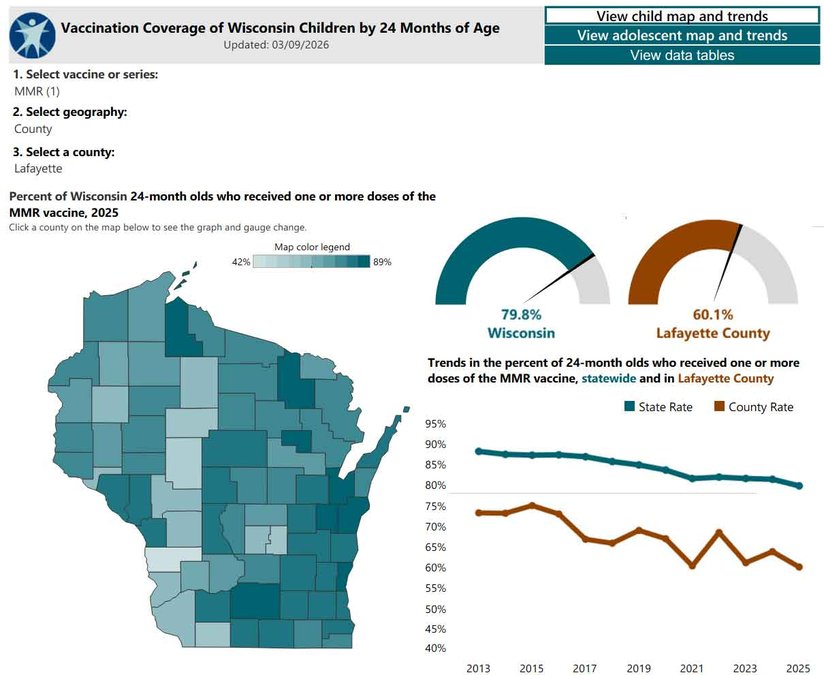
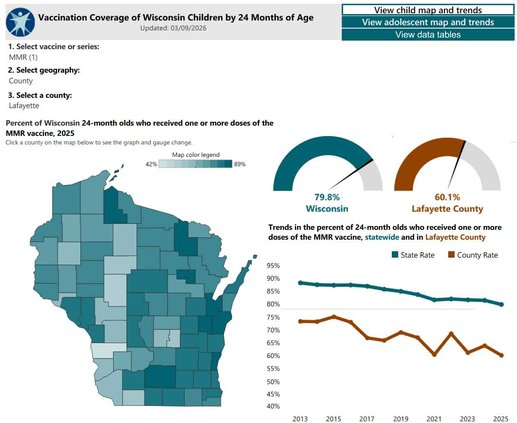
Westergaard said Wisconsin has one of the lowest vaccination rates in the U.S. About 79.8% of 24-month-olds had at least one MMR dose in 2025. Across the board, less than 67% of Wisconsin toddlers under 24 months had received all doses of the recommended series of vaccines, including DTap, Hepatitis and Polio.
In Lafayette County, just 48.1% of 24-month olds had completed the “4:3:1:3:3:1:4” series, according to DHS data last updated March 9. Rates in neighboring counties are 69.8% in Green County, 66.4% in Iowa County and 47.8% in Grant County. Specifically for the MMR vaccine, Lafayette County’s vaccination rate is 60.1%, Green County 81.3%, Iowa County 80.7%, and Grant County 63.9%. Lafayette County’s highest mark over the past two decades was in 2015 at 75%. The state in general has seen a steady drop from 88.2% in 2013.
Warden said that in Green County, 76.1% of 6-year-olds have had two doses of the MMR vaccine, and overall, 85.4% of those ages 6-18 have had the recommended two doses.
Wisconsin is not alone in its struggles against measles this year. The U.S. as a whole is having its worst year with the disease since 1991, according to the Centers for Disease Control and Prevention (CDC). The country has almost 2,500 positive cases of the disease so far in 2026. The outbreak comes as vaccination rates continue to slip across the board.
— Adam Krebs
Preventing Measles ...
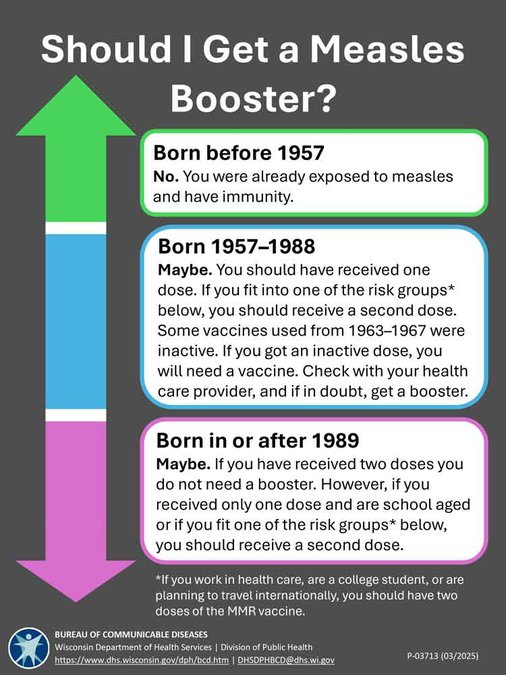
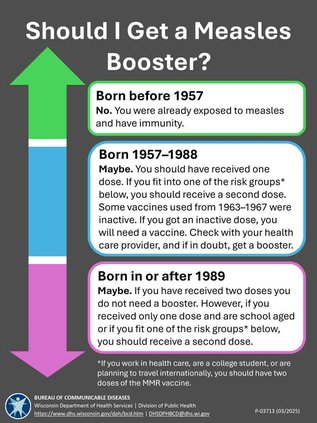
Measles can be prevented with the MMR vaccine. Two doses of the measles vaccine are 97% effective at preventing the disease. DHS encourages all Wisconsinites to check their vaccination status to make sure they and their family are protected from measles. In general, people born before 1957 are considered immune and do not need a vaccine. All other adults without laboratory evidence of immunity should have at least one dose of measles-containing vaccine, and children should have two doses. Find more information about who should get a measles vaccine on the DHS measles page.
People can check the Wisconsin Immunization Registry or contact their health care provider or local health department to see if they or their child has been vaccinated to protect against measles.
Anyone who is not vaccinated against measles can get vaccinated at their regular health care provider, local clinic, or pharmacy. Get free, confidential assistance finding a doctor or clinic by dialing 211. Anyone who is pregnant, has children under the age of 12 months, or is otherwise not able to receive the MMR vaccine can contact their doctor or community clinic for guidance.
Department of Health Services Secretary Kirsten Johnson’s Statement on Federal Executive Order Regarding Routine Childhood Vaccination Schedule
“Consistent with our approach to prior federal actions affecting vaccine recommendations, the Wisconsin Department of Health Services (DHS) relies on systematic and transparent reviews of scientific evidence to inform any updates to immunization guidance we give to parents, health care providers, and public health agencies statewide.
The executive order issued August 10, 2026, by the current administration does not change our approach or our previous statements. Please refer to our endorsement of childhood and adolescent immunization schedules published by the American Academy of Pediatrics and the American Academy of Family Physicians when engaging in shared clinical decision-making with parents, caregivers, and patients.
We are deeply concerned about the lack of scientific evidence in statements from top federal officials, and potential implications for the health of children in our state. Health professionals and parents deserve accurate, credible information. There is no new scientific evidence that justifies changing recommendations that have, and continue to, protect children across the United States.
At DHS, we remain committed to supporting guidance that reflects careful evaluation of benefits and risks, helps families access care that prevents illness, and maintains the trust of Wisconsin families.”
GCPH monitoring the situation
From RoAnn Warden, Green County Public Health Director:
While there are currently no confirmed cases in Green County, we are monitoring the situation closely and aligning our efforts with guidance from the Wisconsin Department of Health Services (DHS). Out of an abundance of caution, we are actively preparing for any potential exposure so that we can act quickly and effectively if a case is identified in Green County.
To help our entire community remain safe and prepared, we encourage all to consider taking the following proactive steps:
Check your Immunization Records: We are encouraging everyone to review their immunization records. The best way to prevent measles is to get the MMR vaccine. You can easily check your status via the Wisconsin Immunization Registry (WIR). If you can’t find your records in WIR, check other places that keep vaccine information, like previous health care providers, or the vaccine registry of the state where you were vaccinated.
Know the Symptoms: You should know the symptoms of measles and call a health care provider if symptoms develop. Symptoms can include a runny nose, high fever (may be greater than 104°F), tiredness, cough, watery eyes, or conjunctivitis (pink eye), and a red rash with raised bumps that starts at the hairline and moves to the arms and legs three to five days after symptoms begin.
Anyone developing symptoms of measles should stay home (not go to work, school, social gatherings, shopping, or use public transportation) and call a doctor’s office or clinic before visiting so they can take precautions to ensure other patients are not exposed to the virus.
Get Vaccinated if Needed: About 9/10 of unvaccinated people exposed to measles will become infected. The MMR vaccine is safe, highly effective, and available at local clinics and pharmacies for adults and children. Uninsured Green County residents can call our Green County Public Health Office at (608-328-9390) to find out if eligible to receive free MMR vaccines through the Vaccines for Adults and Vaccines for Children programs.
Please share these preventative steps with your communities and families. Green County Public Health will continue to track cases closely and will update our community should something change. Thank you for your ongoing partnership and shared commitment to the health and well-being of our community.