At last week’s first informational meeting related to the $45.5 million Lafayette County referendum to build a new nursing home to replace Lafayette Manor, one of the people in attendance asked the very simple question “what will this do to my taxes?”
For those county board members in the audience, their response was a very accurate, but frustrating “it depends on a bunch of things.”
This is true, but for the voters who will decide if there will be a new nursing home to replace the six-decade old Manor, having a better understanding is important for them to decide to balance voting on caring for seniors with balancing their checkbook.
How will the county finance the project? Will the state or federal governments kick in anything to help? Will the new nursing home be able to help carry the debt load? Will fundraisers generate money to cover some items?
While I am not a financial consultant, I have covered numerous local government capital projects over the course of nearly three decades, and have seen numerous different ways the costs would be covered. I cannot give you exactly what it will cost, but hopefully, closer to show you how much a yes vote will be.
Ground rules
First, here are the parameters for this exercise.
- Keeping it simple: For this project, we are going to utilize if all of the costs that need to be financed are from a single source.
When Lafayette County financed the new Lafayette Hospital and Clinics facility, in total they have eight (8!) different loans that cover 20, 30, and 40 years. We will be simply looking at financing this with one single-length bond or loan.
- Sticking with $45 million: That rough estimate for the new nursing home project is very rough, and it is one with a lot of caveats in it.
The volatility of the market for materials for one.
While that number may be high, it is the number being put forward by the county, and that is the number we will be using.
- Annual costs are static: One thing that needs to be pointed out is the annual payments for this project would be static. Year 1’s payment is going to be the same as Year 20, which means this portion of the levy will remain the same. Your house will go up in value, and that may change what you pay, but the total amount being paid back will be the same, and will not go up.
So here we go, let’s see some of the variables involved in how much this may cost you.
20-year versus 40-year
During last week’s presentation, Lafayette County Economic Development Director Allison Taylor, acting as the emcee of the informational meeting, attempted to answer the question of the cost by pointing to information provided to her by the county’s Finance Department.
The Finance Department projected the project by utilizing a 20-year governmental bond. That is a very common way that local governments and schools finance capital projects, like road and building projects.
However, financing this proposal that way would likely make it a non-starter for most voters.
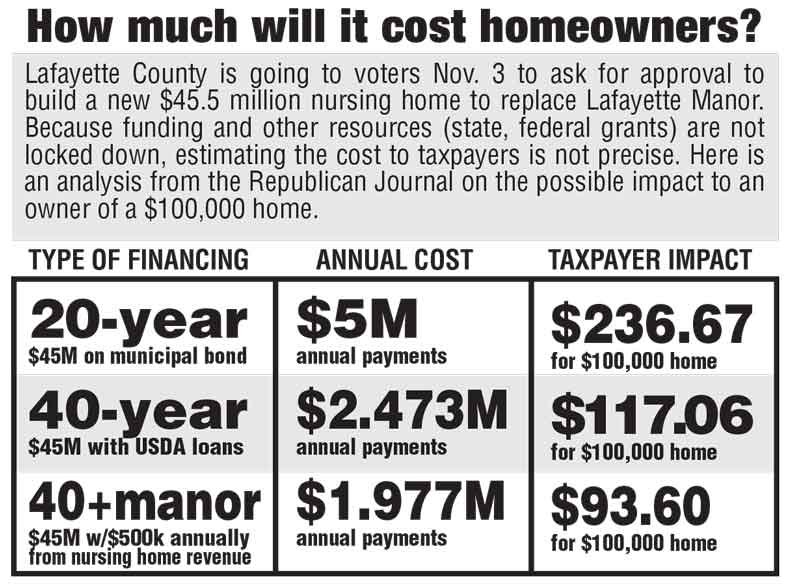
A 20-year bond would mean an annual payment of roughly $5 million to pay it back. That would be a nearly 50 percent increase on the county’s portion of the property tax levy, as this year the levy is $10.4 million.
Taking into consideration the mid-year evaluation by the State of Wisconsin, which puts Lafayette County at $2.113 billion (TID out), this would lead the annual increase in property taxes on a $100,000 home to be $236.67.
At the meeting, even some of the county board members who are in favor of the project quipped that they wouldn’t vote for that.
The thing is, that would not be what the cost taxpayers will see.
Projects like the nursing home and the hospital would qualify for different financing programs. For example, with the Lafayette Hospital and Clinics project, the county qualified for the US Department of Agriculture Community Facilities Loan program, which covered $48 million of the project through loans directly through the federal government as well as government-backed loans through Compeer Bank.
That loan program, which sets the interest rate, can be spread out over the course of the lifespan of the facility, or 40 years, whichever is a smaller timeframe.
Lafayette County would likely take this route, as opposed to a two-year municipal bond.
The hospital currently has annual payments totaling $2.5 million, which it is paying back with revenues generated - the hospital is not subsidized by the local property tax levy.
The Republican Journal had contacted the Wisconsin offices of USDA back in September, and was told that the nursing home would qualify for the program, and those programs that apply get reviewed next spring in a new federal budget — one of the reasons the county board wanted to have a referendum this fall was to show support for the project to get approved for federal funding programs.
Under the current parameters, the county would initially qualify for a 40-year group of loans at 4.625 percent.
Under that scenario, Lafayette County would have an annual payment of $2.473 million. Using the same equalized value protection, the cost for owners of a $100,000 home would be $117.06.
That is a cost that is probably easier to swallow, but that is not the likely cost yet.
Manor contributions
After years of changes with staffing, as well as changes to funding and reporting, Lafayette Manor is looking to end 2026 with a profit. That means no local levy contribution, that the funding it gets from its residents and their coverage programs is covering the costs of the manor, and also means there is more revenue than expenses.
One may assume that if the operations were in a new facility, continuing profitability would take place — a new manor should be more efficient to run, cost less on utilities, and not need major maintenance in the first decade at least.
So what if the Manor could help contribute to the annual payments. If we take the estimate of $500,000, which is less than the profit projections for this year, and placed that as an annual payment towards the loan, this would lower the annual payments on the loans to $1.977 million, which would lower the annual levy portion for a $100,000 home to $93.60.
By the way, if you add up $500,000 in contributions, that is $20 million over 40 years.
Fundraising
The county has created a foundation for Lafayette Manor to help in fundraising for projects at the current facility. That group could shift to getting funds for portions of a new building.
It’s unlikely that the fundraising would be as successful as for other projects like Lafayette Hospital and Clinics.
Just like the hospital generates more revenue from its myriad of services, it also generates a greater volume of people coming through the doors because of the different services it offers, including meals in its cafeteria.
Even at full capacity, a new Lafayette Manor will simply not have the walk-through rate the new hospital has.
With that, there are also fewer items a person could put their name on in a nursing home than in a new hospital. There would be the residence wings, the cafeteria, the outdoor areas, but in total, there are probably a few hundreds of thousands of dollars that may be raised.
In this speculation, we have been using the total of $45 million, as opposed to $45.5 million, which is the referendum maximum. Given some cost savings, and fundraising, we will estimate that removes that extra $500,000 and is baked into our estimates.
State and federal grants
For the Lafayette Hospital and Clinics project, the Federal Government presented $9 million in grants, which along with fundraising meant an estimated $64 million project only had to finance $48 million.
Could Lafayette County be as lucky for a new nursing home project? Would the state participate this time?
U.S. Senator Tammy Baldwin has spoken with county officials, and had noted that she would fight for getting some funding for the project as part of next spring’s appropriations, similar to what she did in helping secure funds for the hospital.
Some funding sources are no longer there — $1 million of those grants for the hospital were related to COVID-era funding to help in public health.
There is also the dynamic of split government and whether politics may stymie any funding. When the funding came for the hospital project, Democrats controlled both Congress, and the White House.
Current projections are Republicans will lose control of the House of Representatives, with predictability markets also seeing them losing the U.S. Senate as well.
However, USDA, which the hospital funds came through, would still be overseen by the Trump Administration, and during the first two years of his second term, the administration has blocked already approved funding from going through.
This potential for grant funding is the biggest unknown when coming up with the actual costs to taxpayers. Any significant amount of funding could really lower the levy impact.
For example, if Lafayette County received $4 million in grants from the state and federal governments — less than half what the hospital received — that would (with the $500,000 manor contribution) put the annual payments on loans to $1.753 million, which would mean a cost of $82.98 for a $100,000 home.
Conclusion
It is difficult for Lafayette County supervisors to give an exact number for the cost to taxpayers for a new nursing home.
Variables are immense — changes in interest rates due to inflation have the current projections at 4.625 percent, whereas the Hospital project got rates at 2.125 percent.
Right now, if the county qualified for the poverty interest rate (4.5 percent) in the USDA program, instead of the intermediate rate (4.625), it would mean a total of roughly $2 million in interest savings, resulting in $50,000 being shaved off annual payments.
My best guess, about $95 on a $100,000 home is the most anyone is going to pay annually for a new Lafayette Manor. To get lower than that, it will be on what the people you elect in November for State Assembly, State Senate, Governor, and Congress.