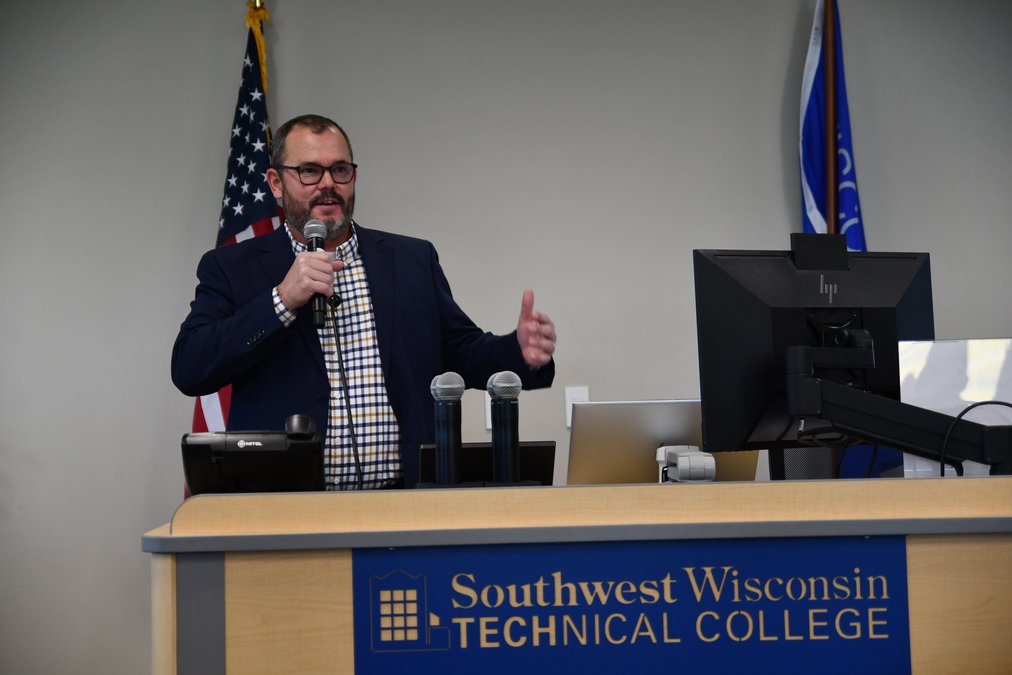
The 2026 Southwestern Wisconsin Housing Summit took place at Southwest Wisconsin Technical College in Fennimore last Tuesday, Nov. 10.
The goal of the event, put on by UW-Madison Division of Extension Economic Development, was to address housing challenges, rural development, and workforce needs across Crawford, Grant, Green, Iowa, Lafayette, and Richland Counties, as well as find solutions that address housing needs.
Both welcoming addresses had personal connections to the region’s current housing issue. Barry Hottmann, Community Development Educator at UW-Madison Extension, who emceed the summit, has also served as mayor of Dodgeville since 2024, and has witnessed first hand community housing issues.
Dodgeville recently held a community assembly to address Dodgeville’s rising housing costs, low housing inventory, and declining school enrollment. The assembly came up with recommendations such as expand affordable housing options to keep young people in Dodgeville, possibly through grants to build town homes and duplexes.
“Housing is something we all can relate to,” Hottmann stated. “It is not just a social issue, it is also an economic one. It is essential to communities to function and grow.”
Southwest Wisconsin Technical College President Dr. Jeremy Pickard has also experienced the region’s housing issues first hand, stating to those in attendance that he and his family have yet to find a home in the area since starting at the college back in July.
Pickard went on to explain that housing and workforce go hand in hand. “Housing is a workforce issue,” Pickard explained. “We want students to enter careers in southwest Wisconsin, and be able to find housing for that career and stay in southwest Wisconsin.”
He closed by stating, “Stop thinking housing is someone else’s responsibility and start asking, ‘what can I do.’ The problem can be solved by a group of individual actions.”
Kristin Runge, Community Economic Development Program Manager at UW-Extension, next addressed the state of housing in southwest Wisconsin.
Going back to the housing/workforce relationship, Runge stated that “jobs are growing faster than homes.” That, along with current housing issues such as high interest rates, rising cost of materials, and the housing market still feeling the effects of the 2009 recession all contribute to the area’s current housing situation.
“Ownership isn’t the solution to housing. Rentals are lacking as well,” Runge went on to say.
She also addressed a common misconception being that once “boomers” start downsizing, larger, family homes will enter the market. The misconception is that according to recent statistics the number of Gen Xers, millennials, and Gen Zers who are starting to have families, each outnumber the total number of boomers.
“Those generations may be having fewer children, but they still need homes,” Runge explained.
Natalie Strait, Regional Planner at Southwestern Wisconsin Regional Planning Commission (SWWRPC), stated that the current supply and demand for housing in the region can lead to restriction of choice, being that people may be having to settle when it comes to a housing choice, and living in a place either larger or smaller than their current needs.
While the morning was spent identifying problems with housing needs in the region, the afternoon of the summit was spent giving examples of possible solutions.
Dan Imhoff, Director of Facilities at Southwest Tech, spoke about how construction students at the Tech build a new home every year, thus participating in a “living lab.”
Imhoff stated when he arrived on campus in 2014, the campus housing buildings were “worn down and past their life cycles.”
To address the issue, and to give construction students more hands-on learning, the college has built a new one on campus every year since 2015. Seven duplexes were built in 2015-2019, and in 2024 and 2025. An ADA compliant quadplex was constructed in 2020, giving the campus 18 new housing units or 64 new beds on campus in that time frame.
Come this current school year, with the campus no longer in need of additional housing, Imhoff stated that the City of Lancaster, through the “It’s a Great Day in the City of Lancaster Fund” (GDCLF), a philanthropic community development fund designed to support local economic growth, business expansion, and housing initiatives, 13 students, some of whom are dual enrollment high school students, are constructing a one-story home with a walkout basement on Newbury Circle in Lancaster.
The project gives the students continued hands-on training, the contractor, Duncan Construction, 13 potential employees, and Lancaster receives an additional home in the city.
Imhoff was hopeful this would the first of potentially more student building projects.
In addition to the house on Newbury Circle in Lancaster, the city has another current housing project. The Southwest Infill Solutions to Housing (SWISH) project, a collaboration with SWWRPC and Southwest Cap (SWCAP).
Michael Kuchta, City of Lancaster Administrator, stated that Lancaster currently has no subdivision development and SWCAP was in possession of empty lots with no future plans. Strait, who spoke earlier, stated that an agreement was made with SWWRPC and SWCAP to place two modular homes on the lots to address the lack of “workforce housing” in Lancaster.
The modular homes were factory constructed by Skyline Homes which is located “right down the road” from the lots on Pigeon Creek Drive, Lancaster.
Craig Woodhouse, Director at Neighborhood Housing Service of Southwest Wisconsin, stated that the modular homes were chosen for their “cost effectiveness,” as the new home cost and median income do not match for many in the area.
These “pilot plots,” as they were referred to, are hopefully the first of possible seven to be constructed.
“We’re sharing the responsibility and sharing the risk in this partnership,” Woodhouse explained. “We’re losing money on these first two, but we’re trying to find a template to continue.”
Woodhouse went on to say, ideally, the overall goal is have 20-25 workforce homes be constructed a year throughout the five county region of Crawford, Grant, Green, Iowa, Lafayette, and Richland Counties.
Platteville may also be having a SWISH of its own as Jessica Fick, Assistant Dean at the College of Engineering, Mathematics and Science at UW-Platteville, stated during the summit’s “community driven housing solutions” panel that engineering students, as part of their senior design course, are working on the planning of a similar project for a new subdivision in Platteville, and urged any community officials in attendance that day who might be interested in a similar project to reach out to the university.
The region’s housing issue also extends to those who are lacking housing. Kimberly Jacobson, Executive Director at Family Promise of Grant County, stated that the organization’s rotational shelters at seven area churches provides a “safety net, but doesn’t answer long term housing issues.”
Jacobson stated Family Promise, in its 10th year as an organization, is looking into a permanent shelter to provide more stability when people are in the program.
She went on to say that Family Promise is looking to work with area landlords and land owners to provide transitional housing and provide a “fresh start for those with a bad rental history.”
Other housing solution programs discussed during the panel include a “starter home project” through Habitat For Humanity St. Croix Valley to sell modular homes at cost, as well as Green County Economic Development working with area businesses and applying for grant funds for low interest loans on homes up to $500,000 and home buyers grants, supplying up to $10,000 for down payments for first time home buyers.
In wrapping up the day, Hottmann reiterated that the goal of the summit was again to “create action/impact rather than just providing info.”
“Now go back to your communities and get some things moving along” Hottmann stated.