It was announced in October 1897 that The Ludlow would have “a complete new steam heating outfit, of sufficient capacity to meet all demands of the rigorous climate of Wisconsin winter.” It was completed and “ready for the first cold snap.”
The billiard room was nicely furnished in January 1898 with two new “elegant Balke, Brunswick & Co. tables, and paraphernalia complete for the greatest of all scientific games. A cigar and news stand and limited amount of space for guests are provided. Electric light, steam heat, etc., and our time with the ivories for 30c at the Ludlow billiard parlors.”
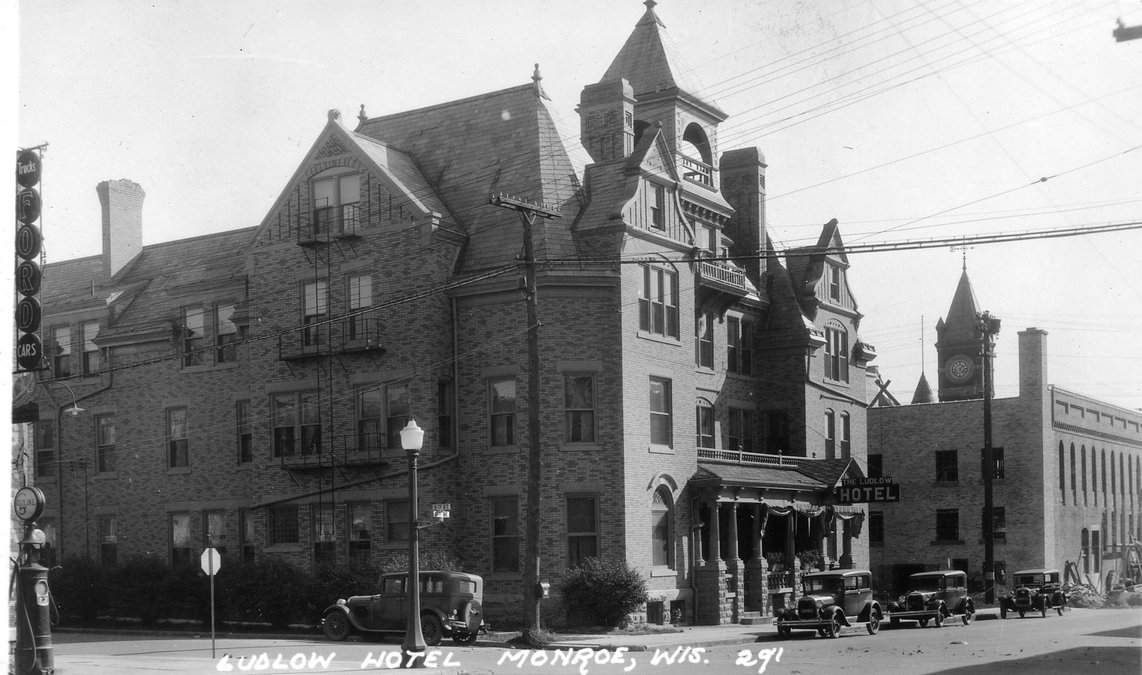
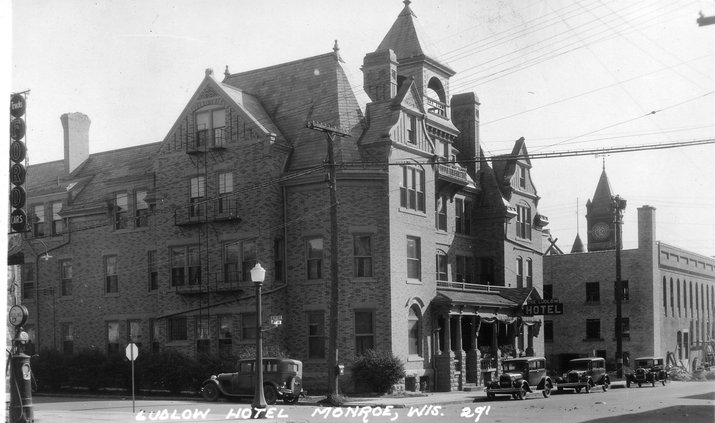
A few things happened in the next few years that might help to identify photos of The Ludlow. An application for a building permit was presented to the city council by Henry Ludlow on July 20, 1909. A new cement front porch was to replace the former wooden porch. A boulevard lighting post with a cluster of five lights was placed in front of the building in February 1911. About the same time the room rate was raised to $2.50 a day, which included a $0.25 increase for dinner.
In February 1912 guests were conveyed to and from the depots via a hayrack after the back runners of the bus had been broken off by catching on the rails at the Milwaukee depot at noon on the 27th. In June “Bill” and “Nell,” the horses who pulled the team bus for 14 years took their first vacation. “Bill” was injured a couple days earlier, so a livery team had to be used. Allie Germann, who had been their keeper all of those years, gave the team his “careful attention.”
The Ludlow heirs sold the hotel to John J. Aeschlimann, a resident of Monroe for the previous nine years, on September 7, 1912. Aeschlimann planned to run the hotel, but D. H. Higgins had been running it since February 1908 and planned to continue doing so until his lease expired on July 1, 1913. Higgins went to northern Wisconsin on April 28 to see about a new location. However, some of the businessmen here talked about forming a stock company to purchase the hotel property from Aeschlimann. Their plan was to build an addition onto the south side by the alley, which would add about 20 sleeping rooms (most of them with a bath), enlarge the lobby, and create a more spacious bar room. Higgins was willing to take a 10-year lease on the enlarged building, but retired on June 30. Aeschlimann took charge the following day. All of the help remained at the hotel with Aeschlimann.
Articles about the hotel seemed fewer as time progressed. The old bus at the hotel was discarded at the beginning of 1914 and a new bus, with a capacity for four more people, had taken its place. Two years later on November 13, 1916, the hotel bus skidded and turned over on the way from the Milwaukee depot to the hotel; 18 traveling men were bruised and cut. A Packard auto bus, which would hold about a dozen people, was put into service on December 1, 1917.
Roy Zweifel, a delivery boy for Young & Co., climbed the flagpole at the hotel on July 1 and “adjusted a rope through a pulley at the top in order that a flag may wave over the building on the Fourth.”
Architect L. W. Claude, Madison, was in Monroe on February 17, 1915 consulting with Aeschlimann about adding a 12-room addition to the south side of the hotel. Many community men were still talking about this in 1921; Aeschlimann met with the Kiwanis who favored the proposal, but it never materialized.
Water pipes on the top floor of the hotel froze and burst on the afternoon of December 10, 1919 and water flooded the hotel before it was discovered. Water was carried out of some of the rooms in buckets. A plumber was called and fixed the break.
A barbershop was added to the hotel on December 29, 1920 with George Stauffacher in charge. An additional barber was expected to be added.
An advertisement in the June 29, 1923, Monroe Evening Times gave a very short history of The Ludlow Hotel, which had served “as a Modern Hotel” for 38 years. Aeschlimann had already been the proprietor for 10 years. The proprietors had “endeavored to give to the traveling public, a fine up-to-date place to stay while visiting our city.”
For the first time in 43 years the Ludlow Hotel dining room did not open on the morning of February 1, 1927. Aeschlimann had “considered this step for some time, but did not act until after the supper hour” the evening before. Mrs. Rose Kenzie had served as a cook for 26 years.
The Ludlow Hotel continued to operate under different managers until the 1950s. The hotel was sold for the last time on February 1, 1954 to Paul E. Baltzer and his son, Paul, Jr. It was confirmed in the Monroe Evening Times on July 20, 1955 that the Baltzers had partnered with brothers, Milton K. and Lester Johnson, who operated a Pontiac and implement business immediately to the east of the hotel, that the hotel would be closing after 70 years.
The last guest of the hotel, George W. Norton, checked out on Monday morning, August 8 after the Green County Fair had ended. As the guest of the hotel since 1947 checked out, there was a crew of workmen employed by E. L. Cheeseman of Freeport on the fourth floor removing the doors. The demolition of the hotel was to take about a month. Thorp Finance Co. conducted an auction of furnishings and other items from the hotel on August 11, which drew about 500 people. The sound of wrecking floated across the crowd as workmen continued to strip the inside of the building. The current building was then built on this site, which served McClellans and J C Penney for years.
— Matt Figi is a Monroe resident and a local historian. His column will appear periodically on Wednesdays in the Times. He can be reached at mfigi48@tds.net or at 608-325-6503.