MONROE - Tucked into the rolling hills of southcentral Wisconsin, behind the dairy barns and milk cows, lies the warm, fuzzy world of wool.
The local animal fiber community is a close-knit one. Some of the sheep, llama, alpaca and goats are known by their individual names for the yarn they produce.
But processors of these natural fibers, the shepherds, yarn producers and knitters, say they have no idea how many local people are involved in their industry. It's not unusual to find wool producers working as professionals in other fields or as hobbyists, they say.
Area fiber enthusiasts say Green County and Lafayette County yarn products are unusual and highly prized - some people even call them the Rolls Royce of wools, because the animals are often pampered. And, most of the wool is processed in small batches, often by hand, without harsh chemicals and is left undyed.
"We're kind of spoiled here," said Jocelyn Kline, an avid knitter and owner of Orange Kitten Yarns in downtown Monroe. "Tourists like the specialty yarns. They love the home-grown stuff produced in Green County."
Kline provides a store-front outlet for local wool producers' small batches of specialized yarns or roving (unspun wools) and accepts consignments.
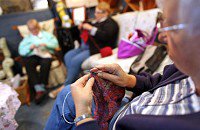
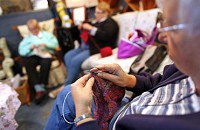
Several local knitters gather in a weekly social group Wednesday at the store, and they are not shy to admit their conversations range far off the topic of wool. But they say they rarely seek yarn outside the county.
"It beats going to Madison," said Benita Miller, Monroe, who dyed a naturally white yarn for her current project. "Natural (wool) feels so much better (than synthetic yarns)."
Another knitter and retired shepherd, Bobette Traul of Monroe, insists on buying her yarns locally. "I like it, because I know what it takes," she said.
Traul said she has dealt with wools at every step of the process. She's also well-known among the knitters for dying her yarns with weeds. A fall blend of Queen Anne's Lace, goldenrod, red-rooted pigweed and chicory produces a creamy heather yellow, she said.
"I've lambed the babies, washed the wool ... everything from the womb to the sweater," she laughed.
Some of Kline's inventory is hand spun. One local line of craft yarn, called Crazy Quilt, from Homestead Wool and Gift Farms, has bits of different weight wools, brightly dyed fibers and sparkling strands mixed into the natural base fiber. What are people making from Crazy Quilt yarn?
"You're limited only by your imagination," Kline said.
Some of the wools that reach Orange Kitten Yarns is processed through Argyle Fiber Mill in downtown Argyle. Open since January 2006, the mill, owned and operated by Kristie Langhus, is popular with local fiber producers because it will process small batches - even batches as small as an individual animal's wool.
"If they want to do just Sophie's, we'll just do Sophie's," Langhus said.
Langhus and her employee, Kathy Olmstead, produce about 10 to 15 pounds of yarn or roving a day, while also working other jobs in Monroe - Langhus as a cardiac rehab nurse and Olmstead at Studio B.
Argyle Fiber Mill uses small machines, which allows Langhus to custom process her customers' wools. Some fleece comes in bags of as little as 6 pounds. Other mills require batches of no less than 50 pounds to process, Langhus said.
Langhus is increasing her customer base each year from further away, but her own in-house lines of yarns, branded as Fifty-Mile Fiber, come from animals living within a 50-mile radius of the mill. The basic lines are 100 percent Icelandic sheep, 100 percent Alpaca, and a 50/50 blend.
Finished wool products weigh about 75 percent of the incoming fleece, because of the release of lanolin and the dust and dirt it holds. The washwater of a batch of fleece becomes a lovely light amber ale color, and the fleece is notably brighter and softer when it is laid to air dry on screens.
Like at the Orange Kitten, local knitters gather in Argyle Fiber Mill in a cozy basement storefront room, with couches, cookies and conversation. Members of the Argylian Society of Knitters often come from as far as Darlington, Mineral Point and even Chicago.
The local natural fibers are "fantastic," said Marian Bak, Chicago, who drops in whenever she's in town visiting family. Because she likes talking with the group, she always brings "something simple," to work on - not the lace alpaca stole she has started at home, she said.
"There's a different choice here. And you don't have to worry about the dye lots," Bak added. If you run out of yarn during a project, you can come back and get more from the same animal, she said.
Bak and Denyse Galbreth, Argyle, said the local yarn selections are unlike anything mass produced.
"This is like the Rolls Royce, hand-made luxury yarns," Galbreth said.
"When you devote so much of your time into something, you want something of quality," Bak added.
The luxurious feel of alpaca speaks for itself, according to Langhus, and alpaca fiber is seven times warmer, even when wet, than sheep's wool.
Llama wools come in 22 different natural shades, and Langhus can keep they all separate.
After more than an hour or two of machine washing in a natural deodorizing cleaner, the fibers are laid out in separate batches to dry. This is when static electricity starts to become the enemy for processing, said Olmstead.
The fibers go through no fewer than seven machines, if it's getting the full processing.
A picker fluffs the dried fleece. A dehairer or separator plows the fiber further for more cleaning. Carding lays the fibers out in lines, when it then becomes roving.
At this point, roving is sold for spinners. There are a lot of spinners in southwest Wisconsin, Langhus said.
The roving is sometimes reprocessed to make it more uniform, before going into the spinner to become single-ply, and then two spools of yarn are paired for the familiar double-spun yarn.
A steamer machine sets the twist and locks down the fibers. And finally, the cones of yarn are measured off on a skein winder, and each 20 yard skein is hand-folded and ready for labeling.
About 200 yards of rough alpaca fur, which comes from the neck and legs, makes a nice pair of socks, Langhus said. About 800 to 1,200 yards of the finer fur, from the animals' back and sides, should go toward making softer sweaters. A skein of alpaca sells for about $30.
The interest in natural fibers is growing alongside the interest in buying and eating locally, according to Patty Reedy. Reedy and her husband Andy Wersal raise sheep fulltime and host the Autumn Fiber Extravaganza, now in its 22nd year, near New Glarus.
The natural fibers are "more comfortable to wear, breath better" and buying them "supports the local farmers," she said. And now the area, with "a wealth of growers" and processing mills is becoming "fiber rich," she added.
On Rainbow Fleece Farms, Reedy and Wersal, raise Bluefaced Leicester Sheep, a "hot, new breed right now from ancient Scotland, and imported starting about 10 years ago.
Reedy produces her own brand, Yarn from the Barn, natural and hand-dyed artisan yarns in Mohair (angora goats) and wool.
"There's a lot of interest in knitting and crocheting, and felting in various forms, Reedy said.
"Quilters are embracing the needle felting," creating felt appliqués on their finished quilts, she added.
Both Reedy and Kline find hobby crafters are starting to "crossover" - wool dyers will spin, spinners will quilt and quilters will felt. The crafts are outlets for relaxation, they say.
What they can do with all those products is make a little money on the side, which can help pay for hobby supplies.