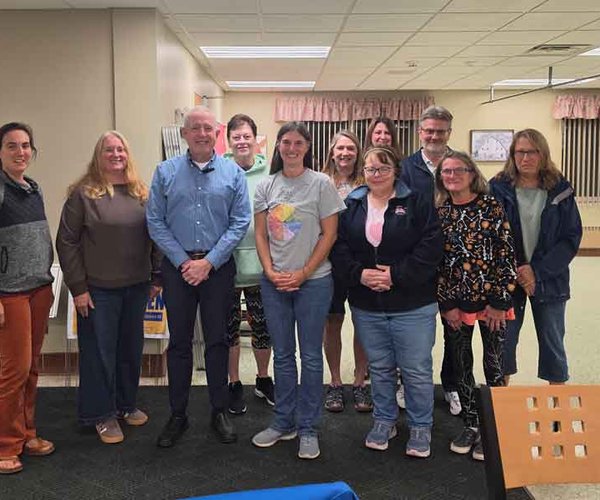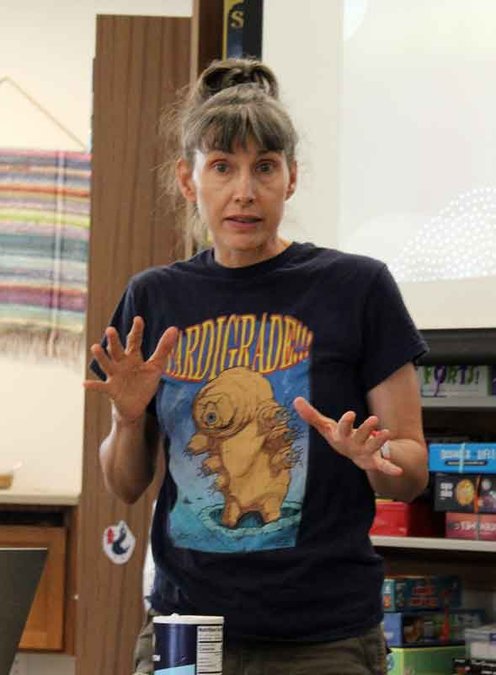
BLANCHARDVILLE — A dozen individuals gathered at the Blanchardville Library on Thursday, to listen as Ellen Petrick gave her presentation, sharing some of the the latest research on microbiomes, probiotics, fermented foods, and fiber, on Thursday, September 10.
“Recently, a new study has discovered that we don’t know as much about microbiomes as we originally believed,” shared Petrick. “We’ve only began to scratch the surface, as we are just now trying to figure out what a healthy microbiome looks like.”
Petrick, who lives in Green County, has a passion for fermented foods and the health effects that microbiomes have with the human body.
“We are beginning to better understand how to influence our microbiomes into working for us,” she said. “This can be done with eating the right foods, and also with getting enough sleep, and through regular exercise.”
Petrick enjoys the flavor and benefits of eating fermented foods. She also shared the importance of avoiding processed foods, as there are so few health benefits.
“Making and eating delicious, fermented foods like sauerkraut, kimchi, sourdough, kombucha, kefir, pickles, yogurt and cheese, all have positive effects on our bodies,” she said. “These delicious foods are produced by the fermentation activities of microorganisms like bacteria, yeast, and fungi. As they digest, they actually make the food they are eating more nutritious.”
As she was talking, she asked for assistance in making fermented kraut. Two of the guests washed their hands and assisted by cutting up a few heads of organic cabbage.
“You will want organic or homegrown cabbage for this recipe,” Petrick advised. “The store-bought cabbage won’t ferment properly, and you’ll be forced to toss out your kraut.”
The heads of cabbage had a total weight of six pounds. The recipe that Petrick shared called for one teaspoon of salt for each pound of cabbage.
“The salt cannot be iodized salt,” she said. “Otherwise, the recipe won’t work correctly.”
The salt that was used in the recipe was a natural sea salt that can be easily found in any local grocery store. While the two volunteers continued to cut up the organic cabbage, and place their clippings in the large crock, Petrick sprinkled the salt in between the layers.
The last ingredient for the fermented kraut recipe was not an ingredient, but a process. The goal is to get the water out of the cabbage so the natural process of fermentation can begin.
“To get the water out, we’re going to ‘tamp’ the cabbage and salt,” she instructed.
Tamp means to press, squeeze, squish, crush, smash, or cram the vegetable. This process takes a while. It is a deliberate step to get the water out of the cabbage so the natural fermentation process can begin. Several guests took turns participating. Their combined efforts took roughly a little more than a half-hour to complete.
The final ‘ingredient’ in the fermentation process is time. Once the water content is achieved, the entire mixture will need to be covered up with the water, and will need to sit for approximately two weeks, give or take for personal taste. The longer it sits, the stronger the flavor. The bacteria will work its magic during those two weeks, creating its own vinegar, which will allow the health benefits of microbiomes to do the rest of the work. Fermentation can be done with a variety of vegetables. If there is a vegetable that doesn’t produce or hold a lot of water, then water can be added to the organic food of choice to start the process.
The kraut was made in a large floor crock, which also had a lid, and some interior crock weights to keep the cabbage mixture below the surface of the water. What is used to create the mixture while being created, makes all the difference in the process. For best results, plastic or metal should not be used. The best suggestions are glass (such as a mason jar, with a lid); stainless steel; or a glazed piece of pottery, such as a crock.
The health benefits of microbiomes cannot be found in processed foods, as live cultures are necessary. For that reason, raw milk is suggested for successfully creating cheese and fresh yogurt.
“My main reason for moving to Wisconsin was to live the rural life while making dairy products from raw goats’ milk,” she said. “I grew up in the Chicago area, and for 15 years, we planned on making our home in Wisconsin. For the past four years, my husband and I have enjoyed our life just north of Argyle. I have made all kinds of cheeses and yogurts, benefiting from the natural process of fermentation. We live on a farm with a dozen goats, 70 chickens, several turkeys, geese, and ducks. I enjoy teaching people the benefits of eating naturally fermented foods.”
Petrick shared a lot of science behind the process, along with the health benefits of eating microbiomes, to the guests that were in attendance.
To learn more about fermenting your own food, the libraries in the area have several books, and recipes for patrons to try. Creating food for the sake of one’s well-being is something that each of us can benefit from. Microbiomes continue to be part of everyday life.