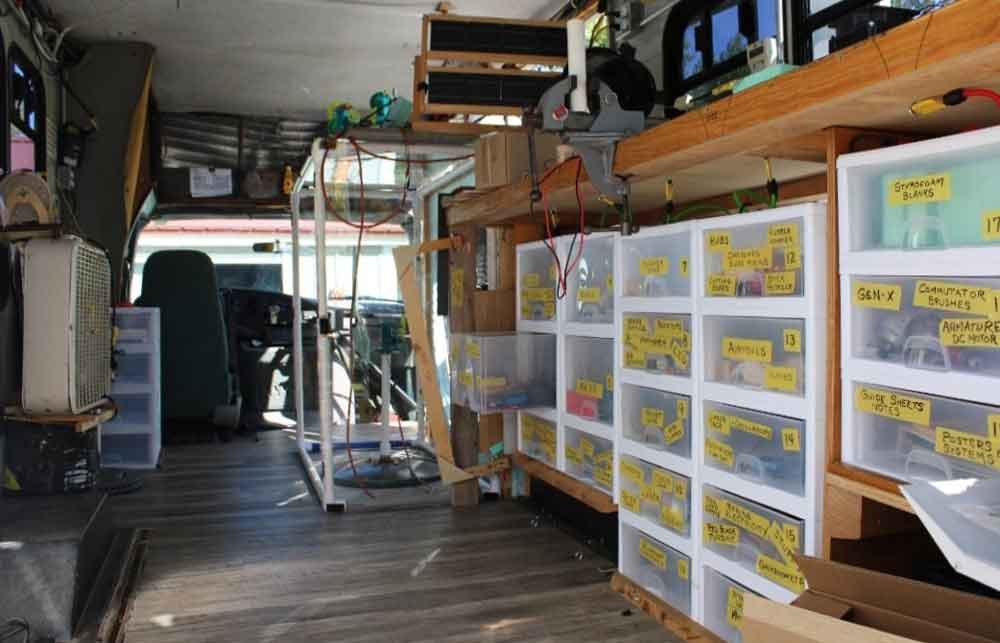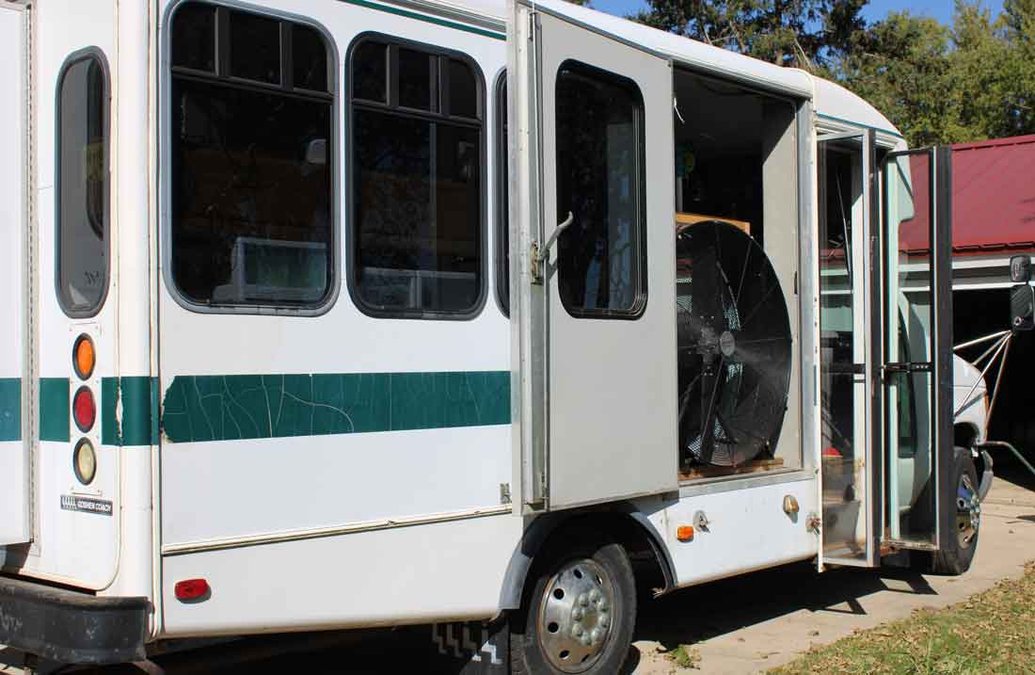
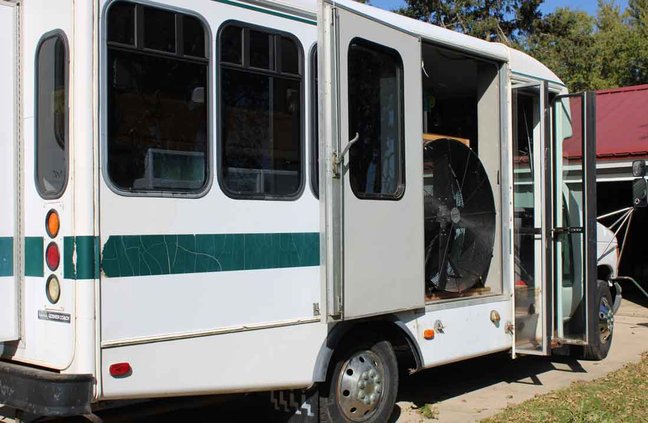
DARLINGTON — Dick Anderson may have retired 16 years ago, but his interest in staying up to date with the latest technology continues to draw his interest into the classroom. As a former educator, he enjoys teaching and watching students learn. To continue to inspire the next generation, he has created the Mobile KidWind Training Laboratory Bus, which offers 32 hands-on learning activities for teachers to advance their skills, in order to further educate their students.
“I’ll call it, ‘Hands on problem solving with a purpose’ and having serious fun learning,” Anderson says with a smile on his face.
The bus is a 2001 transport vehicle with only 8,000 miles on the odometer. It was a generous donation by Parth Patel, owner of the Mound View Motel in Platteville, and the Belmont Convention Center and Motel in Belmont.
The KidWind bus was created for teachers, who would like the experience of hands-on activities, to better enhance the subject of renewable energy being taught in their classrooms. With an engineering mind, Anderson, himself, is always looking to further his own knowledge and that of each individual in which he comes into contact with. It is beneficial for each instructor to experience for themselves, through the hands-on learning experience, to gain a better understanding of how electricity is produced by wind and solar systems.
“In the near future 80% of all electricity will be produced from the wind and sun,” Anderson shares. “When it comes to electricity most people know very little about it. Thinking that food comes from the grocery store, and heat comes from a furnace is a weakness. So, it is with electricity. Thinking that all you need to know about electricity is how to write a check, is a mistake.”
Teachers can learn necessary skills to better help prepare their students for future KidWind events. How it works is simple. The Mobile KidWind Learning Lab Bus can travel right to the school or teacher’s residence, which is prescheduled between the teacher and Dick Anderson, who will provide the training. The sessions are for the duration of 2, 3 or 4 hours, and the K-12 teachers have the option to select 8 to 10 hands-on learning activities from the list of 32 class options. Once a date and time are agreed upon, the Mobile Kid Learning Laboratory goes right to the teacher’s location, where they can have hands-on experience similar to any classroom.
Anderson has enjoyed working with KidWind for several years and continues to inspire others who are eager to learn. One of his best experiences came from working with two students who were not selected for the program when they were in the 8th-grade.
“As freshmen, the students formed a team outside of the school and went on, against all odds, to be in the top 3 at the World KidWind Challenge,” he shares. “In later years, one of the team members designed and built a wind turbine that broke the KidWind record and produced over 900 joules of energy.”
Seeing potential in students is what inspired Anderson to begin teaching their instructors how to put wind turbines together by hand. What makes the mobile lab bus even better is that there isn’t a cost to the teacher or the school district. The Mobile KidWind Learning Lab Bus is sponsored by a community of supporters who believe in educating the next generation in Renewable Energy.
The categories for the instructors to learn from are similar to any of the KidWind competitions. First and foremost is safety, which is always the number-one concern when working with electricity. The ‘Log Out — Tag Out’ system is taught to be employed in each classroom.
For the purpose of this article, the “Sun Light in a Jar” model was selected to be used as the learning demonstration, which had a lot to do with batteries and cells. Most people may or may not have noticed, but a Double-A cell battery and a Triple-A cell battery both provide 1.5 volts of power. When 6 cells are placed together, each containing 1.5 volts, a 9-volt battery is produced. When making battery purchases, the rechargeable batteries serve the environment best, as they can be reused instead of ending up in a landfill. They can easily, with little time or effort, be recharged, simply by using the sun’s rays. This is done by collecting light with a solar panel and storing it in a battery or capacitor. The rate and amount of discharge to run devices, and recharge from the light, can easily be measured.
Learning to wire and assemble an AC generator isn’t something most people understand unless they are involved in engineer-based learning through KidWind projects. Teachers can sign up to learn more about generators to further instruct students in their classroom. Wiring an AC generator stator for 3-phase and single-phase output is something that requires hands-on skills which further emphasizes the need for Anderson’s mobile lab bus.
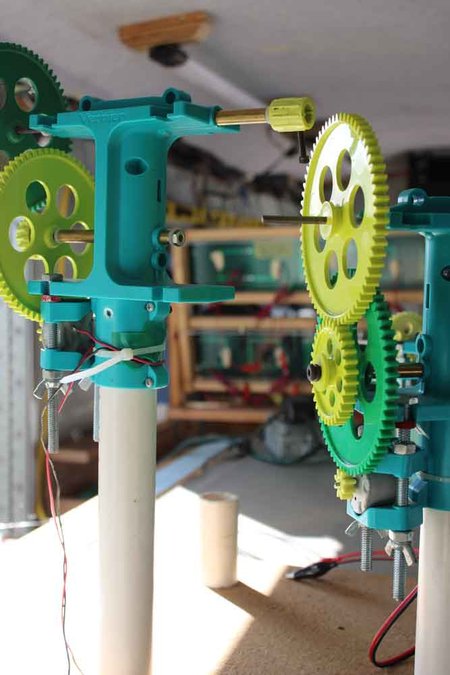
Teachers have the opportunity to experiment with different blade designs, numbers of blades in a rotor, how to laminate a turbine blade, and learn the several ways in which blades can be created for competition purposes. They also have the option to problem solve with different gear ratios, work with planetary gears, and how to set a gear ratio in KW Nacelle, which is a wind turbine. They can sign-up to learn how to design and assemble a PV panel, which is used to convert sunlight into electricity.
Instructors can learn more about testing wind turbines, measuring the output of a solar system, how to measure the strength of different magnets, how to build a full wave bridge rectifier, stabilize a grid, and how to use a multimeter to measure volts, amps, and ohms.
Dick Anderson is a retired school teacher who continues to be a strong supporter of the KidWind program. He previously created the KidWind shark, which is a high-speed wind tunnel that traveled the distance to the Kansas State KidWind event earlier this year. He has not only educated students, but he looks forward to providing the same hands-on education to their teachers. Anderson has earned the Energy Educator of the Year award in 2020 and continues to educate and empower others by his example.
Teachers and school districts can learn more about the Mobile KidWind Training Laboratory Bus, by contacting Dick Anderson at richard640@centurytel.net.