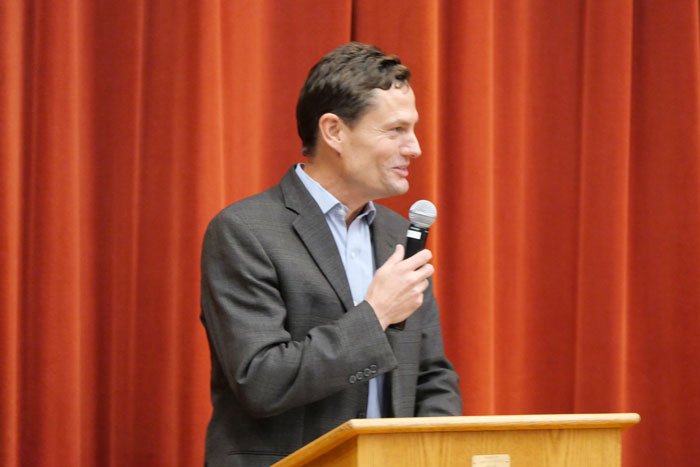
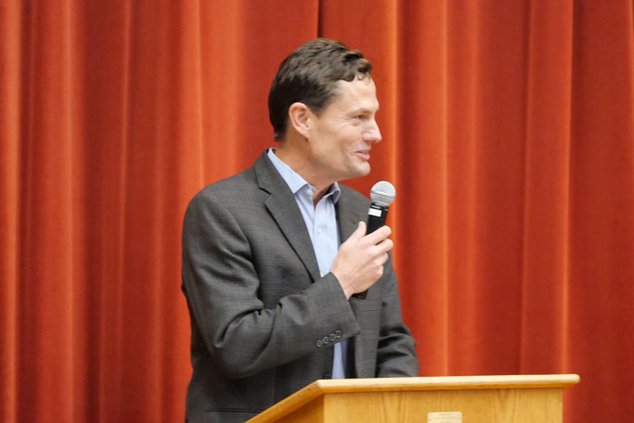
MONROE — Wisconsin’s 17th Senate District may be getting yet another candidate vying for an office in the state capitol building. Democrat Sam Rikkers of New Glarus is exploring his options and may throw his hat into the ring for the primary election, set for Aug. 11, 2026, with the general election Nov. 3, 2026.
Rikkers would be joining Current 50th Assembly District Representative Jenna Jacobson (Oregon), Corrine Hendrickson (New Glarus) and Lisa White (Potosi) on the Democratic primary ballot. The senate seat is currently occupied by Republican Howard Marklein (Spring Green), who assumed office on Jan. 5, 2015.
Earlier this month he came down to Monroe for the original — then rescheduled due to a snowstorm — Shop Small Saturday. He also had a sit-down conversation at the dinner table with Tom and Christina Becker of Christina’s Family Daycare in Monroe to discuss some of the issues the childcare industry (and themselves as providers) face in light of a dwindling economy, stagnant wages and increasing costs of goods and services.
“I deal with child care a lot,” said Rikkers, who is the Deputy Secretary/COO of the Wisconsin Economic Development Corporation (WEDC). “Businesses need folks working and they need folks to have childcare if they’re going to work.”
He said the WEDC is trying to engage more businesses and chambers of commerce across the state to help add to the voice for it.
“It’s not a partisan thing,” Rikkers said. “The system is totally broken. In my opinion, childcare should be a public good if you want the economy running like it needs to and you want to unlock the workforce.”
Tom Becker said that the grocery bill for the daycare is up nearly $200 over the past month, and that is despite having even fewer kids in his and wife Christina’s care.
The bipartisan state budget that was signed in June included more than $365 million to education and child care. However, that number still came up over $100 million short of the funds sought in order to continue Childcare Counts money given by federal legislators during the 2020 COVID-19 pandemic. Those funds expired this year, hence the push for added state funding.
“I just think that, yes, it’s not enough, but there needs to be an acknowledgement that there was some movement after a long time of no movement,” Rikkers said. “The investment made this year didn’t come close to fixing it, but nevertheless, it’s the first time that there’s been an investment. There was a decision by folks on both sides of the aisle to do something they’ve never done before. This is nothing to celebrate as if we got it fixed, but what do we got to do to keep this momentum going?”
Tom Becker said that the money providers receive from the new budget not only isn’t enough of a continuation of the lost Childcare Counts funds, but they are only a portion of it — about $110 million is coming from interest from ARPA funds.
While the Beckers maintain their desire to stay in business, other providers face a tougher hill to climb. Several local providers have had to raise their weekly rates this year, and the number of providers in the county and 17th District is dwindling rapidly.
“Green County — this district — lost one more day care this month. We are now at 28. We are minus 15 day cares since April,” Tom Becker said.
With state regulations limiting the number of children a provider can care for — as well as ages — losing further childcare options only hurts families more.
“The system is totally broken. In my opinion, childcare should be a public good if you want the economy running like it needs to and you want to unlock the workforce” said Rikkers, who himself has two young children at home, ages 4 and 2. “My wife and I, we spend 40% of our wages, collectively, for child care.”
“That should be about 10%,” Becker interjected.
“We spend more on our child care than we do on our mortgage,” Rikkers added. “I find it really fascinating — the system has been broken for years and years.”
He’s traveled the state with the WEDC, working with businesses and chambers of commerce, helping find solutions that work best for local communities at every stop.
“For the last six, six and a half years, as we’re trying to figure out what the best way is that we’re investing in Wisconsin businesses and communities, the first thing we’re doing is saying, well, we’re not the only state around here. What are the other states doing?” Rikkers asked.
Tom Becker handed Rikkers some information on what two other states are doing to combat the issue. The Vermont Plan takes a small tax from companies that goes into a pool to help subsidize the industry in the state. In New Mexico, a ballot measure for no-cost universal child care was recently passed and went into effect in on Nov. 1, guaranteeing free child care access to residents across the state.
“Child care is essential to family stability, workforce participation, and New Mexico’s future prosperity,” said New Mexico Governor Lujan Grisham.
Rikkers was highly optimistic in finding solutions in Wisconsin to a variety of funding problems. His resume includes a Doctor of Law from UW Law School in 2007, serving as Director on President Obama’s Energy and Environment Team in 2013-14, and for the last six years has been with the WEDC in Madison.