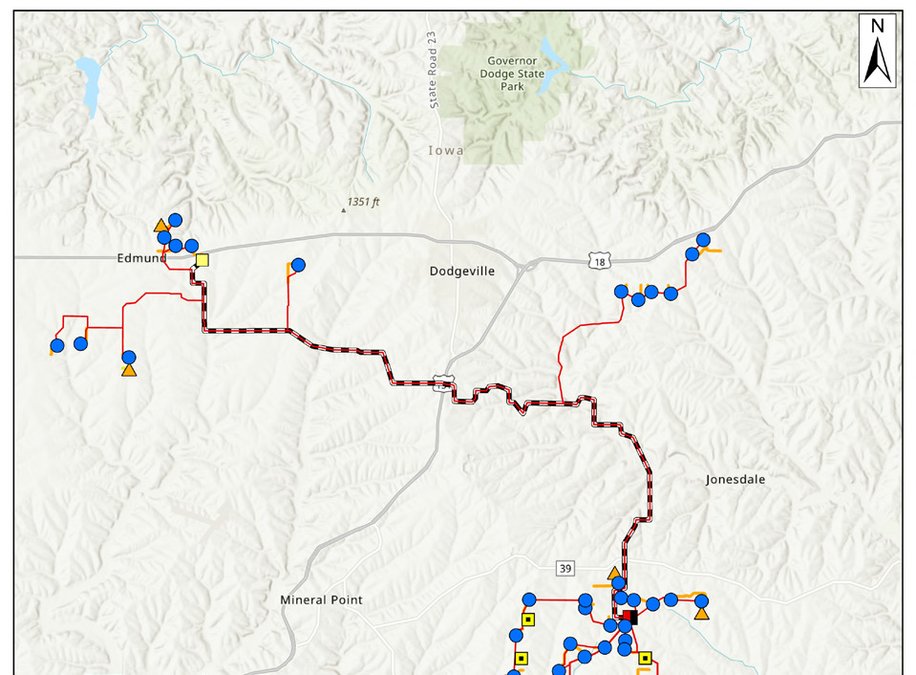
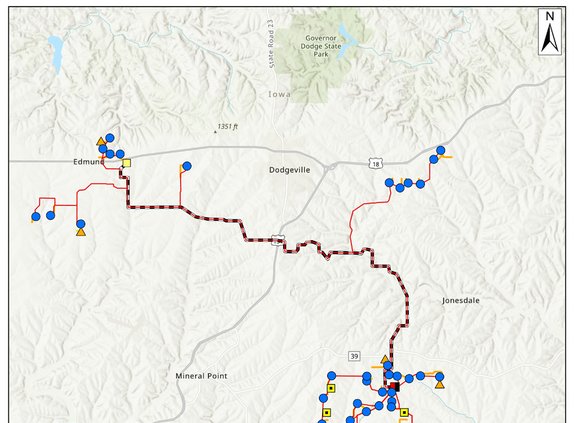
A new map reveals where wind turbines are projected to be placed for the first phase of Southwest Wisconsin’s largest proposed wind farm. The eastern phase of Pattern Energy’s $1 billion Uplands
Wind project is planned to generate 300 megawatts of energy from 51 wind turbines in central and southern Iowa County and northern Lafayette County, according to a new Pattern Energy map.
Pattern Energy said Uplands Wind will provide electricity for about 215,000 homes once both phases are online. “The Uplands Wind map reflects months of work with participating landowners, local
officials, and other stakeholders advance a project that meets the needs of the region,” said Pattern Energy’s Matt Dallas. “We’re excited to continue working with communities in Iowa and Lafayette
counties to advance a project that will help meet Wisconsin’s growing electricity demand while creating jobs, growing the local tax base, and investing directly in Wisconsin families and communities.”
Pattern Energy initially applied in a Federal Aviation Administration map for 181 possible locations for wind turbines, with locations as far west as the Platte Mound and Belmont Mound State Park, and as
far as northwest as adjacent to operating or proposed wind farms in the Livingston area. According to the new Pattern Energy map, eight of the Uplands Wind East wind turbines will be in the Edmund
area with half north of U.S. 18 and half south of 18, and six will be east of Dodgeville south of U.S. 18/151. The remaining wind turbines will be in the towns of Mineral Point and Waldwick southwest of
Jonesdale into the northern Lafayette County towns of Willow Springs and Fayette northwest of the Yellowstone Savanna State Natural Area. Dallas said the western half of Uplands Wind is earlier in the
process of development. Pattern’s original plans included connecting with the Badger Hollow Wind Farm and the Cardinal–Hickory Creek power transmission line in Montfort and in Edmund.
“Pattern is committed to the success of both projects, and we look forward to sharing specifics as they become available,” he said. Project opponents believe the development of only the
eastern half of Uplands Wind is for specific reasons. “From examination of public records of signed leases, one explanation for the scale reduction is the developer was unable to acquire the right-of-away
to route a second, large [345,000-volt] grid tie line to connect wind turbines sought in western Iowa County and northwestern Lafayette County,” said opposition volunteer Rob Danielson. “This reduced the
currently sought size of the Uplands Wind power plant from 600 MW to approximately 300 MW. This change is likely due, in part, to the extensive effortsof potentially affected landowners in western Iowa
County, NW Lafayette County and Eastern Grant County who reached out to their neighbors and explained concerning aspects of the proposed wind power plant that the developer had not been making
sufficiently clear.” Uplands Wind is the largest of four proposed wind farms in Southwest Wisconsin. In September the state Public Service Commission approved a Certificate of Public Convenience and
Necessity to allow construction of the Badger Hollow Wind Farm, a 17- to 19-turbine 118-megawatt project in the Grant County towns of Clifton and Wingville and the Iowa County towns of Eden, Linden
and Mifflin. The original application lists turbines 390 feet tall to their hubs and 656 feet to the top of their blades. “There are several health and other siting factors that should not be left up to the sole
determination of the out of state, merchant utility developer,” said Danielson. “During the recent PSC review of the much smaller Badger Hollow Wind proposal in Iowa and Grant Counties, it became
apparent to public intervenors that the developer had not sufficiently accounted for the risks associated with pervasive karst topology and historical mining activities. These risks stand to be even
greater in the areas that Pattern has narrowed down for Uplands Wind at this juncture.” The Whitetail Wind project includes seven turbines slated to be located on Wisconsin 80, five on Rock Church
Road, four on Grant County E, two on Old 80 Road, one on New California Road, one on Hickory Grove, and one off Hopewell Road, according to the application. Two meteorological towers also would be
built on four locations — two off County E, one north of Crow Branch Lane and one west of 80 just south of the north Livingston village limits. Whitetail Wind does not require a Certificate of Public
Convenience and Necessity from the PSC because the project is smaller than 100 megawatts, according to the application. Badger Hollow Wind Farm is east of the Red Barn Wind Farm, built by
Allete, which has 28 turbines producing 92 megawatts. The wind farm is 90 percent owned by Wisconsin Public Service Corp. and 10 percent owned by MG&E. Red Barn, which began operation in
2023, has been the source of complaints including health effects. The blade of a Red Barn turbine separated from its hub on Annaton Road west of Livingston in September 2024. Two other Red Barn
turbines have flaws in blades. Another blade was replaced on a wind turbine north of Livingston last September. Liberty Utilities, a subsidiary of a Canadian utility, is proposing a 30- to
40-turbine project, with turbines up to 656 feet tall, to generate 200 megawatts of electricity in western Grant County. The proposed project area is south of U.S. 18 west of Wisconsin 133 and
along Wisconsin 35/133 and generally west of Grant County J. The PSC on Dec. 30 approved three utilities’ purchasing ownership interest in the Badger Hollow Wind Farm and the Whitetail Wind
project in the Grant County towns of Clinton and Wingville for $576.9 million. Invenergy of Chicago owns Badger Hollow and the 21-turbine 70-megawatt Whitetail Wind project. Invenergy purchased
Whitetail Wind from Allete Clean Energy of Duluth, Minn. Wisconsin Electric Power Co. of Milwaukee, known as We Energies, will own 80% of the wind farms. Wisconsin Public Service Corp. of
Green Bay, which is owned by We Energies, and Madison Gas & Electric will own 10% each. None of the three utilities has Southwest Wisconsin customers. Both projects are in the Town of
Clifton, which last year amended its wind project ordinance to require town board approval of turbines taller than 500 feet and with capacity of more than 2.3 megawatts.