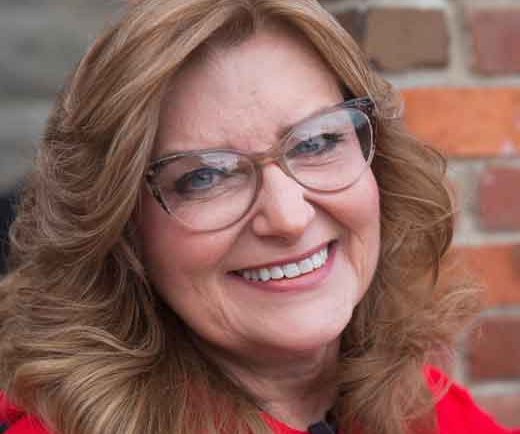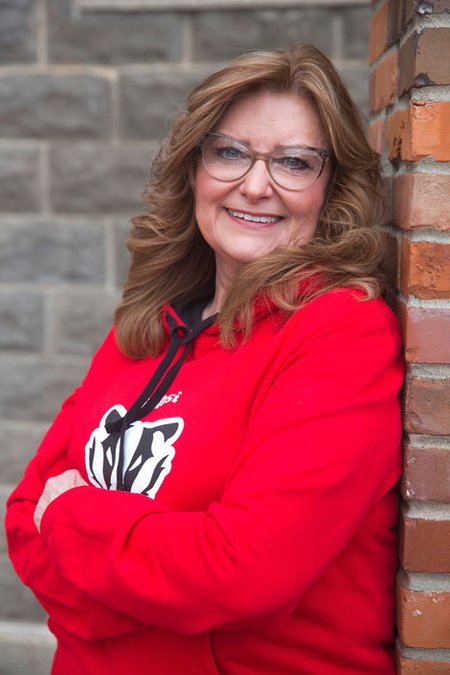
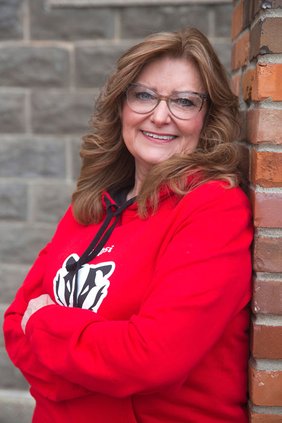
DARLINGTON — Lisa White was born and raised on a Potosi farm. She grew up in a family of union workers at John Deere. She’s built her adult life in her hometown as well, staying connected with neighbors across her town of about 650 people.
White has over three decades of experience as a businesswoman. After working as a registered nurse, at 54 she started her own painting company, The Painter Lady, which has grown into a multi-million dollar business and among the top 2% of performing woman-owned businesses nationwide.
Her biggest areas of pride, however, are being a grandmother and a Potosi-girl through and through.
“I am a lifelong Potosi farm kid,” White said.
This past year she took on yet another endeavor: running for the Wisconsin 17th Senate District, which is currently held by Republican Howard Marklein, chairman of the powerful Joint Finance Committee, which oversees the building of the biennial state budget. Two others are currently campaigning in the Democratic primary with White: Rep. Jenna Jacobson of Oregon and Corrine Hendrickson of New Glarus, while others are still exploring a possible campaign.
“I felt compelled — almost drafted into this,” White said of running for public office. “I would describe it almost as a calling. I’m a grandma now — I’ve got to dedicate it to the future of my neighbors and my family.”
White has eight grandchildren, including three on the Autism spectrum, which she said influences her views on both education and inclusion. She also has seen the struggles of farmers and local economies in the region, with rising cost of living and inflation, yet little relief for those not living near major cities.
“When I see my people — my neighbors, people in southern Wisconsin, my kiddos and grandkiddos — and what the future is looking like for them compared to how our country was prepared for me, I can’t not run,” she emphasized. “We owe them a better environment, a better economy, and a better political situation than where we are at now.”
White said she knows what it means to sit at the kitchen table with impossible healthcare decisions, and she knows what it means to raise children in underfunded schools and for children with special needs.
Simply put, White believes the 17th District deserves a senator that listens to their constituents, has walked in their shoes and never forgets who they serve — the people as a whole, and not a political party or cultist leader.
White’s painting business covers eastern Iowa and the entirety of the 17th Senate District (and beyond). She has been to every community and gotten a chance to make connections in each one over the years.
“The culture in the east side of the state, like the greater Madison area, is different — for better or worse. It’s a little bit different than there is in the far west where you have the rural farm regions. It’s super important to me that the very populated areas really put that western part of the district moreso in their visual field — we don’t want to continue to be invisible,” she said.
The 17th Senate District last elected a Democrat in 1974, White said. “That was Katie Morrison, the very first woman elected to the state senate,” White added.
“I think it’s time to shift from the Republican model, which has taken us kind of in a downward trend, to a Democratic model that used to act in the way of the Wisconsin Idea.”
Proudly promoted by the University of Wisconsin, “the Wisconsin Idea signifies a general principle: that education should influence people’s lives beyond the boundaries of the classroom.”
White said that Wisconsin has a proud tradition of being progressive thinking, working class, taking care of and having pride in its schools and building its rural health blueprint.
“I think that the idea that I have served all of those people, and I’ve been a steward of their homes and a steward of their money, over and above the cultural differences and have still been successful, speaks to my ability to listen and to visit with folks despite any kind of lifestyle differences we may have,” White said. “Whoever is standing in front of me anywhere I go ... that person is my neighbor and I don’t care who they voted for. I’ll hold the door for them at Kwik Trip, I’ll listen to them talk, and my heart is in serving people and getting back on the same page.
White grew up in a family of union working Democrats and farmers. Her father was a “union man” at John Deere. Four of her brothers worked at John Deere as well, three of which were union workers. Her uncles were union workers at Dubuque Packing Company.
“Democrats were the party of the working class, and I think a huge portion of us are still that flavor of Democrat. We respect the people who have sweat on their brow,” she said.
One of White’s big pushes is to fix the state’s funding on public schools. Not only has the funding not been as much as promised over the past few decades, but it has been getting harder for districts across the state to state fully funded. In 2025, more than half of the state went to referendum to either balance its regular budget due to a slide in state funding, or to build new facilities due to deteriorating structures.
The state sits on approximately $4 billion in budget surplus, and public school funds have been shifting to private voucher school programs over the past two decades as well.
According to an analysis by Wisconsin Watch, private school vouchers cover about half of the total enrollment at the for-profit schools. When it launched in 1990, the Milwaukee Choice Program had just 300 students at seven secular schools, and the students came from families earning less than 174% of the federal poverty level. In 1990, the cost was about $700,000 (about $1.7 million today, adjusted for inflation). State aid to public schools that year was $1.9 billion, however, with another $2.4 billion of property taxes being used to fund schools.
This year, taxpayers will spend more than $700 million for about 60,000 students, about 96% of which attend religious — not secular — schools.
“The voucher program has to go away,” White said flatly. “The state has to budget for education and we need a different model of funding our schools that does not tie property ownership so heavily.”
She said she’s not opposed to part of the state’s sales taxes going towards the schools.
“We need to think of economic development, public education, and good healthcare as the three-pronged stool that is going to create healthier rural communities in every regard,” she said. “Our schools, hospitals and small businesses are the backbone of our communities, and they must be protected and strengthened. I will bring my lived experience, entrepreneurial grit and lifelong Wisconsin values to Madison to represent the voices too often ignored.”
To find out more on Lisa White, visit her website, LisaWhiteForWisconsin.com, or search for her campaign on social media.