
The description of the construction of the Eugene Hotel in 1924 is continued from last week.
“The same brick exterior follows the building around on the alley side, showing that no expense has been spared to make the building equally attractive on all exposures. At the extreme north of the alley wall will be a recessed delivery entry where the trucks may be backed in and luggage unloaded.” An elevator was placed near the entry, designed for freight, but available for carrying passengers, if necessary.
The roof of the building was flat with a special draining system. An open air court, not covered by glass, extended from the center roof down to the ceiling of the first floor, allowing light and air to supply the 16 rooms that could not be built with outside wall exposure.
The lobby, 42 by 22 feet, was finished in quarter sawed oak and “circled by an attractive mezzanine floor on the west and south sides.” The clerk’s desk was to be on the west with a large fireplace “of imported Belgian black marble” on the right. The floor was to be of white tile, but that was changed to a “gray and white ceramic tile in unique design.” Phone booths (one of which still remains and will be restored) “were convenient” at the rear of the lobby.
The lobby furniture, all by Mike Karpen, was of “unusual design and pleasing appearance [to] give the lobby an atmosphere of home and comfort rarely equal in a hotel of this size.” There were three lighting options in the lobby. The entire chandelier could be lit; only one circle of lights on the chandelier could be lit; only the lights on the wall brackets could be on.
Another stairway was to lead “to the basement to a public laboratory,” which was also called the “men’s washroom.” A sample room for salesmen staying at the hotel was located just to the north of the lobby. Just off the mezzanine floor was a small room intended for the public stenographer.
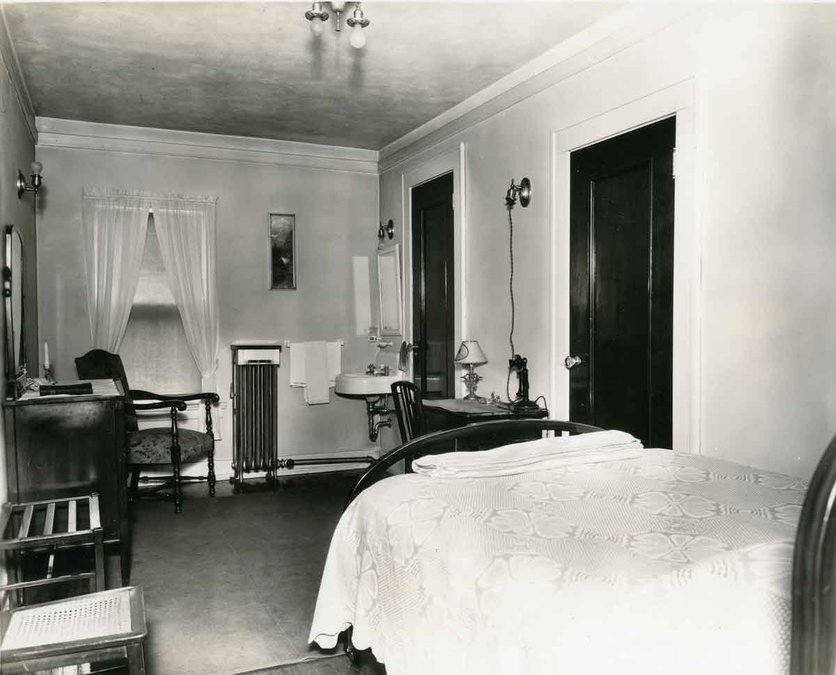
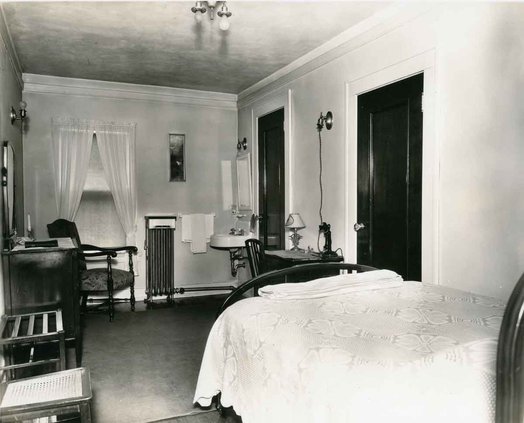
The second and third floors were “designed exactly alike with the hallway, circling the entire floor around the rooms surrounding the open air court.” A stairway from the east as well as from the lobby were to furnish a convenient exit from each floor. “Since the structure will be of semi-fireproof construction with all wires in conduit, steel lath, hard plaster, firewalls, and fire doors, well protected boiler room, fire stand pipe with 50 foot hose in each hall and a private alarm system in the lobby, no fire escapes are required by the” industrial commission.
Rooms were to be from 18 by 13 down to 10 by 10. Ten of those were to have showers and another 12 would have tubs. Only two of the smaller, less expensive rooms surrounding the court would have a bath. The court would be 11 x 33, unobstructed by pipes. Large floor bathrooms were provided for men and women. There would be a telephone in every room.
Room doors were to be of mahogany and black walnut, with woodwork in enamel. Solid bronze hardware was to be used throughout. Special attention was being given to the flooring preparations so they would deaden the sound. Room locks gave “the guest insurance against being disturbed and also indicating occupancy of the rooms.”
“There will be no key rattling by maids in the door of a guest’s room when he wants to sleep and the maid does not know if he has gone out. All she needs to do is to see if a small button on the outside of the door protrudes from the lock. This is shoved out when the guests turn the bolt on the inside, but not if he locks the door with the key from the outside. A glance at the door if it is light, or if it is dark, a touch of the finger at the place where the button is, tells the maid if the room is occupied or not.”
It was shared on January 16, 1925 that Charles Hawthorne, brother of Alfred and John, was in a dilemma after returning to Monroe after an absence of several years in Webster, South Dakota. He found that his former residence, the McKey Block, was in the process of being remodeled. His personal belongings that he had left in the apartment were nowhere to be found. He was especially eager to locate a bookcase that he highly prized. Nothing more about this was seen in the newspaper.
H. B. Miller was fortunate not to be hurt on February 6 when a brick, with plaster clinging to it, fell from a third story window of the hotel and grazed the top of his cap. It left a white streak before hitting the sidewalk. F. W. Wettengel, who saw the danger, shouted to Miller, who did not understand. But Miller had turned his head enough that it did not strike him squarely on the head.
“Utmost precaution, has been exercised by the workmen on the building to barricade the sidewalk when any danger to pedestrians is expected. It is believed that the brick of the inner wall became loose and fell through a window opening, since Harry Young is under the impression that no men were working at that particular spot at the time of the incident.”
It was shared on February 10 that the “last exterior vestiges of the old McKee [sic] block front were disappearing today as workmen tore down old brick and removed ancient frames that will be replaced within two weeks by new brick and new window frames to comprise the front of the new” hotel.
The next two columns will share more about the plans and construction of the Eugene.
— Matt Figi is a Monroe resident and a local historian. His column will appear periodically on Saturdays in the Times. He can be reached at mfigi48@tds.net or at 608-325-6503.