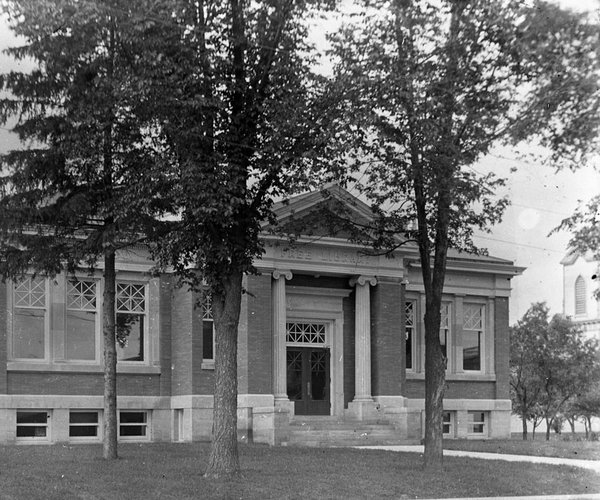
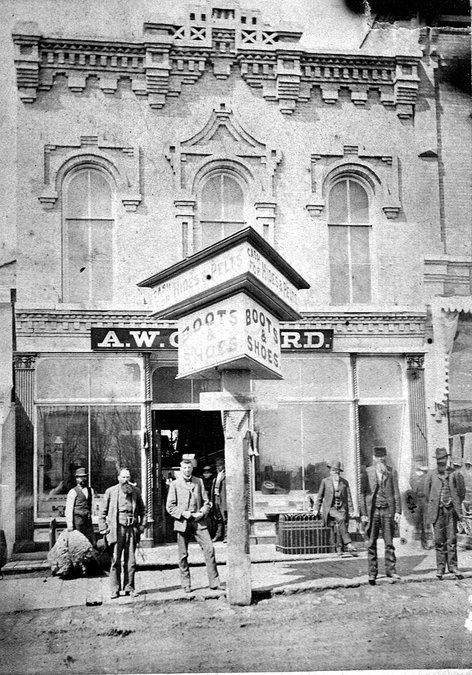
The Monroe Sentinel editor wrote the following about Elisha Mosher and the building he built on the west side of the Square on August 11, 1869. “Mr. Mosher, in the style of his new brick block, has set our business men an example which we hope will not be forgotten, in the future erection of business houses in this village. Mr. M is entitled to the thanks of this community for introducing a style of architecture so strikingly in contrast with some of the plain, old-fashioned, homely brick blocks that surround the Public Square. Let us hope that a new architectural era has dawned upon Monroe!”
As had been planned, Goddard & Miller opened their store of “boots, shoes and leather” on October 8 in that location.
By the time the 1870 census was taken, Elisha was listed as an auctioneer. His real estate was valued at $11,000 and his personal property as $4,400. Delbert Carrington, 22, a tinner, was also living with the couple.
As mentioned in the previous column, there was a large fire that took out all of the old wooden buildings on this block located to the north of Mosher’s building in October 1871. [This fire was the topic of a previous column. A photograph of the buildings that burned can be seen on page 40 of the Pictorial History of Monroe.] In a card of thanks published on October 25, Mosher “wishes hereby to acknowledge the endeavors of the Fire Company and citizens of this place, which proved so successful in saving my property next to the buildings so recently destroyed by fire, and without which the property would have been destroyed. One and all accept my thanks. Very Truly Yours.”
It was reported on August 7, 1872 that Elisha was “lying at the point of death at his residence.” He had “been troubled for several years with erysipelas, and being quite an old man now [age 71], it is greatly feared this attack will be his last.” On September 4 it was reported that he was “convalescent, and will be about in a few days.” Elisha must have had a strong will to live since he would live another 20 years. This was at the same time that the Treat Block was being constructed next to his building.
Mosher and E. B. Pratt formed a partnership in January 1874 for the manufacture of superior Lap-Window Shades, Pratt having purchased George Carrington’s interest. The Wisconsin Window Shade Company was “preparing for a large business, their goods having found favor with the public wherever they have been introduced. Some improvements on the shades heretofore made by the factory are being introduced.”
Mosher was remodeling his building in April 1879. The editor said, “when completed it will be the largest and pleasantest boot & shoe store in this county. One of the largest in the State.”
The 1880 census shows the couple living alone. It was reported in the Sentinel on Wednesday, December 22 that Elisha’s oldest son, Gideon A., had drowned in Dixon, Illinois. According to the Ogle County Press, he had left the house about noon on Sunday and his body was found on a gravel bar on the river Wednesday afternoon. His body was accompanied back to Monroe by his father on Thursday for a funeral from his father’s home on Friday. According to the December 29 Sentinel, “the cause was mental despondency, caused by ill health.”
Elisha’s children, grandchildren, great grandchildren, and other relatives “enjoyed a regular old-fashioned reunion” in February 1882. People arrived on Tuesday and continued gathering until Thursday evening. On Wednesday they met at the old Homestead and enjoyed bountiful hospitality. On Thursday they all met at J. D. Mosher’s for dinner and had a masquerade party and ball in the evening. On Sunday, there was a more quiet dinner at Henry Durst’s home where “the formalities of the reunion came to a tight climax, and the byes were said.” The editor added that the couple “received the congratulations of many warm friends here for the safe and long journey, thus far, and the wishes for their future health and comfort.”
It was reported on June 16, 1886 that the couple added a wing to the west side of their residence on the southwest corner of 19th Avenue and 11th Street. It is believed that this is the same home that Peter Wells purchased.
Not much else was shared in the newspapers until December 1891. This was the occasion of Elisha’s 91st birthday anniversary. In attendance was Mr. DeHaven, who was a few months older than Mosher, and Nathaniel Treat, Sr., who was already 96 years old. “The latter made a short address, and congratulations were extended by all present.”
It was reported on January 6, 1892 that Mosher was stricken with apoplexy [a stroke] on Saturday evening, January 2. They said that it was not possible for him to recover.
Elisha lived only 22 days past his birthday. His obituary in The Daily Independent the same day stated that he was “one of the most enterprising citizens of Monroe.” It also said, “he was a gentleman who make [sic] many friends who will regret his death, even at his great age. He held many honorable positions in this county and discharged their duties honorably and well.” He was also “kind hearted and performed many deeds of charity that were never made public.” Seven of his children, proceeded him to the grave. Surviving were his son, J. D., and a daughter, Cordelia.
His funeral was held on Friday at the residence — under the direction of the Odd Fellows, which was a special request of Mosher.
At the time of Elisha’s death, his second wife, Electa, who was ten years younger than him, was reported to be in feeble health. She passed away on September 16, 1896 in Minneapolis, Minnesota.
— Matt Figi is a Monroe resident and a local historian. His column will appear periodically on Saturdays in the Times. He can be reached at mfigi48@tds.net or at 608-325-6503.