

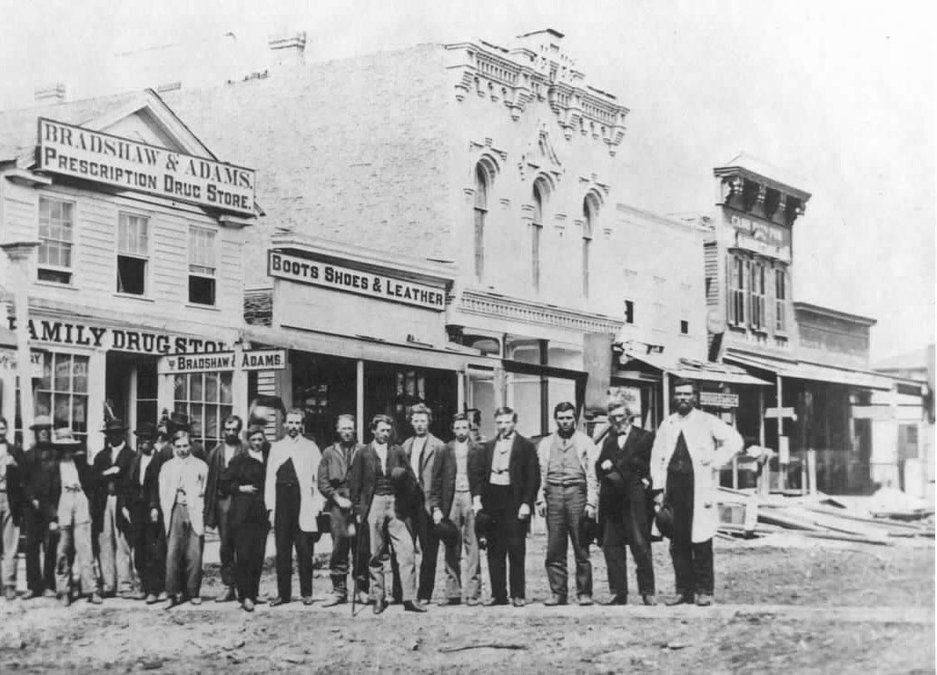
The oldest brick building still standing on the west side of the Square, located at 1007 16th Avenue, was built by Elisha Mosher in 1869. Some of you may remember that Dave Mosher portrayed Elisha Mosher at the 2023 cemetery walk, sponsored by the Monroe Public Library. In this column and the next one, we will learn more about the man, his life, that building, and his business dealings in Monroe.
Mosher was born on December 15, 1800 in Washington County, New York to parents who were also born in New York. He married Elizabeth Allen there and had nine children before moving to Green County in the mid-1840s. His obituary stated that he “engaged in lumber manufacturing, owning a mill about 2 miles east of the then small village of Monroe. Afterward, he was in partnership with his two older sons, Gideon and Jerry, engaged in general merchandise in the ‘Empire Block’ then a large brick building.” That building was located.on the southernmost lot on the east side of the Square.
The 1850 census shows that the couple (both 50 years old) and four of their children, ranging in age from 12 to 19, were living in Monroe where he was making staves along with his sons, Stewart and Joseph D.
Quite a bit of information about Elisha during the 1850s was included in the book, Becoming a Village. He was operating E. Mosher & Co. in 1856 and the Empire Bakery in 1859. There was a house fire in 1857. He was also involved in serving the community as a village father and a Marshall. He also served on committees for the July 4 celebrations, and to secure new grounds for the city cemetery [now Greenwood]. An article in the Sentinel in 1861 stated that he was also a 1st Lieutenant in the Home Guard.
His obituary stated that in January 1858 he was appointed chief Marshall of the day at the celebration of the railroad arriving in Monroe, such a great day in Monroe.
An advertisement in the Sentinel from June 11, 1860 stated that he had “opened a shop a few rods southeast of the Public Square” where he could “furnish flour barrel staves, heading and shingles much cheaper than can be purchased elsewhere, and in quantities to suit the purchaser.”
The 1860 census showed the 61 year-old couple and Henry and Gerusha Mosher, both 28, and Fanny E. Mosher, 6, living together in Monroe. Elisha was listed as a miller and mechanic while Henry was a farmer. Elisha’s real estate was then valued at $13,500 and his personal property at $1,000. Also enumerated with them was a 21-year-old male laborer, Zera Dout, who was born in Illinois.
Moshers received word late in 1861 that their son, Stewart, had been killed in the battle of Harper’s Ferry. Lieutenant O’Brien had just been speaking with Stewart a moment before he fell. Stewart remarked, “Lieutenant, I want to fetch my man this time.” He asked, “Where is the best place?” He went around the corner of the house and was about ten feet from it, ready to raise his gun to his shoulder, when he fell. He was the first man from the county to die on the battlefield in the Civil War.
Mrs. Mosher died at home on February 17, 1868. The funeral was held at the M. E. Church and she is buried in Greenwood Cemetery. Elisha married Mrs. Electa Carrington the following year.
It was announced in January 1869 that Elisha was to build his brick block on the west side of the square; Goddard & Miller were plannng to rent it. It was shared on April 14 that the foundation had been started.
Mosher made an agreement on April 14 with Henry Durst, who planned “to erect a similar building on his premises adjoining” on the north side. Both parties planned “to have one common entrance and stairway to the upper stories of said buildings, at the East and West ends of the same.” According to the their agreement Mosher was allowed to “build the North wall of the cellar or North foundation wall of his building which shall be of stone and 24 inches of thickness” on the land belonging to Durst. The brick wall “shall be 26 inches north from the North line” of Mosher’s land. The brick wall was to be 12 inches thick and the stairway 40 inches in width with 12 inches of wall and 14 inches of stairway being upon Durst’s land. Durst would “have the privilege at any time during the construction of the said party wall or afterwards to open a doorway or doorways in said wall as an entrance or entrances into the upper story of his building when it shall be erected.”
The only financial agreement was that “the expense of building the said party wall and stairways shall be borne equally” by the parties. “Whenever any repairs of the said party wall or stairways may become necessary, the expense of such repairs shall be borne equally.” Shared stairways from different buildings are common on the Square.
Unfortunately, Durst did not build the building next door but rather sold the property to the Treats. The Treats then built the building that stands to the north in 1872 after a fire destroyed the wooden buildings [shown on page 40 of there Pictorial History of Monroe] that used to stand at that location.
It was common for the editor of the Sentinel to encourage anyone building in downtown; this is evident in the following blurb from July 21. “From present indications we should judge that E. Mosher’s store front will be the finest one in the village, and will be an ornament to the west side of the Square.”
More will be shared about Elisha Mosher’s life and his new building next week.
— Matt Figi is a Monroe resident and a local historian. His column will appear periodically on Saturdays in the Times. He can be reached at mfigi48@tds.net or at 608-325-6503.
