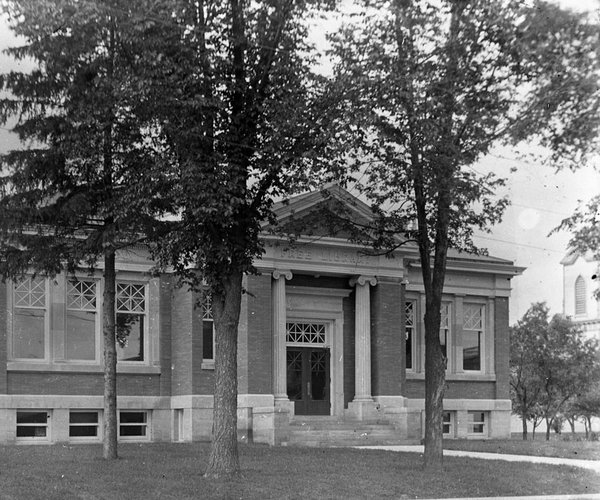
City Council passed the Carnegie library ordinance on October 6, 1903, the exact same one passed at Janesville. The Carnegie library board was appointed on October 20, consisting of Dr. C. W. Bennett, representing the City Council, C. W. Twining, Colin W. Wright, Fred J. Bolender, J. B. Treat, and Edward Ruegger. Their duties were to select a site, arrange for building the library, and to have control of it. They would also accept the Carnegie gift and “negotiate with the school district for the transfer of the school district library to the city.”
Treat, Twining, and Rueeger were appointed to a committee in early November to purchase the site for the new library. A favorite site was “the Burgy corner” on the northwest corner of 16th Avenue and 9th Street. The Nance corner across the street to the east was also available; either was “more preferable than the site occupied by the present library building.”
Stoddard Jess, son-in-law of Benjamin Chenoweth from Pomona, California, shared that he had plans and specifications of the new Carnegie library that was built there, and “will gladly turn them over to the local library board for suggestions or to be adopted.” The Pomona library cost $15,000, but could be duplicated for $12,000 here.
It was reported on January 18, 1904 that the committee was dickering with the owner of one of the properties that was being considered, but the outcome was in doubt. People were wondering a month later why nothing was being accomplished by the committee. Some were of the opinion “that there is something wrong with the committee.” Similar sentiments were expressed another month later.
The library committee met again on February 27 and announced that they would settle on a site within the next week. They were also considering visits to other Carnegie libraries, including the one at Whitewater, which cost about the same as Monroe was getting. The new library would be on one of four corners, the Nance corner.(which was the most sightly), the Wells corner on 11th Street, the Steiger corner on 10th Street (more centrally located nearer the Square), and the site of the current library at that time (only 120 feet square). The board wanted to obtain the site before deciding on a building that would suit the grounds.
It was announced on March 4, “The new Carnegie library will be built on the Steiger corner,” accepting an offer made by Mrs. Belle Steiger for $3,800. The site where the library was located at the time was not favored because “it was too far removed from a prominent street for a building that will be as costly as the one projected.” The school district could then sell that site and use the money for other purposes. The Steiger site was also 120 feet square and was across the alley from the site where the new Commercial & Savings Bank was to be built.
There was opposition to the Steiger site because “the lots are low and subject to overflow with every thaw or rain.” Mrs. Steiger refuted that saying that she was born there and “the cellar under the house has always been perfectly dry.” Even more of the opposition was due to taking the library away from the site where it had been for more than a decade. The school board “maintained that the property could not be transferred to the city” and that the sale of that property would have to be authorized at the annual school meeting. The editor also pointed out that Bennett and Wright would be able to sit on their front porches and look at the new library. It would also be next door to the bank where Twining would be working.
Another article on March 5 stated that the language of the Wisconsin statute gave the library board of directors exclusive rights “to select and contract for purchase of the site.” Those directors would report to the city council who would then pay for the site.
Yet another article on March 10 said that the city Council “was in favor of the old library site if the school district would transfer it to the city.” The same article mentioned that members of the library board had been told in confidence that local parties were ready to advance the money for the library if the board would agree to place it on the old site. The committee held “that it is too late and is entirely outside of the Carnegie proposition.” It also stated, “there is nothing definite about the offer and it is doubted if it was authorized.”
It was shared the following day that Arabut Ludlow’s three sons, Henry, Willis, and Edwin, were ready to give the Union school district $12,500 to duplicate the Carnegie gift with conditions that it was to be a school district library, be built on the site of the library at that time, and be known as the A. Ludlow Memorial Library. The only question was whether the city could repeal the ordinance accepting the Carnegie gift.
Edwin’s death in 1935 “made it possible to reveal the family secret that he alone contributed this structure as a memorial to his father. First suggested by the youngest brother, Willis, as a joint gift” the library was paid for by Edwin. He insisted that he, as the only brother without family responsibilities, “should be permitted to contribute the civic asset unaided. He pledged the family to secrecy regarding this arrangement and only after his death, have they divulged it.”
As you will see in the next column, the construction of a new library in Monroe would certainly move forward more quickly now that the Ludlows made their donation and endorsed the project.
— Matt Figi is a Monroe resident and a local historian. His column will appear periodically on Saturdays in the Times. He can be reached at mfigi48@tds.net or at 608-325-6503.
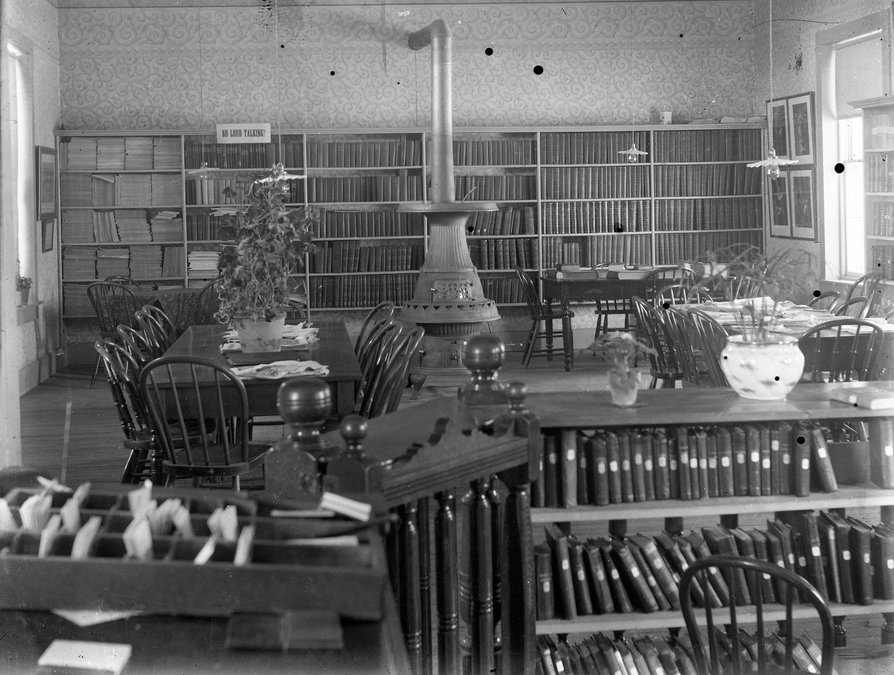
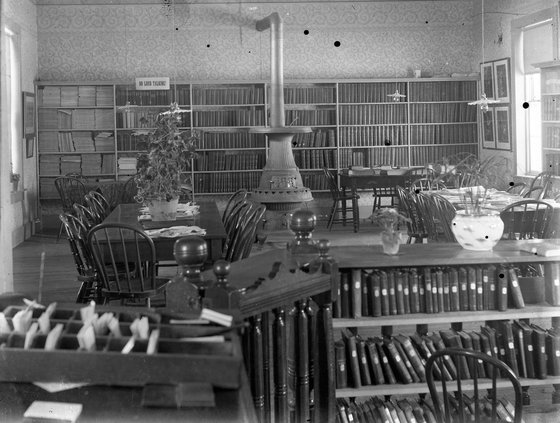
This photo, from the collection of Sharon and the late Dr. David Riese, shows the interior of the library in the former county building that was used from 1892 until 1904, when construction on the Arabut Ludlow Memorial Library was ready to begin. The sign on the far wall says, “NO LOUD TALKING.”