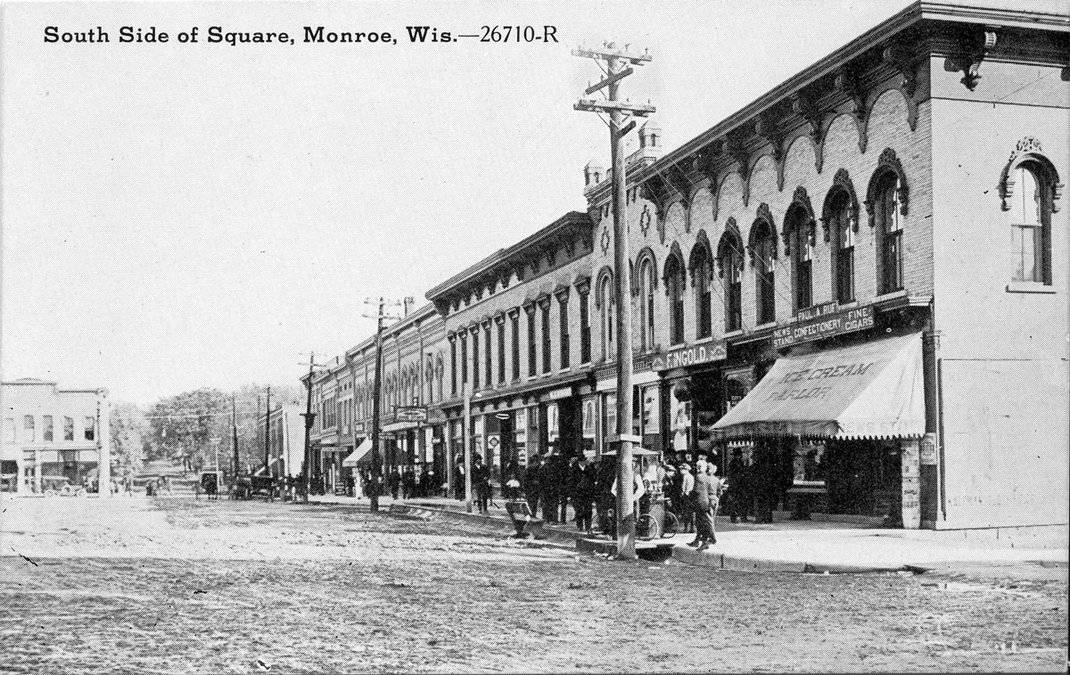
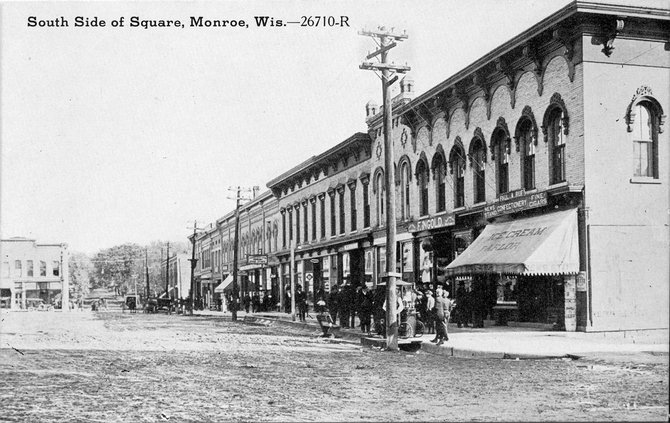
Paul A. Ruf had removed the pool/billiard tables from his new confectionery space on the southwest corner of the Square in October 1907. The editor summed up Ruf’s character and business sense, “Through the judgment he has exercised in selecting his stock he has been able to build up a successful business in limited quarters, and the enlargement will permit of general expansion which promises to make the place still more popular as a headquarters for the lines represented. The place is one of the neatest and most attractive on the square and the proprietor is a young man of energy and enterprise who is ever wide awake to the wants of his patrons, to which his success may be directly attributed. The move is another step in his business advancement, which has been rapid in a few years since he first launched in business.”
He made more improvements during the next few months. In December he installed “an electric candy pulling machine and will make a specialty of hot candy.” He traveled to Chicago in early March “to close a deal for a large new soda fountain to take the place of the one he bought a year ago.” This elaborate fountain, the best that could be purchased, was installed later that month and represented an investment of $2,500.
Shortly afterward he “added a new electric piano to his restaurant room outfit, and it is proving an attraction that is drawing the crowds to his place. Mr. Ruf is showing commendable enterprise in the way he is making his place attractive for his patrons.”
An ad in the July 16 Times said, “Soda is the great American drink. It cools and refreshes without ill effects.” It added that at Ruf’s it was properly served cold and was made from the best supplies with plenty of crushed fruit. They made their own syrups. “They’re fine.” They had “all flavors.”
Another ad at the end of the month stated, “Our soda fountain serves the coldest of refreshing soda made from the purest and the most wholesome materials.” It added that their ice cream was noted for its smooth richness.
Yet another ad in early September said, “Such soda as we are now serving is better than Monroe has ever known before. We believe that no standard of quality is too high for this town. We believe that Monroe wants the best to be had. The best soda is to be had at our fountain. No better can be found in the Country.”
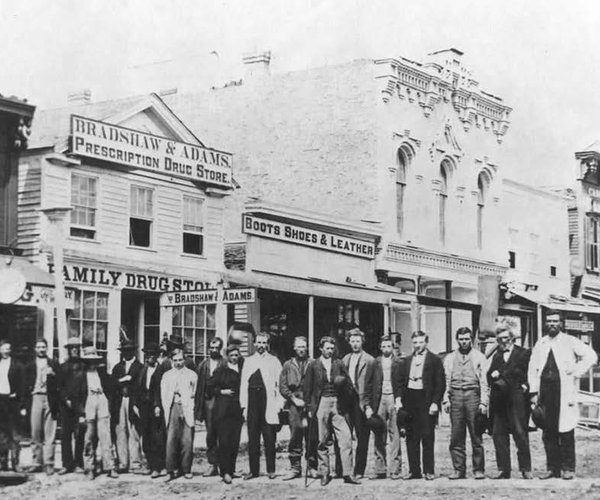
In the largest business deal of his early life, Mr. Ruf purchased the entire Bridge block from the Bridge heirs on December 5, 1908 for $15,000. The Bridge block was built by J. H. Bridge in 1870 after the wooden buildings that had previously stood there [shown on page 36 of the Pictorial History of Monroe] burned. The large block is 44 by 100 feet; at that time it contained three additional businesses, the Adam Schmidt shoe store next door, an additional store used as a store room by Schmidt, and the store occupied by The Times - both facing west.
Ruf planned to enlarge his present business, extending his store through the “two buildings” on the south, which would make his store 100 feet long. He planned to install an up-to-date café in the space occupied by Schmidt and “conduct it on strictly metropolitan plans.” He also planned to install a steam-heating system and spend considerable money in decorating the interior of both stores. His arrangements were still incomplete at the time, “but the café will excel anything of the kind ever undertaken in the city.”
The article on November 16 stated that he had invested in western lands, which had made him good money. That summer he had “rented a large tract in South Dakota on the shares and secured a handsome revenue from the crop. While luck seems to have played into his hand in every venture he has made, it has been more foresight on his part that has brought him success.”
By the end of February Ruf was having improvements made to his newly acquired building. A new steel and glass plate front was being placed on the room facing the west, behind the confectionery. A wide stairway was being installed leading to and from the room facing the square as a side entrance. This additional room would be fitted up for an elegant ice cream parlor, where no lunches or meals were to be served. The rooms over the café were to be fitted up “in fine style for living rooms, suite for light housekeeping, or offices.”
Ruf, at that time, wanted to rent the vacant store east of the confectionery to the right person, but stated that no picture show need apply as “one is enough for Monroe.” He wanted a permanent renter. The improvements described did not involve the Times office, which was also facing the west behind the confectionery. Some minor changes might also happen in the confectionery.
It was reported less than two months later, on April 6, that Messrs. Weller and Wertz, of Rockford, had leased Ruf’s space for a year to open a moving picture show. “The room will be newly furnished for the purpose, an entirely new outfit having been purchased for the theater. It is expected that the theater will be ready for opening in the course of two weeks. The proprietors promise a first-class theater and will offer the best pictures to be obtained.”
The Star Theater did not go well and closed on September 26, 1910; Ferdinand Ingold moved there on November 1. The Star Theater could be the topic of a future column.
In the next few years Ruf made many changes and added businesses to his building, including the Annex, the Cafe, and Ruf Gardens. In addition he started a small chain of bakeries. If I can sort all of this out, they may also be topics of future columns.
— Matt Figi is a Monroe resident and a local historian. His column will appear periodically on Saturdays in the Times. He can be reached at mfigi48@tds.net or at 608-325-6503.