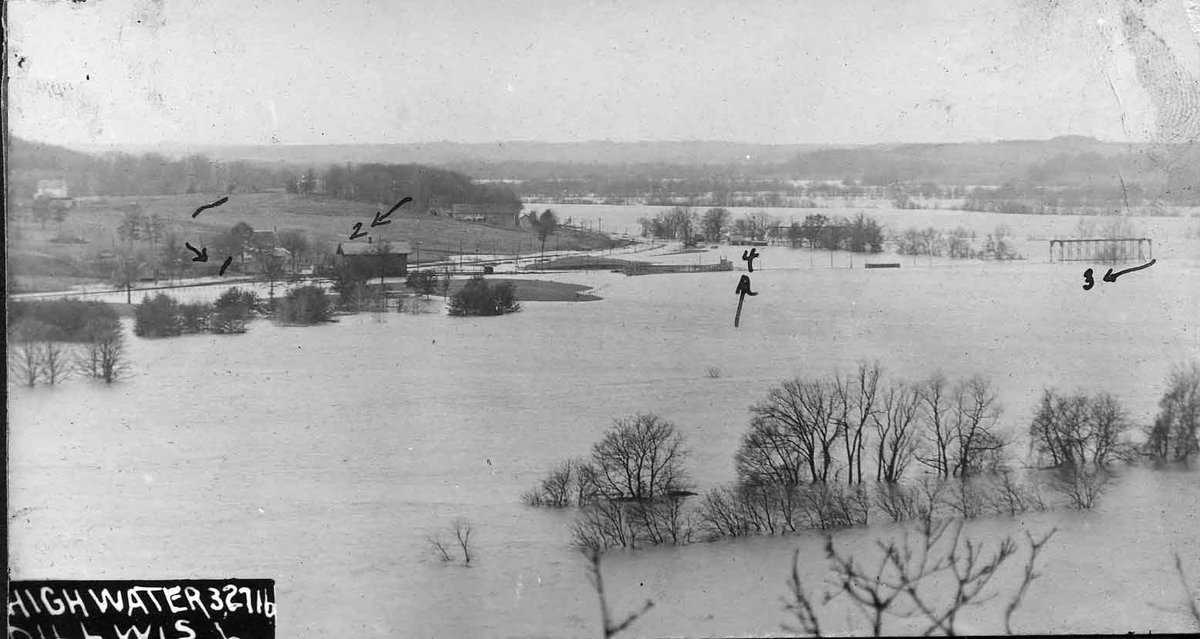
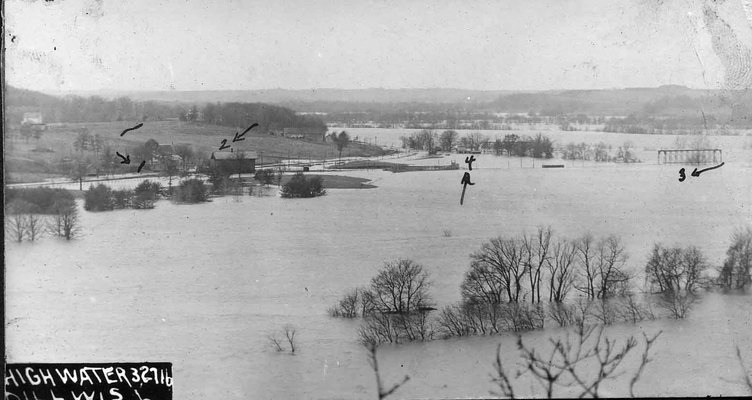
It was 110 years ago on Sunday, March 26, 1916 that heavy showers and the rapid melting of snow caused the flooding of the Pecatonica and Sugar Rivers. The heavy downpour on Sunday was steady from the early morning until late at night with “a large volume of water falling.” Due to previous rains and the melting of snow the previous week, the ground had absorbed practically all of the moisture it was able to carry; “the greater part of the rain falling on Sunday had to be carried off by the streams and rivers.”
While some damage was reported, it was not as bad as the previous fall. “The greatest damage is to the west of Monroe, the Milwaukee Road suffering considerable from the high water with the result that no trains were operated during Saturday and Sunday between Gratiot and Mineral Point.”
There was much damage done in Blanchardville, with 10 inches of water reported in the post office on Monday morning. It was believed that the flood had reached its crest, but a number of the residents along the river “were compelled to vacate their homes.” Blanchardville schools had been closed the previous week because of an epidemic of scarlet fever and would remain closed because of a new case that had just developed as well as because of the high water there.
Monticello and Albany reported flood conditions there although it was not as serious as the previous fall. Because of the damage done to various points along the Dodgeville line of the Illinois Central, traffic was practically abandoned on Monday. It was feared that it would be several days before normal conditions were restored on that line.
Reports from Darlington said that the business district was flooded so badly that boats were being used. Many families there were forced to leave their homes due to them being filled with water.
It was learned through a telephone interview from Winslow on Monday afternoon that the water was 16 inches higher than it had ever previously been known — and was still rising. A report that the Winslow bridge had been carried away was not true. A large part of the businesses there had flooded cellars with the implement dealers being the principal losers; much of their machinery was inundated and some of it being carried away.
Argyle reported that the water had dropped 3 inches since the morning and South Wayne hoped the crest of the flood would be passed before Monday night.
“At Dill the roadbed was badly eroded, and several train loads of gravel will be required before it will be safe for trains.” Many others reported equally bad conditions. The rain was followed by freezing temperatures during the night that resulted in the roads being passable, but exceptionally rough on Monday.
The biggest tragedy of the flooding occurred at Dill. William Owen, South Wayne, was in Monroe with his companion, Cecil Schloesser, on Saturday night, making the trip from South Wayne on a small railroad hand car known as a “speeder.” They left on their return trip after attending to their business matters. About 15 rods from the depot at Dill, they encountered the water and the two were thrown into the stream. “Owen was carried to his death, and it was only after a hard fight that Schloesser was able to save himself.” Owen, 20, had been employed by the railroad at South Wayne. Owen’s body had not been recovered at the time; it was feared that it would not be found until the water receded. The water in South Wayne was the highest ever known and continued to rise.
The noon passenger train on the Milwaukee Road in Monroe arrived on time about noon on Monday, but was held in Monroe until 3:15; it then returned in place of the regular afternoon passenger train. No trains on the Milwaukee Road traveled farther west than Monroe that day.
It was reported on Tuesday that “the flood situation at South Wayne, Dill, Winslow, and other nearby points on the Pecatonica is somewhat relieved today. The crest was passed during the night and since then the water has been slowly receding, although it will be a week before normal conditions will be restored.” It was also shared that the water reached as much as two feet higher than ever previously known.
Many of the businesses in Winslow were forced to close. Articles were floating about in some of those buildings; some windows had been broken by the tide. The buildings closest to the river were in up to three feet of water. It was feared that the foundation of the IC depot in Winslow would be “undermined and the building carried away.” For a distance of at least a mile, the tracks were under two or three feet of water; it was unknown how much damage was done to the tracks.
The home of George Eels on the edge of Winslow was abandoned because there was “several feet of water in the home.” The post office there “was in three or more feet of water.” Even though the warehouse of Schramm & Hawthorne “was built high to avoid the high water,” the water “gained the interior early last evening.” The office of Fred Karlen was also in “mid-ocean.” Karlen had removed his books and valuables from the office.
lumber stored at the Winslow Lumber Yard had floated down stream. The warehouse of W. G. Tyler, which contained a number of automobiles, was also under water, as were Mr. Retlaf’s blacksmith shop, the W. J. Kennedy warehouse, and the Wetz barbershop. Niemeyer’s drugstore was being threatened, even though it was “on very high ground.”
Conditions on the railroads were even worse on Tuesday. The Illinois Central was nearly on schedule on Monday, but a washout near Sciota Mills on Tuesday had tied up the line. Newspaper delivery from bigger cities and the mail were affected because of the train traffic.
— Matt Figi is a Monroe resident and a local historian. His column will appear periodically on Saturdays in the Times. He can be reached at mfigi48@tds.net or at 608-325-6503.